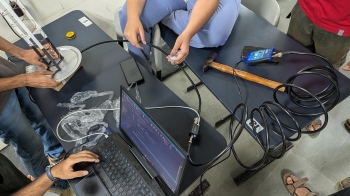
“Dream, Dream, Dream. Dreams transform into thoughts, and thoughts result in action.” A quote by Dr A P J Abdul Kalam that holds true for the Project Antara team. This team consists of about twenty students from BITS Pilani, K K Birla, Goa Campus. With a vision in mind, they chase after their dream, juggling academics, study sessions, and all the mini projects that shall eventually be a part of Project Antara. The four from the team, Project leads Saksham Mishra and Abhinav Teerthala, Amrit Senapati from Design and Marketing, and Dheeraj Reddy Komatireddy managing Operations, walk us through it all.
CUBESAT RADIATION MISSION
So what is Project Antara all about? The project leads, Abhinav and Saksham, delve right in. Project Antara, a CubeSat project, goes for 3 U, that is 10cm, 10cm, and 30cm. These are called CubeSats. Their mission’s objective is to study the South Atlantic Anomaly region in the Low Earth Orbit (LEO), which is known for its harmful radiation. “This region is closer to the Earth than any other radiation region. The majority of CubeSats’ orbits pass through this particular region. Our mission objective is to study the radiation profile here, get the accumulated data, and create maps that can help future satellites shield themselves,” Abhinav explains.
A lot of work went into the naming of this project as well. “The name Antara did not just come up. We had a list of names for this. Antara means within, particularly within the atmosphere. It also refers to starting or eternal, so it resonated with the idea that we are starting something this big in Goa. We were looking for names in an Indian language, and that is how Antara emerged,” the team replies.
DREAMS SPARK INNOVATION
The story behind the inception of Project Antara is one of dreams and passion. “The story is actually quite interesting,” the four laugh in unison. “One day, Abhinav came to me and said, ‘Why don’t we build a satellite?’ I agreed, Saksham says. “So we started planning, spoke to PhD graduates, and worked on the design for a month. By the end of it, we thought we had built a solid satellite in just one month! Abhinav has a neighbour who is retired from ISRO, so we showed it to her. She took one look and said, ‘What are you doing? This is not how a satellite is built. This needs far more work.’” Saksham replies. “She educated us,” Abhinav recounts.
Their ambition, however, is not without its challenges. With a waiting period of nearly two to three years to access resources from the five to six government institutions that house such equipment, and an academic timeline of just three to four years, the process can become overwhelming. In technical terms, accommodating a fully self-sustaining system within a CubeSat, capable of surviving and operating in harsh orbital conditions, remains their biggest challenge. “One obvious challenge we face is procuring funds for the manufacturing process. The equipment is not easy to access and is expensive as well! We are completely open for sponsorships, and it would be immensely helpful for us,” the team responds.
DRIVEN BY PASSION
What keeps them going, you ask? “The team! We have got an amazing crew!" exclaims Saksham. “It feels wonderful to wake up every day with an aim that we have to get this going,” adds Abhinav. “For me, this is the realization of a childhood dream," says Dheeraj. "Personally, moving from just being amused by 'rocket science' to actually managing a satellite mission has been an incredible, full-circle experience for me,” he adds.
For the team of around 20 First Years, Project Antara is only the beginning. A budding club with bold ambitions, they aim to launch their CubeSat in the coming years. “It is a big trajectory. Right now, we do not have many industrial resources available in Goa. Industries could come forward to support us, which would, in turn, help us grow. We are also looking at building a ground station in Goa, but again, that is a long-term plan,” says Amrit. They hope their journey inspires future students to learn and study about this as well.
Project Antara is aiming for the skies, literally. With their faculty and management supporting them through it all, the team hopes to fly high. While it has currently almost finished the Mission Concept Review stage in its long journey to get itself approved and verified by ISRO, the day is not far to see the launch of Project Antara in space.