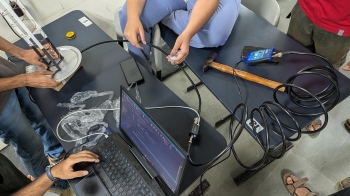
Innovation isn’t a mere spark of thought. It is a process that begins with creativity, discipline, determination, and relentless hard work. In a small garage in Merces, a group of ambitious diploma students spent months amidst grease, welding, cutting, and testing a mini project, their custom-made amphibious vehicle, that can work seamlessly on land as well as water.
The idea for the project emerged during brainstorming sessions, when the team was searching for something meaningful. Their conversations soon turned to the devastating floods in Punjab and Goa. “In emergencies, rescue teams often struggle to reach people because vehicles cannot move through flooded or damaged areas,” they said, explaining what pushed them towards this idea.
The dedicated team of students from Agnel Polytechnic Verna comes from different parts of Goa: Sandesh Kadalgekar from Mapusa, Ratish Shirodkar from Panaji, Tejas Kalangutkar from Bicholim, Sarvesh Hoble from Merces, Upamanyu Radkar from Margao, and Suyash Gaonkar from Assagao. Sharing the same vision, they remained committed, often working late into the night. “We would finish college, come back, and continue working till midnight, then return the next day,” they said.
Under the guidance of their mentor, Parag G Bhat Mathker, they began by sketching designs and mapping out each stage. “The process taught me how to gather and analyse information effectively,” said Upamanyu.
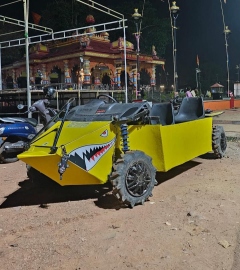
Fuelled by curiosity and determination, they brought their idea to life. They built a geared vehicle powered by a petrol engine, with a fibreglass body shaped like a boat so it could float and move through water. Tejas said working on the structure taught him how to handle materials carefully, maintain precision, and ensure the right balance so the vehicle stays stable in water.”
They used mini tractor wheels, a Maruti Wagon R engine, and even repurposed stadium seating to keep the structure light. Painted bright yellow for visibility in extreme conditions, the vehicle also features a crab-walking mechanism. “It helps us move sideways in tight or blocked spaces where turning normally is difficult,” the team explained.
Testing the vehicle was a critical phase. They took it to local water bodies, where it successfully floated, though not without issues. “We did face some leakages initially, but we fixed them and improved the design,” they said.
One of the toughest challenges was reworking the engine placement. Instead of keeping it at the front, they shifted it to the rear, which required reconfiguring the entire drive system. “The project helped me understand real challenges in fabrication, especially how designs need to change during the build process,” said Ratish.
Sandesh, who handled much of the cutting, welding, and chassis work, said the experience gave him hands-on learning and a better understanding of strength, precision, and teamwork.
The project was not just technically demanding but also financially challenging. The students funded most of it themselves, with support from local MLAs. What started as an estimated Rs 1 lakh project eventually rose to nearly Rs 1.5 lakh. “There was a point where we thought of stopping because of the costs,” they said, “but our sir motivated us to continue and even supported us financially.”
Beyond the build, the students say the experience shaped them in unexpected ways. “Working on the design and presentation improved my communication skills and taught me how important teamwork and planning are,” said Sarvesh, while Suyash added that handling documentation helped him maintain a proper and professional record of the entire project.
Their efforts paid off when they secured fourth place at the Mapusa Carnival in the fine junk category. “We were really happy with that,” they said, adding that the response on social media has been very encouraging.
Looking ahead, the team hopes to refine the vehicle further and, with support, build more units for emergency use. “This is just a prototype, but it can definitely be improved and used on a larger scale,” they said.
Their message to other students is clear. “Think out of the box, work on your ideas, and don’t be afraid to try something new,” they said, adding that more students should explore automobile engineering, as there is a lot of scope, but not many are taking it up in Goa.
There is risk everywhere, but these students have shown that with persistence and belief, even a small garage can become the starting point for something meaningful.