


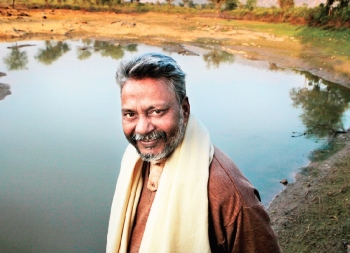
Prabhakar Dhage
Rivers are the lifelines of civilisations. For cultures to survive and thrive, the rivers must be protected and saved. The rivers in India are dying fast and if the governments do not intervene to rejuvenate them and steps are not taken in time to protect these lifelines, a time will come when battles would be fought between the states. "Once wars over water commence, the countdown will begin, marking the end of human civilisations," warned Rajendra Sing, the Water Man of India in his recent visit to Goa.
Initiating the‘Goa to Guwahati Jal Yatra' from Panaji, he highlighted the plight of rivers in Goa and in India. Expressing concern over the sorry state of rivers, he pleaded, "Rivers are being exploited, polluted, high-jacked and auctioned and it's time we stop this." There is commercialisation of rivers and some are being privatised too. Both, the Central as well as the State governments are marketing them for their own profits. "There are underlying vested interests," alleged the Water Man, an activist for 34 years in the water conservation mission who strongly believes, that water-crises is man-made, and one can end it.
Mentioning of Rajasthan, where it rains hardly 10-12 inches a year, Rajendra Singh stated, "We have successfully revived eight dead rivers and thus successfully put an end to the water crises in 1200 villages in Rajasthan. These rivers are now flowing with full glow of life. If the health of the rivers is disturbed or compromised, it affects human health too. We can witness this in the form of various water borne diseases. Owing to this fact, when so many rivers are turning into nullas, we can't afford to turn a blind eye toward it. It's wrong."
Realising the need to address water crises issue on a war front, he initiated Kashmir to Kanyakumari Jal Yatra in May. "There would be a total of 101 Jal Yatras across India, with each state participating in them," added Singh.
A dialogue has been started between people from various walks of life - common man, students, teachers, political workers, leaders, social workers, non-government organisations etc. The importance of water is being highlighted and water education being imparted. Do not privatise the water, make it available for public usage, is the message being given to all. The volunteers are stressing the need to rejuvenate the rivers. The water-crises is giving birth to many problems in the country - economic, social, political and cultural. The villages are being vacated and people are migrating on a mass scale. The overcrowded cities are becoming more and more polluted with the migrant population. "We are dreaming a nation, free from floods and famines," expressed Rajendra Singh.
The farmers' suicides are the result of water crises, according to Rajendra Singh. After Maharashtra, now the farmers in Andhra Pradesh, Karnataka and Punjab are committing suicides. To construct big dams is to let the water dry. In Maharashtra, 40 per cent of the dams are built in this style. This has encouraged wrong practices in farming. Considering sugarcane as a cash crop, more and more farmers turned to sugarcane cultivation which needs a huge amount of water. The farmers forgot their traditional way of farming and what type of land is good for a particular crop. When the water from the dams fell short, the farmers competed in digging bore wells. This depletes the water table. More and more farmers became bankrupt. They began to commit suicide. They admitted that it was the result of misuse of water. They agreed that they did not follow the traditional method of agriculture - to sow according to the rain pattern in that particular region.
Diverting the waters of river Mhadai is wrong, felt the Water Man. Karnataka has been trying to divert the water of this river in their border and this is a long pending issue. "This is not fair. It is social injustice and also environmental injustice," he said.


