SNEHA UMARYE
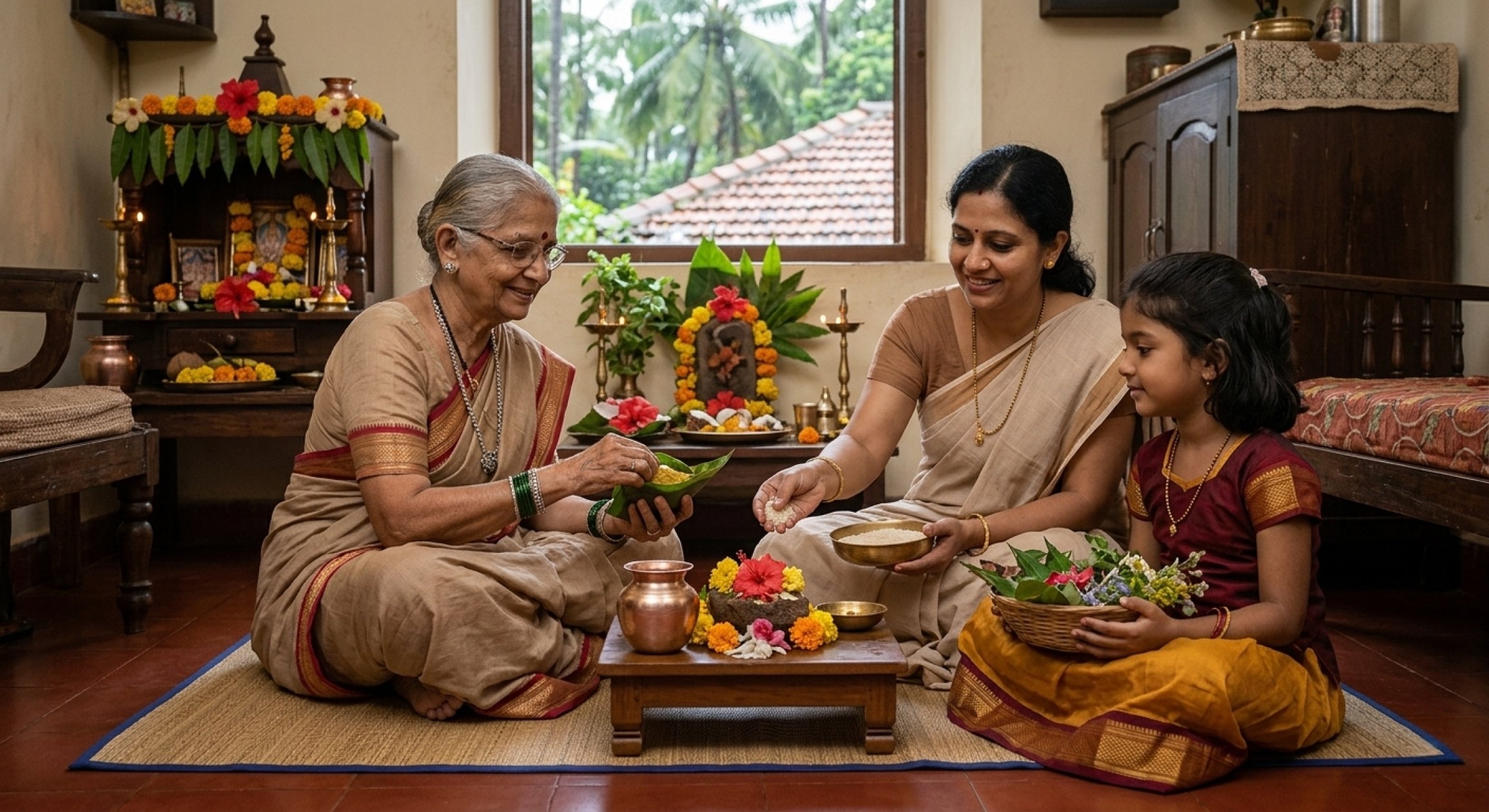
As Shravan begins in Goa, it arrives as a calendar of small things to remember: which vrat falls on which day, what is offered on each day, which flowers must be gathered, and which song everyone still remembers only after the first line is sung. Much of that memory, in many Goan homes, sits with women.
The books tell the month through devotional stories of Somvar, Mangalagauri, Shilasaptami and Nagpanchami. Today, beyond their devotional frame, they also reveal something else: a domestic culture built through traditions. A mother shows a daughter how much rice makes a shivamuth. A grandmother recalls a forgotten song. A newly married woman learns a ritual by observing the older women.
Shravan is a month women keep in motion.
When each day brings something new
On Shravan Mondays, the practice of Shivamuth, literally “a handful for Shiva”, involves offering a fistful of rice grain. Followed in parts of Maharashtra and Goa, it is associated with seeking marital harmony. Older accounts from Goa describe rice as one of these offerings, while there’s also a sequence of moves through different grains on successive Mondays.
Tuesday belongs to Mangalagauri, celebrated by newly married women for the first five years after marriage. For the puja, women call their extended family circle and, especially, women friends to sing, dance, and gather. In her first year of Mangalagauri, Shruti remembers her grandmother telling her, “anandane gani gavit, nrutya karave,” meaning to sing joyfully and dance. This observance is not confined to prayers; it becomes a shared space of fun and togetherness for women.
That joy makes it memorable. In the evening, neighbouring women come for haldi-kumkum, aartis are sung, and Mangalagauri becomes a get-together. Customs vary across communities: Mangalagauri is of particular importance for some, while Shravan Sunday observances have strong traditions for others.
Then the Shilasaptamivrat, whose story ties a woman’s vow to the well-being of the household. The name itself evokes shila, stale food, with preparations such as idlis traditionally made a day in advance and served as part of the observance. In the traditional tale, a king sacrifices his grandson to bring water to a newly built pond. When his daughter-in-law observes the vrat and prays to the water deities, her child is restored, reflecting faith and compassion.
Rituals that grow with the monsoon
Shravan brings close attention to the month’s offerings, drawing women towards flowers, leaves and seasonal produce. In many homes, what grows in the backyard or around the village finds its way into worship and food.
Suvarna Kerkar speaks about Aitar Pujan (Sunday worship), in which married women gather this seasonal produce. She describes Shravani Aitar as honouring nature during the monsoon, when the landscape is at its most verdant. On Shravan Sundays, women worship the Sun and Moon, with the Sun holding particular significance as a source of energy. “The Sun is a primary source of energy necessary for survival on this planet. Sunday is considered Lord Sun’s day, and hence worshipped,” she explains.
She has also pointed to foods such as patolyo (steamed rice-and-coconut sweets in turmeric leaves) and rann bhaji (wild seasonal greens), made from what the season provides. Rekha Kare remembered the work of collecting varieties of patri (ritual leaves) around the house and preparing naivedya (food offerings) such as athval, muthlya, patolyo and sweet polle on different Sundays. Aitar Pujan also brings in paanacho pudo (leaf cones), seasonal flowers and, in some homes, fugdi, the spirited group dance associated with women’s gatherings.
What women hold on to
Shravan today does not look identical in every Goan home. Working hours are different. Families are smaller, and rituals are shortened, and some women choose only the practices that still feel meaningful to them.
It asks ordinary questions: “Which flower comes next?” “Did Aai make this on the second Sunday?” “Who remembers the ovi?” A woman may no longer spend an afternoon collecting many kinds of leaves, yet she may still call her mother to ask what was traditionally used. A daughter may not know every Mangalagauri song, but she learns two at a family gathering. For working women, however, keeping up with these traditions can also mean finding time around an already full day. Shruti puts it simply: “As a working professional, I don’t get the time, but I look forward to meeting friends and family and doing things I like.”
Shravan is often described as a month of festivals. Through the eyes of Goan women, it is also a month of work and warmth. There is pressure in finding the time, but there is also pleasure in the familiar rituals, the food, the songs and the women one meets. None of these acts look monumental on their own. Together, they are the reason a season on the Hindu calendar still feels recognisably Goan when it enters the home.