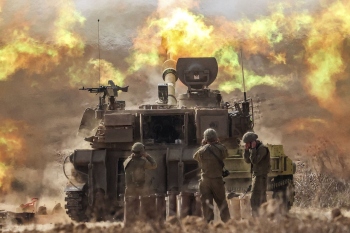
Since last few days as tensions and conflict between Israel and Hamas-ruled Gaza strip escalates; the world is a petrified witness to carnage, destruction and mayhem of unprecedented scale. The empty streets filled with eerie silence interrupted by sirens, sonic boom of exploding weapons, skies overcast with criss-cross smoke trajectories of fired missiles, shocked and confused civilians scurrying to escape the assault; are all a ‘bloody collage of war’.
The heaps of rubble, concrete, and mangled vehicles smothering streets, amidst which the desperate civilians attempt to retrieve the dead and search for the trapped are heart wrenching scenes that can affect any sensitive person irrespective of political inclinations and diplomatic posturing. The right to defend notwithstanding, nothing can justify death and destruction, no matter where and who initiates it, and how convincing the basis of the assault.
Among human activities driving adverse ecological change, war is both intensive and far-reaching. But wars have been viewed through geopolitical frames of reference, and little attention has been paid to the environmental costs of armed conflicts. Whenever a combat is unleashed, its consequences can never remain limited to the warring factions and the ‘ground zero’.
Wars inflict severe and serious damage to climate, ecology and biodiversity not only within the actual ‘conflict theatres’, but cause a profound impact much beyond the ‘war epicentre’ and within the zone of influence. Due to an anthropocentric bias and complex dynamics of this ‘conflict spill over’, little attention has been paid to analyzing and quantifying this damage potential of wars on non-human species, their spaces and resources critical to their survival and recruitment. Given the paradigm shift in modern warfare due to novel technologies, new enemies and asymmetrical nature of conflicts in a world marred with resource inequities and fast deteriorating environment, understanding ‘warfare ecology’ becomes imminent and urgent.
Very clearly there is a complex relationship between warfare and ecosystem change that must be deciphered. The cost of ‘collective killing for collective purpose’ must be integrated with concerns of ecosystem science. Morally if science contributes to war (and it does), it must counterbalance by attenuating war-related damage and restoring pre-war environmental matrices.
The aftermath of modern wars and weapons can unfavourably change microclimates, destroy critical habitats pushing out their inhabitants, diluting their health and vigour and increasing their vulnerability to ‘drivers of decimation’, cause resource depletion and resultant spill-over and conflict situations.
Much of the safeguards for protection of ecology and conservation effort have been prescribed for implementation during peaceful time, but there is little vision and policy for this mandate during wars and conflicts. The ‘peace dividends’ of tranquil biodiverse landscapes cannot be guaranteed in times of turmoil and conflict, as the stage is set for demolition and death for assertion of primacy. The energy exuded by weapons, the fireworks and noxious smoke-screens that veil the sky, extreme noise and vibrations accompanying launch and landing of projectiles, tremors that rip through the land following collapse of buildings and installations, heaps of inert materials; are all a complete package of disaster and detriment to all that dwells in and near the war zone. Climate change is now a clear ‘threat multiplier’ affecting national security and therefore post-war restoration of disrupted ecosystem services is critical to the restoration of peace.
While there are international codes of conduct to consciously minimize savagery intrinsic to conflicts, theses efforts are chiefly human-centric; with little done to lessen parallel harm to biodiversity and ecology. Amidst growing unrest among nations today due to fear, uncertainty, domestic pressure, skewed sense of injustice, incursion and misplaced opportunism; wars are no longer viewed as extreme and exceptional. Preparation for a war, actual conflict and post-war phases; all have ecological consequences.
It takes accelerated resource consumption, and stockpiling of materials, weapons testing for the preparation; training of battle field personnel can leave unexploded artillery in landscapes that are contaminated, denuded and cratered; reducing their habitat potential. War on the other hand will usher in significantly enhanced energy flow, destruction of critical habitats, and increased fatalities not limited to our species. The post war setting is that of contaminated, scorched and degraded ecosystems, disrupted ecosystem services and sharply declined species richness.
While we account for war captives and casualties of our species, multitude of plant and animal species suffer and die an inadvertent indefensible death that nobody even accounts for, leave aside mourning! Some of these victims could be relictual species populations of high conservation value; others could be migrants from distant lands. The flight path being filled with haze of explosions could be difficult to negotiate for birds and bats, dust and smoke emanating from collapsed infrastructure could further interfere with navigatory abilities of aerial migrants, also smothering vegetation and depressing its vital bio-assimilative functions and fodder value to herbivores.
The increased ambient noise levels can be a deterrent to foraging, mate acquisition and also raises stress levels in exposed species. Nocturnal species get badly hit by intense flashes of light and war noise, and may abandon their roosts. Vast expanses of abandoned spaces filled with war debris can invite alien species posing threat to native communities.
Every war zone is a potential habitat and the governance of biodiversity conservation therein can be stalled due to international isolation. One must remember that there are no geo-political barriers when it comes to transboundary ecosystems and migratory species; who become the worst victims of such cross-border aggression and invasion. The wartime triad of disruption, contraction and collapse of biodiversity governance systems is a major blow to the mandate of conservation. Protected areas boundaries in the vicinity of war zones lose effectiveness, there could be reallocation of budgets sapping major chunk of conservation funds being diverted for military revitalization.
How true then, that those who wish to fight, must first count the cost!