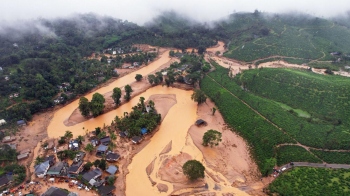
The Wayanad landslide was a crushing catastrophe, that shook the sensitivity of those who value nature and human life. The scale of damage was immense, demonstrating the destructive power of nature. The fabled resilience of Western Ghats and its assumed endurance against incessant human assault was shattered by this majestic mountain range itself.
This seems to have been a rain-driven event, causing creep, root-throw and debris avalanche. Mass wasting of montane strata, whose stability stood challenged over a long timeline due to tree felling, constructions, quarrying and a complacent air of ‘all is well’. Honestly all wasn’t well, and alarms were sounded long ago by those who witnessed this abominable human arrogance of using engineering prowess to appropriate, annex and adapt the Western Ghats to human greed and grab.
Regrettably, the few who felt the feeble pulse and heard the convulsive sobs of this fragile ecosystem were ridiculed by the powerful lobby vested with authority, but low on eco-prudence. And as is the thumb rule in any ruling dispensation, the rulers are sought to be pleased with concurrence and not corrections. The advisors, bureaucrats, and the engineers, invested in towing the line of modifying the montane terrain using engineering and technology for ‘people-centric’ development, paying no heed to ‘eco-centric’ safeguards whatsoever.
Roads, tunnels, bridges were constructed by breaking the earth in seismically sensitive areas without proper assessment of geology, tourism infrastructure was promoted without assessing the ‘carrying capacity’ of the sites, projects were fast-tracked flouting rules of environmental impact assessment and in many cases easing the environmental clearances with doctored EIA reports, or sham appraisals by state-favoured experts.
Other than the government, engineers and ecologists are important stakeholders’ groups in this discussion. However, engineers cannot afford to be ecologists, simply because they suffer ‘political captivity’ and their approach and analysis is determined by political decisions. To put it straight, ‘political managers’ influence engineering decisions regarding the systems that are to be investigated and avoided, and likewise the environmental variables to be monitored and ignored as required for ‘politically correct’ outcomes.
I’ve met many field and executive engineers, who practice and promote this ‘cult of trivializing ecology’ and laugh at my idea of biodiversity assessment of project sites. “Notwithstanding the rarity and high conservation value, one can’t stall development for sake of a grass, a creeper and an insect” …they have argued with me in a tone of contempt and pity on my non-engineering status.
And using all my subject acumen and communication skills, I have zealously attempted to correct their seriously skewed impression about non-human life and ecology, and its importance for earth’s well-being.
I am convinced that the practice of engineering is driven by ‘decision dominated process’, rather than knowledge, resulting in serious trade-offs like undervalued ecosystem services and misvalued social costs. Opposition to many project proposals today by people in Goa and other eco-sensitive localities in the country, reflect this genuine fear of losing our precious earth-capital in exchange for manufactured-capital!
That brings us to a rather serious point of contemplation; and that is, why do governments hate ecologists and shun all those who ask to account for externalities beyond monetary costs of developmental projects? This collective dislike by those in power for those who sound the bugle against environmental violations, is best exemplified by the scorn held by governments in Western Ghats states towards one of India’s finest ecologist, Madhav Gadgil, who prophesied the Wayanad tragedy a decade ago, warning the state to apply emergency brakes on unsustainable development in the ghats.
In fact, Gadgil wasn’t demonstrating his prevision, nor he gazed into a ‘crystal ball’ to predict future of ‘God’s own country’. Instead, he simply relied on his ‘ecological prism’ to gauge the consequences of unprecedented assault on the Western Ghats in the garb of development. The repeat catastrophes that strike Kerala by way of heavy rains, floods, and landslides only confirm that this region has reached a tipping point long ago!
In August 2011, the Western Ghats Ecology Experts Panel under Gadgil’s erudite chairmanship tabled a detailed report on threats to the Western Ghats and eco-remedies, based on ground truthing and consultations with locals. The political lobby likened the report to a ‘spoke in the wheel’ of development and a ‘speed-breaker’ for economic activities.
Goa too under the then chief minister Parrikar, an IITian and Metallurgical Engineer; conveyed its blunt disapproval of Gadgil’s recommendations for safeguarding the ecology of Goan Sahyadris. The delimitation of ecological sensitive areas (ESA) was opposed vociferously by every state. Political resistance to Gadgil committee report was rising, dubbing it as excessively eco-centric and anti-development. The central government then appointed Dr Kasturirangan, former director of ISRO and an astronomer to dissect and dilute the Gadgil report.
Again, it is interesting to note that an ‘engineer’ was tasked to examine an ecologist’s prescriptions for an ailing ecosystem, and his assessment criteria and tools differed. Unlike Gadgil who visited the villages of the ghats to assess and interact with people, Kasturirangan, a man of satellite technology used remote sensing to assess the fragility of Western Ghats and recommended that only 37% of area was ecologically sensitive. At this instance the ‘politics-engineering combo’ prevailed over ecological prudence!
If governments are serious about achieving sustainability targets, they must shift their focus from choking our land with ‘built environments’ to preserving our ‘natural environment’. The engineers must sit with ecologists and understand ecological constraints of their technical designs. The greatest challenge of our times is to balance progress in engineering and our deepening ecological understanding. Ecologists must not to be demonised as ‘foes of progress’ but be looked upon as ‘prophets’ warning of natural calamities, to avert loss of life and property through their scientific predictive acumen.