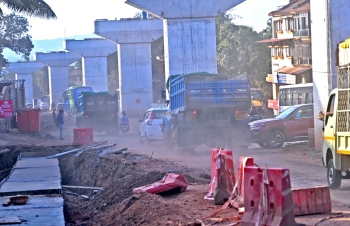
Development is increasingly portrayed not as a subject for public deliberation, but as a necessary trajectory. Resistance is subtly recast as reluctance

As the year draws to a close, reflection becomes inevitable. The final day of the calendar is not merely symbolic; it serves as a pause between what has already been set in motion and what is likely to follow. In Goa, this pause invites an assessment of patterns rather than events. The question is no longer confined to what development has occurred, but how development itself is being framed, accepted, and normalised.
Across the globe, development has often been narrated as a forward moving force from which there is no dignified exit. The frequently cited example of Shenzhen, once a modest fishing settlement that was transformed into a global economic hub under a Special Economic Zone framework, is commonly held out as proof of inevitable progress. The story is presented as inspirational, yet its persuasive power lies less in the transformation itself and more in the language surrounding it. Communities are told that development is not a choice to be debated, but a train that must be boarded.
A similar grammar has begun to surface within Goa. Development is increasingly portrayed not as a subject for public deliberation, but as a necessary trajectory. Resistance is subtly recast as reluctance, and restraint as obstruction. The underlying suggestion is simple: adaptation is required, and dissent is a delay.
From judicial pause to
narrative recalibration
This shift was evident in the public discourse following the Bombay High Court at Goa reading down Section 17 subsection 2 of the Town and Country Planning Act. The judgment was widely perceived as a reaffirmation of planning discipline. Yet the response that followed revealed a recalibration rather than a retreat. It was emphasised that the provision itself remained intact and that its relevance would be realised in time. The argument was framed around future need. Ordinary citizens, it was suggested, would eventually require the same flexibility to rebuild ageing homes and generate value on their land.
In this telling, discretion was not rejected but deferred. The meaning of the provision was pushed forward, asking present concern to wait for future understanding. Development was not halted by judicial intervention; it was linguistically repositioned.
Arambol and the
elasticity of zoning
The recent reclassification of approximately three lakh square metres of land described as private forest in Arambol brings this recalibration into sharper focus. The controversy did not arise merely because of the size of the land involved, but because of what the conversion revealed about zoning itself. When forested land can be administratively treated as settlement, zoning begins to function less as restraint and more as facilitation.
The Forest Act remains cited, files continue to move, and clearances are recorded, yet the outcome suggests that protection survives largely in form. The statute appears intact, but its capacity to refuse is weakened. The law exists, but its deterrent effect resembles that of a paper tiger.
Arambol is not best understood as an isolated case. It highlights a broader pattern in which green zones, orchards, no development slopes, and private forests are progressively absorbed into settlement categories. Once that transition is made, the path towards commercial exploitation becomes smoother and increasingly routine.
Why village level politics
now matters more
Against this backdrop, the heightened emphasis placed by political parties on Zilla Parishad elections becomes easier to understand. Panchayat and district level contests were once treated as peripheral exercises. That perception has changed. Control over village constituencies now carries strategic value, particularly where large tracts of land are involved.
Political alignment at the grassroots offers assurance long before any file reaches a state department. It signals that when conversion becomes due, resistance will be limited and legitimacy will already have been socially prepared. Electoral success at the local level thus becomes a precursor to land outcome, not merely a reflection of political popularity.
This shift is not confined to any single party. It reflects a shared understanding that development proceeds most smoothly when village level political geography is stabilised. Investment is framed as empowerment, infrastructure as opportunity, and electoral dominance as inevitability.
From these patterns emerges what may be described as a theory of deeper collusion. At first glance, the term appears accusatory. On closer examination, it is explanatory. When political leadership facilitates the monetisation of land under the banner of progress and national development, it becomes rational for communities to internalise the same logic.
In villages where families know who is migrating, who is indebted, and whose inherited land lies vulnerable, the distance between custodian and intermediary quietly narrows. Brokerage replaces guardianship. Participation replaces protest. Collusion ceases to be hidden and becomes participatory.
Each action within this ecosystem is capable of individual justification. Investment is welcomed. Revenue is generated. Employment is promised. Yet taken together, these actions produce a convergence in which political ambition, economic incentive, and social acquiescence move in the same direction. Zoning changes cease to appear exceptional and begin to resemble routine outcomes of electoral arithmetic.
Looking ahead to 2026
If the message repeatedly conveyed is that Goa must get on the developmental train or risk being left behind, it is unsurprising that citizens recalibrate their choices accordingly. Why preserve what is being steadily reclassified. Why resist what is officially normalised. Why stand apart when participation promises immediate return.
The comparison with Shenzhen therefore acquires relevance not as aspiration, but as caution. Shenzhen’s rise is often narrated as success through inevitability. Goa’s present trajectory raises a quieter question. What is lost when inevitability replaces consent, and when heritage becomes merely another commodity in the developmental ledger.
As the year closes and 2026 approaches, the patterns are clear enough to be recognised. They suggest a future shaped less by isolated decisions and more by convergence. That convergence, rather than any single statute or clearance, is likely to define Goa in the years ahead.