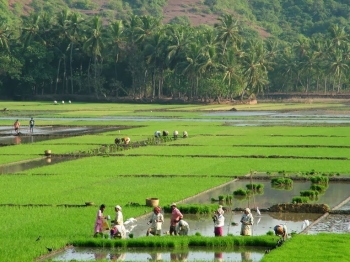
Tourism in Goa remains a pillar of economic growth although it is evident that the unsustainability of tourism related development projects in the State of Goa has led to the dilapidation of numerous forestry areas and has trampled upon the fertility of agricultural lands only to ensure that the rental vehicles can zoom past on the wide open roads as they roam freely in search of every perceivable form of hedonism.
Nostalgically, one can ask any veteran from the tourism industry about the tourist season and the charters and the response would inevitably be the same, that: “the British and European tourists are no longer to be found in the large numbers that they once used to arrive on the charter flights.”
And there are bound to exist good reasons for this declining trend among the tourists from developed countries such as the U.K. and European Member States.
These reasons range from the issuance of travel advisories by their respective foreign ministries which caution about the growing tension in the Middle East due to the wars and the solidarity to the strife of the Palestinian people among Iranians and Yemenis. These countries remain in close proximity to India and any war like escalation could have ripple effects within the proximity of the entire region.
Of even more relevance would be the fact that the entire European Union had jointly resolved to wean off Russian petroleum and natural gas and this implied a boycott of all its perceived allies including India who relies heavily on Russia’s supply of crude oil.
The reason for the boycott of Russian petroleum, gas and crude oil was at the relevant time mainly based on the territorial aggression it committed upon Ukraine and which has led to avoidable carnage due to the so called liberation efforts of the Russian Army in order to rid the people of Ukraine of the oppressionist rule of Kyiv.
The reason for the change in the dynamic of travellers patronising certain preferences in tourism may be on account of a myriad of reasons but the most astounding of all reasons would always be that if tourists from belligerent nations chose to frequent a certain destination for their vacation, then the nationals of the country who are facing the oppression of the belligerent country would choose not to visit the same destination.
In other words, it would be counterintuitive for an Ukrainian national to visit a holiday destination which is a known tourist hotspot frequented by Russian tourists.
And the same generalisation could even be understood with respect to a Lebanese national choosing to avoid a tourist destination which is highly preferred by Israeli nationals for their own holidays.
In fact, having come across a personal example of this generalisation in Berlin, Germany (circa 2015) when the Syrian refugee crisis was at its peak and European Member states especially Germany witness large scale exodus of Syrian Refugees seeking Asylum there, when suddenly in November, 2015 there were news reports which came out of Cologne Germany that elite commandos of Assad’s Special Forces Unit disguised themselves as refugees in order to gain access to the refugee camps in Germany where they attempted to assassinate the leader of the Syrian anti-governmental rebellion as he fled with his family to Germany to seek refuge there.
So even in tourism related settings, no place is safe when two nations are at war and their nationals inclusive of lethal soldiers have access to a visa on arrival in a destination with a weak home intelligence unit, to the point that violence and aggression only needs to be fueled by alcohol induced patriotism in the perception of the tourist for their respective home country.
Acquiescing to rationality and affording academic discourse a chance in order to make sense of the prevalent practices in tourism shall only aid in proving the hypothesis further.
According to Cooper and Hall (2024) in their Commentary entitled The geopolitics and challenges of current issues in tourism published in the Journal of Current Issues in Tourism:
“The tourism industry, destinations, and the wider tourism community and stakeholders face several significant short and long-term challenges that will substantially affect the future direction of tourism. Issues of social, economic, and environmental change are further complicated by current geopolitical conflicts and competition.” (Cooper & Hall, 2024).
The United Nations High Commissioner for Human Rights, Volker Türk while delivering a Speech on the 8th of October stated:
“We are approaching 1000 days since the Russian Federation’s full-scale armed attack on Ukraine.
A period marked by massive destruction, death, and injury, displaced and tormented families “ and widespread violations of international law.” (OHCHR, 2024).
Charter tourism according to Jakob Lauring while contributing to the living reference work entry in the Encyclopedia of Tourism:
The term “charter” originates from the Latin word chartula, denoting a contract or to hire means of transportation. In the tourism industry, charter tours have come to signify package trips consisting of prearranged services, including transport, accommodation, and often meals and options for associated activities.
Chronicles of tourism geopolitics:
According to author Jennifer Lynn Kelly in her book entitled: Invited to witness: Solidarity tourism across occupied Palestine published by the Duke University Press:
“The machinations of tourism geopolitics reverberate strongly in today’s polarised political milieu, presaging some of the most tragic clashes of our times in places like Gaza and Ukraine” (Kelly, 2023).
David Weaver et al. (2023) have opined that “Geographers are increasingly addressing the role of tourism practices in facilitating and challenging national identity and citizenship, territorial claims, and border conflicts” (Weaver et al., 2023).
Therefore, Tourism related endeavours in Goa need to remain mindful of the geopolitical constraints that govern each and every nationality that visits its offering and enterprise. Merely expecting all visiting nationalities to accept brand Goa would be tantamount to an insensitive practice that does not take into account the geopolitical implications of the ongoing conflicts globally.