


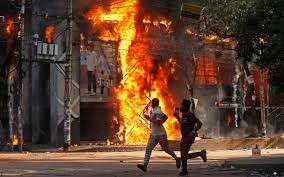
Unexpected news is coming in from Bangladesh, and it's not very pleasant. In whatever way this finally resolves, one thing is clear: Bangladesh has suffered more than its fair share.
Phenomenal corruption, assassinations and treachery, military coups, poverty, devastating floods and cyclones have made news out of the region over the past five decades. Many thought their problems would decrease after that nation split away from Pakistan, but that has hardly been the case.
Bengalis are a smart people; they deserve better.
In the 1970s, almost a decade after India's intervention in Goa, the issue of Bangladesh unfolded before our very eyes. Refugees were trickling into India, by the million, from across international borders. There were special postage stamps issued, that marked the refuge influx. Soon it resulted in another Indo-Pak war, one that fortunately lasted only a few days, and the only one that some of our generation would know.
But it was serious enough for us too in Goa, on the distant west coast, to have to cover our window panes with brown paper (to avoid enemy planes detecting villages by night). Or to take note of the sudden sirens that would alert us all to the possibility of an air-raid.
Indira's intervention was swift. It is said (though this has been questioned) that even the young Atal Bihari Vajpayee praised Indira as a Durga for bisecting our antagonistic neighbour Pakistan, after the East Pakistani crisis.
But the Indian involvement in what came to be Bangladesh was never really appreciated by the Pakistanis. And naturally so. Their instigation of the insurrection in Kashmir can be seen, at least in part, as an attempt to 'pay back' India for this action. And so the military race in the subcontinent continues.
But just as India was beginning to forget Bangladesh (or Bangla Desh, as it was then spelt), things started unravelling in strange ways. Its leader Sheikh Mujibur Rahman was brutally assassinated by mid-ranking officers of his own armed forces.
Suddenly, the threat of CIA-inspired coups seemed all the more real in the South Asian subcontinent itself. Indira brought up the possibility of the "foreign hand". Many of us were willing to believe it, not without a reason. Politics in Bangladesh reminds us that the clock indeed turns a full circle!
Sheikh Hasina Wazed, ousted on Monday itself from power at Dhaka following student protests, is the daughter of Sheikh Mujibur Rahman. Except for her husband, children and sister Sheikh Rehana, Hasina's entire family was murdered during the August 1975 Bangladeshi coup d'état which saw the assassination of Sheikh Mujibur Rahman. Sheikh Hasina is said to have survived 19 assassination attempts. She has herself fought autocratic Bangladeshi regimes in the past.
Distant Bangladesh has a rather unusual Goa connection too.
The journalist who played a key role in the birth of this nation was the former Karachi-based Goan, Neville Anthony Mascarenhas. He is better known by his second name. Born in Belgaum to a Goan Catholic family, Mascarenhas (1928-1986) was a Pakistani journalist, and later author. He had been on a military "guided tour" to East Pakistan, when the conflict started.
The story goes that Mascarenhas was horrified by what he saw, and realised he would not be able to report it in Pakistan itself due to the censorship there. So, he ferreted off his family to London, and himself fled there. His news-story was prominently published in the leading British newspaper, 'The Sunday Times', edited then by the legendary Harold Evans. It carried a three-word headline and dominated the entire front page of the reputed newspaper. It simply said: "Genocide in Bangladesh."
It was that story which set the tenor and tone of the conflict, and how people across the world understood the East Pakistan situation. Some believe that even leaders like Indira Gandhi were partly influenced by this reporting.
(More recently, one read critiques of Mascarenhas' reporting, which question his depiction of the situation in that part of South Asia. Human rights violations are human rights violations; but when exactly does this grow into a genocide? There may be some need to debate and better understand such issues.)
Once, during a visit to Bangladesh, I had a few taka in my pocket remaining, and was wondering what to do with the same while at the Dhaka airport. By some chance, one came across Mascarenhas' second book at the airport bookstall. It was well narrated, and made for an interesting story. After his first book 'The Rape of Bangla Desh' (1971), he wrote 'Bangladesh: A Legacy of Blood' (1986). Both the books are very insightful, and offer a blow-by-blow, almost cinematic I-was-there account of the plottings and struggles that led to the politics and birth of Bangla Desh.
One lacunae is that while what happened is well described, the reader is left guessing about why things happened, or who was the puppet-master behind these things happening. Was Mujib's killing really part of Cold War politics? Did the CIA see him as being too left wing for their tastes?
Coming back to the present, the external drama and flood of facts might make us forget some important aspects. We should not lose sight of the fact that the Bangladesh government is being toppled by a series of angry student protests. This might seem almost anarchic to many. But when a population lives under the yoke of a increasingly unpopular and discredited regime, outcomes like this are not hard to understand. Recently, the students of Kenya also went about openly challenging their own ruling classes, and threatening the latter's base in power.
My own memories go back to the 1970s and early 1980s, when Goa too had an active, idealistic and sometimes-overboard student movement then. A few of those students made the most (and their fortunes) in mainstream politics subsequently. But, many of them became -- and remained -- idealistic campaigners for many causes. May Bangladesh see better days.


