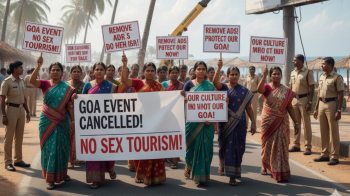
Once more, the issue of how Goa is being promoted (for tourism, or activities related to it) has been sharply raised in the local media, following the social media. The "Tales of Kamasutra & Christmas Celebration" row raked up many responses, mostly angry ones, in the media.
This trend is not new. For long there have been charges that Goa directly or indirectly promotes "sex tourism". Or, at least, is has been willing to tolerate it. If it doesn't do so directly itself, the powerful outstation media (including Bollywood) does so. Meanwhile, the State (or its people) don't take any action.
Goa's connection with “sex tourism” usually draws diverse and distinct responses. Firstly, there is denial. Officials and some locals insist the claim is baseless and rooted in stereotypes. Then, there is defensiveness. Goa blames “outsiders” or a few rogue elements while maintaining that the state’s culture is unfairly maligned.
On the other hand there is also exaggeration: critics inflate isolated incidents into a narrative of a moral free-fall. Sensationalism, especially by the national media, highlights beach parties, drug raids or trafficking cases to frame Goa as a permissive playground.
Not the least important, by way of official responses, the government issues routine assurances. They offer task forces, police crackdowns, moral policing campaigns. At the same time, there's avoiding deeper structural issues like unregulated tourism, trafficking networks, unchecked distasteful online advertising and a lack of community oversight.
Those who have been tracking Goa's touristic portrayal for some decades would know that this is indeed a complex issue. Just because you haven't encountered it, doesn't mean to say the problem doesn't exist. Likewise, because it is intensely felt in some areas, you can't presume that the entire State is facing the crisis.
First of all, sex-tourism is a reality. It doesn't exist only in our imagination. It involves travel undertaken---wholly or partly---to purchase sexual services. Usually, the destinations are places where legal loopholes, weak regulation, economic vulnerability or a permissive reputation make these transactions easier. It is more than commercial sex work. It can also spell trafficking or targetting minors. It is based on power imbalances between visitors and the host society.
The term 'sex tourism' has been used since the early 1970s. It grew in the 1980s, when global travel expanded. The links between tourism, prostitution and exploitation became more obvious from then onward.
Often, Goa has been included among the areas affected. There's also parts of Kolkata (like Sonagachi), some beach areas in Kerala, parts of Mumbai, and pockets of Rajasthan.
At the global level, Thailand (Bangkok, Pattaya, Phuket), Philippines (Angeles City, Manila), Cambodia (Phnom Penh and Siem Reap), Brazil (Rio and Fortaleza), the Caribbean, Eastern Europe cities after 1990, parts of Kenya-Tanzania coasts and also Gambia, Senegal, Morocco besides parts of South Africa have faced up to the same. Sex tourism, when compared to prostitution, has different drivers, scale and power dynamics.
In Goa, one won't encounter this uniformly across the State. But it definitely exists in some pockets. Coastal belts, north more than the south. It is an underground kind of thing, visible to those in the know, or who go searching for it. It reaches out to a certain kind of tourist.
We might feel that this is a needless slur on the local society, but that is ducking the issue.
Over decades, or even centuries, this is the perception that has (rightly or wrongly) been connected with Goa's image. Even Richard Burton has shades of it in 'Goa and the Blue Mountains'. Burton’s book was published in 1851, and based on his travels in 1847-48. With these Orientalist-Victorian views, he saw Goa, especially its "Luso-Indian" Catholic society, as decadent, over-sensual, and morally lax.
He speaks about the supposed “easy virtue” of Goan women, and the relaxed social codes of a tropical colony. He referred to devadasis (whom he called “bayadères”) in Goa’s hinterland and exoticises their music and dance, insinuating sexual availability and portraying them as morally lax.
Demand creates it own supply. Life imitates art.... Such stereotypes have been long promoted. This makes it easier to presume that conservative Goa is a society where "anything goes".
Historian Ernestine Carreira commented in an online discussion: "The lascivious image of Goan women and the degeneracy of drunken Goan [males] are the classic vision of all accounts by... travellers who visited, some even without visiting, Goa from the first decades of the 17th century. See Linschotten and successors.
"What is extraordinary, for me, is the persistence of this stereotype throughout the centuries and the cultural mutations of India and Europe. Especially when compared with the social reality of Goa in these times."
Dr Robert S Newman, the anthropologist, has written a fascinating article titled 'Goa at the Movies'. In it, he focuses on how Goa has been "mythologized" by Bollywood.
Writing elsewhere, this columnist has a chapter titled 'In fact, this is only fiction: unusual 'visitors' who came Goa's way'. It focuses on how Goa is depicted in Indrajal Comics (Phantom visits 'The Calunge Beach'), some sensational novels (Gates of Fire, The Ganja Coast, Grave Secrets in Goa, Khushwant Singh's The Company of Women) or even films like Trikal and adult comics like Savita Bhabi.
Sadly, very little academic study has been done on topics such as these. Waking up when something sensational hits the headlines, is action that is too little... and too late.