Dr Suresh Shanbhogue
A government’s primary responsibility is ensuring the basic foundations for a dignified life. It is the fundamental duty of a welfare state to ensure that every citizen has access to basic necessities to live life with dignity, comprising education, health care, food, and, above all, a safe and secure roof over one’s head. The Constitution of India reflects this larger vision of a welfare state. The Preamble itself commits the Republic to securing social and economic justice and assuring the dignity of the individual. The Directive Principles of State Policy further require the State to direct its policies towards promoting the welfare of the people and creating conditions in which citizens can live with dignity.
A house is much more than four walls and a roof. It provides security, privacy, sanitation, protection from the elements, a stable environment for children, and a foundation from which a family can pursue education, employment and a healthier life. The Supreme Court of India has repeatedly recognised this constitutional dimension of shelter and recognised the right to shelter as an essential component of the right to life under Article 21.
Recognising this, the Government of India has undertaken several initiatives to expand affordable housing for both urban and rural households. The flagship housing programme, Pradhan Mantri Awas Yojana (PMAY), has two major components. In cities, PMAY-Urban (2015) supports eligible families through assistance for house construction, affordable housing projects, rental housing and interest support on housing loans. The recently introduced PMAY-U 2.0 seeks to extend housing support to additional urban families. For rural India, the corresponding programme is Pradhan Mantri Awaas Yojana–Gramin (PMAY-G). Launched in 2016, it seeks to provide pucca houses with basic amenities to eligible rural households that are houseless or living in inadequate housing. Across India, more than 4.1 crore houses have been completed under the Pradhan Mantri Awas Yojana in rural and urban areas.
The significance of these programmes goes beyond the construction of houses. A permanent home can provide families with greater social security and stability. Housing construction also generates employment and stimulates demand for materials, transport and related services, thereby contributing to the rural and urban economy. However, affordable housing continues to face challenges. Rising land and construction costs, delays in implementation, identification of eligible beneficiaries and access to basic infrastructure can reduce the effectiveness of housing programmes.
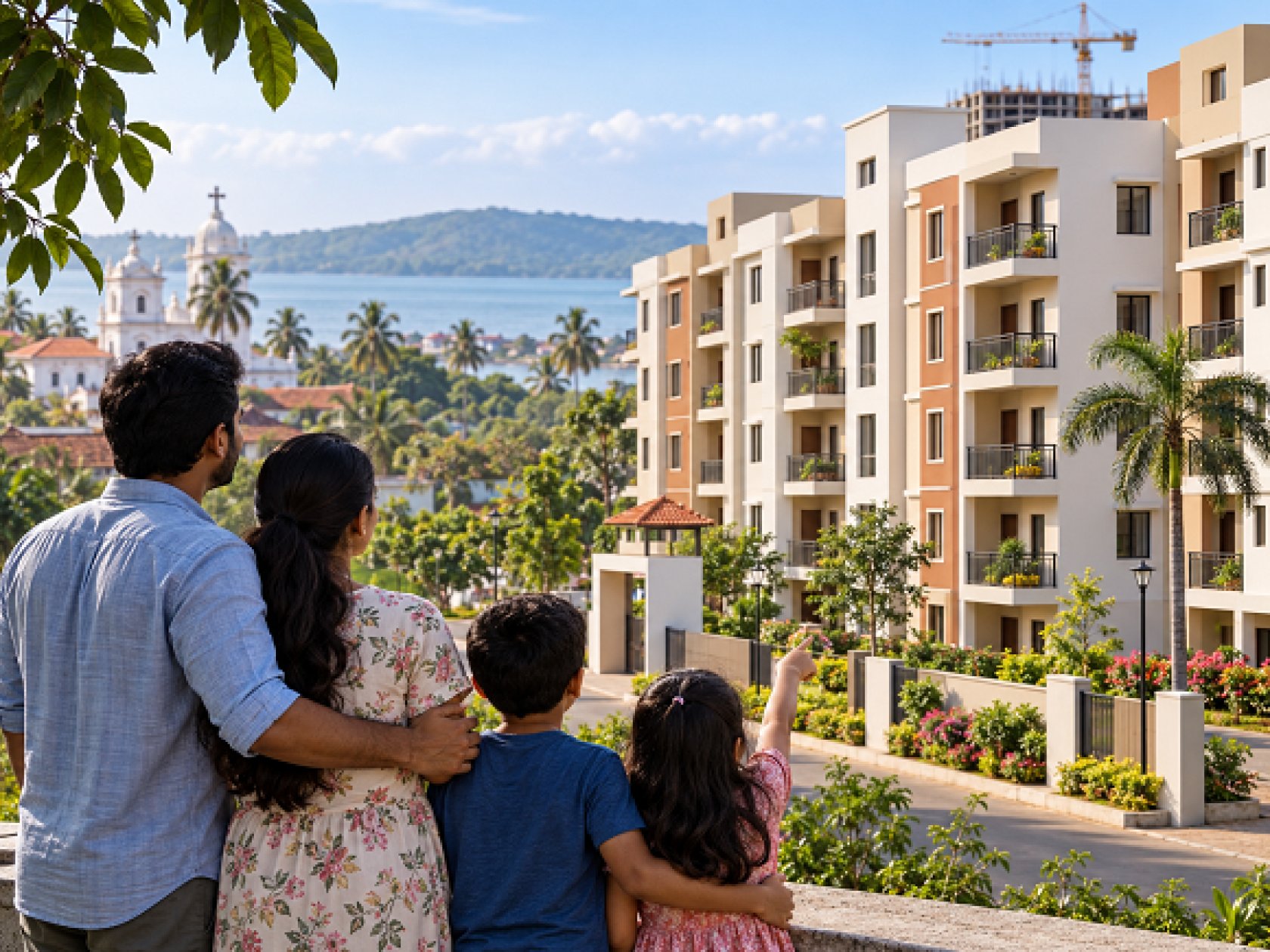
But the housing affordability problem in Goa has different dimensions. Goa’s housing market, which was historically linked primarily to the needs of the local population, is now increasingly influenced by demand from outside the State. Tourists, second-home buyers, retirees, investors, high-income professionals, and people seeking lifestyle-oriented residences have added a substantial layer of external demand to Goa’s relatively limited land and housing stock. Because the supply of developable land and the intensity of construction are constrained, additional demand can translate disproportionately into higher land and housing prices. The Government of Goa’s policy of registration of houses/apartments as homestays and B&Bs has further fuelled external demand for housing both as an investment and economic opportunity. The issue is not that homestays and B&Bs are inherently undesirable. The concern is that permitting ordinary residential properties, particularly apartments purchased by non-resident investors, to be used as short-term tourist accommodation can change the economic use of housing from a residential asset into a tourism/investment asset.
Goa property expos being marketed outside Goa are a visible indicator that developers and the real-estate industry are actively targeting external purchasing power. The impact is already visible on the ground as housing projects in Goa are being opposed by the local population in many places. In this context, Goa’s homestay policy could be reviewed with a specific housing-affordability objective. Eligibility for homestay registration should be closely linked to genuine owner occupation and residence, preferably with Goan ownership getting priority.
Affordable housing is a long-pending requirement of Goans, which deserves the highest priority from the Government of Goa on the lines of the Education and Health sectors. Though the Goa Housing Board envisages meeting the housing needs of Goans, it neither has comprehensive data on housing gaps nor an Affordable Housing Policy for Goa meeting the spirit of the Central framework. Therefore, there is an urgent need for a dedicated Affordable Housing Policy for Goans followed by an Affordable Housing Scheme for native Goans to ensure that every Goan has a roof over their head.
In this direction, the recent decision of the Sawant Government to launch the CM Housing Scheme at Diwali, starting from Pernem for 30-year residents, is a positive step. The scheme needs to be evolved carefully so that every section of society is covered with different sets of incentives based on income criteria. Incentivisation may comprise public-private partnerships, private-private partnerships, higher FAR, single-window clearance, concessional government fees, standardised building plans, incentives for smaller and energy-efficient homes, etc. For economically weaker sections irrespective of caste, creed and religion, the Government may consider exemption or reduction in stamp duty charges, land conversion charges, all statutory charges, including infrastructure tax, and facilitating house-building advances with interest subsidies, etc. However, the caution is that if the State creates inexpensive apartments for Goans as affordable housing but allows them to be freely sold to investors, the incentive may simply become a transfer of public benefit into private property appreciation. Therefore, the scheme needs to put a strict ban on resale for economic gain.
In cities, redevelopment of old housing complexes needs to be incentivised and accelerated, considering both safety and affordability, by giving higher FARs so that the economic viability of redevelopment would attract investors. Considering the scarcity of land and various environment-related restrictions on development, the cost of apartments could be reduced by promoting vertical construction with higher FAR and liberal height relaxations, facilitating a greater number of housing units.
(The author is a retired senior bureaucrat)