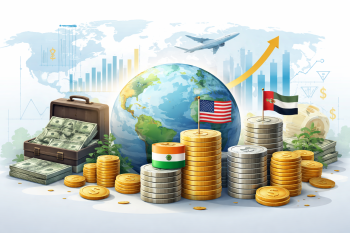
Over the last one year, the Indian Rupee has weakened from Rs84.84 to Rs90.56 per US Dollar”a depreciation of roughly 7%”and has continued to drop to 90.70. Now, what does this actually mean for your wealth?
If you had Rs1 crore invested only in India, and you now want to convert that money to USD or AED (which is pegged to the USD), your global purchasing power has fallen.
In dollar terms, Rs1 crore today is effectively worth only ~Rs93 lakhs.
And here’s the key point:
You didn’t lose money because your investments performed poorly.
You lost value purely because the rupee weakened.
This is the impact of currency risk”an often ignored but extremely important factor in long-term wealth planning.
Core Insight Most Investors Miss
Many investors think risk = market volatility. But the bigger, quieter risk is currency erosion.
When your entire wealth is in INR:
- Your global purchasing power drops over time
- Foreign expenses (education, travel, healthcare, retirement abroad, global assets) become more expensive
- Even if your Indian portfolio grows, its value may decline when measured in USD
This currency risk affects every investor”especially those with future global financial commitments.
Wealth Building Has Layer
In my view, international investing should not be the starting point of your wealth journey.
The first layer is protection and foundation building.
If your resident country is India and you plan to live here, your basics must be solid:
- Emergency fund
- Basic child education corpus
- Core retirement planning
- Adequate insurance and contingency structures
This foundational planning ensures stability in your home currency.
Only after this base is secured and you have meaningfully accumulated capital does it become prudent to look outward.
That is where the second layer begins ” geographic diversification and exposure to global markets, primarily USD-denominated assets.
International investing is not about abandoning India.
It is about expanding beyond it.
Why USD Exposure Is a Natural Hedge
The United States remains the world’s largest economy and continues to dominate innovation, capital market depth, and global trade influence.
Having exposure to USD assets allows you to:
- Participate in global economic leadership
- Hedge against long-term INR depreciation
- Access sectors and companies not fully represented in Indian markets
However, this is also a very interesting time globally.
We are witnessing conversations around de-dollarisation, shifting geopolitical alliances, and evolving global monetary dynamics.
While the US remains dominant today, how the dollar shapes up over the coming decade will be closely watched.
Which is why diversification is important ” not blind concentration.
Strategic allocation decisions must be reviewed from time to time based on global realities, not emotions.
What This Means for Your Portfolio
India remains one of the world’s strongest long-term growth markets”so staying invested here is essential.
But staying 100% invested in India means carrying 100% INR currency risk, which is not prudent for a modern global investor.
A balanced, resilient portfolio today should include:
- International equity or global mutual funds
- USD/AED-denominated investments
- Geographic diversification across major economies
This combination protects your wealth, enhances returns, and ensures you are not dependent on the performance of any single country.
The Strategic Takeaway
Currency diversification is no longer a luxury.
It is a necessity for long-term financial security.
The goal isn’t to predict market movements.
The goal is to preserve and grow real global wealth”not just wealth measured in rupees.
(The writer, as Founder and Chief Financial Coach of PlantRich & Vama PlantRich, has coached 5000 plus corporate professionals in rewriting their money story)