MARGAO
While large-scale protests over mega housing projects and the controversial Section 39 A of the Town and Country Planning (TCP) Act have rocked parts of North Goa ” particularly in the St Andre constituency ” Salcete’s countryside has, until now, remained relatively calm.
That calm, however, may not last much longer. Opposition to 100 per cent Floor Area Ratio (FAR) and mega housing projects featuring amenities such as swimming pools is steadily growing across the taluka. The rising murmur suggests that Saxttikars may once again be preparing for a grassroots agitation ” this time against what many describe as a new wave of high-density, luxury-style developments in village landscapes.
Unlike the dramatic street protests seen in parts of North Goa, Salcete’s resistance is, for now, more localised and issue-specific. Yet the steady build-up of opposition ” particularly around water security, village identity, and planning regulations ” indicates that rural sentiment is hardening.
Resistance to housing projects
Nearly two decades ago, Salcete witnessed a massive mobilisation against a proposed 600-plus apartment complex by a Mumbai-based developer in Carmona. The agitation became one of the region’s defining resistance movements against large-scale real estate expansion.
Today, villagers are increasingly pushing back against housing projects equipped with amenities such as swimming pools. Residents say such projects strain fragile water resources and erode the rural character of their communities, while proposals to allow 100 per cent FAR for housing and commercial projects have intensified concerns.
Villages such as Telaulim, Benaulim, Dramapur and Curtorim have formally flagged objections to the FAR proposal, demanding that construction be capped at 60 per cent. Residents fear that allowing higher construction intensities could permanently alter village ecosystems ” from groundwater availability to demographic patterns ” and accelerate changes to the social and environmental fabric of rural Goa.
Betalbatim’s ongoing legal battle
In Betalbatim, resistance has moved beyond public meetings into courtrooms, with the village panchayat engaged in legal disputes with developers over a dozen housing projects, many reportedly featuring swimming pool amenities in a village that struggles with water supply.
Sarzora raises water concerns
Sarzora residents have opposed a proposal to construct six villas, each with a swimming pool, questioning the sustainability of water use when many households already face low water pressure and erratic supply. Although the panchayat has stated that it secured an undertaking from the developer to source water through private tankers rather than the public system, residents remain unconvinced and are questioning how such assurances will be monitored.
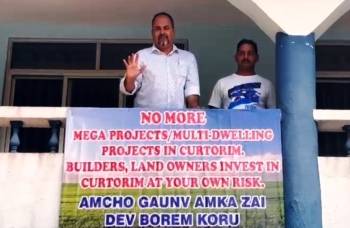
Curtorim protests housing project
Curtorim is witnessing mounting unrest over a proposed housing-cum-commercial development at Maina comprising 26 residential flats and 16 commercial shops. Residents allege that the scale and nature of the project threaten the agrarian character of the area and could place additional pressure on local infrastructure and water resources.
The sustained agitation has prompted the local panchayat to issue a stop-work notice, temporarily halting construction. Villagers are scheduled to meet on Sunday to chart their future course, with organisers saying their aim is to ensure that large housing projects are not permitted in the village.
The protest has drawn strong backing from the farming community, underscoring wider concerns over rapid real estate expansion in Salcete’s agrarian villages.