SANGUEM
The proposed bandhara project across the Zuari River at Mirabag-Sanvordem has triggered a prolonged grassroots agitation in South Goa, underscoring the growing tension between infrastructure planning and local ecological and livelihood concerns in Goa’s hinterland.
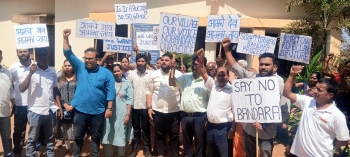
Alleging that the project threatens their homes, fields, the village temple and way of life, the agitation entered its 19th day on Saturday. The project, estimated to cost around Rs 280 crore, has been conceptualised by the Water Resources Department (WRD) as a bandhara across the Zuari River to store water for irrigation and drinking purposes for onward supply to nearby villages.
Water security versus ecological fears
Locals of Mirabag have accused authorities of starting preliminary works and surveys without proper consultation, transparency or detailed explanation of the environmental and social impact. They expressed fears that the proposed bandhara would lead to submerging of houses, coconut groves and fertile agricultural land, besides causing saline water intrusion and disturbing the river’s natural flow.
They claimed that the adverse impact of the project would be felt not only by villagers at Mirabag but would also cause substantial damage to livelihoods and houses at Mugoli ward of Uguem Panchayat in Sanguem and some parts of Curchorem alongside the Zuari River.
According to villagers, the WRD had first proposed a project to build a bandhara at Mugoli in Sanguem about 10 years ago. At that time, villagers strongly opposed the construction and the project was eventually cancelled.
The project was then proposed at Mirabag, and the local panchayat reportedly issued a No-Objection Certificate. However, villagers later alleged that the NOC was granted without fully informing the affected population about the implications of the project.
Public opposition gathered momentum through village meetings and gram sabhas, where strong resolutions were passed against the construction. Under mounting pressure from the community, the original proposal at Mirabag and the NOC issued by the panchayat were withdrawn.
Soon after, reports surfaced that excavation activity had begun at a different location ” Falnem ” within the same Sanvordem panchayat jurisdiction. Villagers viewed this as an attempt to relocate the project rather than cancel it altogether. Fresh fears emerged that the new site would also result in flooding of nearby wards and agricultural fields.
Residents from Mirabag and surrounding areas united once again, staging protests and demanding clarity. The panchayat reportedly issued stop-work notices at the shifted site as well, and gram sabha resolutions were passed opposing the project at both Mirabag and Falnem. Faced with renewed resistance, the shifted proposal too was stalled.
Renewed agitation
Earlier this year, the issue resurfaced when the project appeared to be revived at the original Mirabag site, this time reportedly with plans that included a 50 MLD raw water pumping station. This triggered immediate and intensified protests. Residents launched a continuous sit-in agitation, with participation from men, women, youth and elderly residents. The movement expanded beyond Mirabag, drawing support from neighbouring villages such as Curchorem and Sanguem, transforming into what organisers described as a wider people’s movement.
A major concern was the presence of deep excavated pits at the Mirabag site, which villagers claimed posed safety risks. Under pressure, the WRD reportedly assured that these pits would be filled in March.
Despite this assurance, villagers have maintained that their core demand remains unchanged ” that the Mirabag bandhara project be permanently scrapped.
The repeated attempts to start the construction have deepened mistrust and strengthened the protesters' resolve to get the project formally cancelled.