TEAM AUTO | THE GOAN
Artificial intelligence is being presented as the next big revolution in automobiles. It can already recognise objects, read road signs, monitor drivers, assist with parking and make navigation smarter. The next generation of cars will only push these capabilities further.
But in India, some of the most useful applications of AI may have little to do with making cars drive themselves.
They could instead be about making cars stop their drivers from doing things they shouldn't.
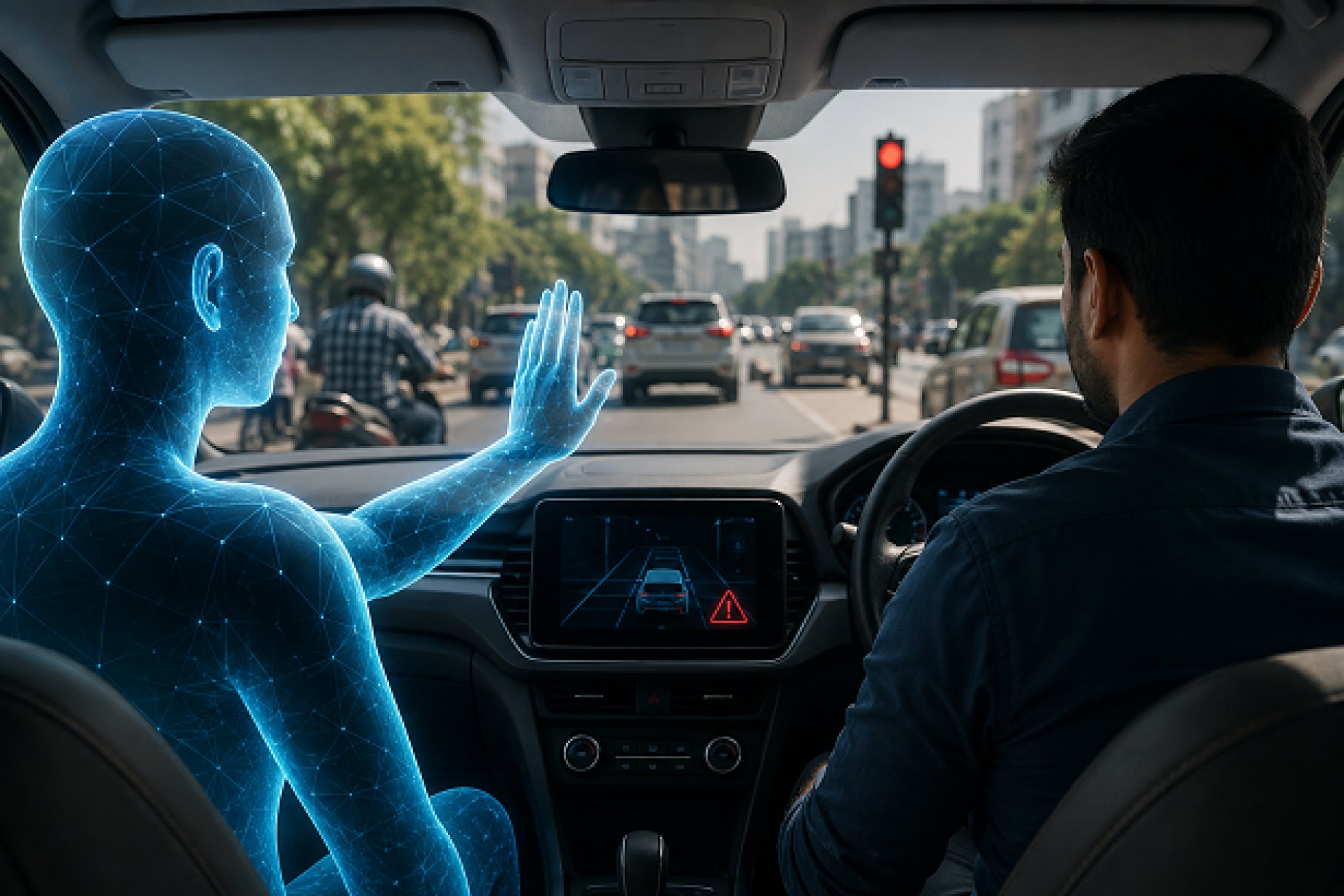
With road discipline often depending on individual judgement — and that judgement not always being particularly reliable — AI could become the electronic enforcement mechanism sitting quietly inside every car.
High beams need an AI referee
Few things are more frustrating than an approaching vehicle with its high beam permanently switched on.
Whether the driver has forgotten to dip it or simply doesn't think about the person coming towards them, the result is the same: temporary blindness for everyone travelling in the opposite direction.
AI could solve much of this. Cameras and sensors can identify oncoming vehicles and automatically switch between high and low beams.
If the driver insists on keeping the high beam on when it is unnecessary, the car should simply override the command.
A car capable of recognising pedestrians, cyclists and vehicles should certainly be capable of recognising when its headlights are being antisocial.
Indicators should not depend on memory
Lane changes and turns without indicators are another familiar sight on Indian roads.
A vehicle suddenly moves across a lane, and the indicator either comes on halfway through the manoeuvre or not at all.
AI could make signalling automatic. By combining steering input, lane markings, vehicle position and navigation information, the car could determine when a turn or lane change is taking place and activate the appropriate indicator immediately.
The driver would still steer the vehicle. The AI would simply ensure that other road users aren't forced to guess what the driver intends to do.
Speed limits should become actual limits
Modern cars can read speed-limit signs. Navigation systems can identify roads and, increasingly, their restrictions.
So why should the speed displayed on a sign remain merely a suggestion?
AI could determine the applicable speed limit and control the vehicle's maximum speed accordingly. If a road has a 120 km/h limit, the car should not allow it to be driven at 150 km/h. If the limit falls to 80 km/h, the maximum should fall with it.
The driver would still decide whether to travel at 50, 60 or 70.
AI would simply establish the ceiling.
That is an important distinction: driver assistance doesn't have to mean driver freedom without limits.
The horn needs some adult supervision
Few pieces of automotive equipment get as much use in India as the horn.
A quick warning is perfectly legitimate. But repeatedly leaning on the horn in stationary traffic, outside hospitals or because the vehicle ahead hasn't moved quickly enough is hardly productive.
AI could monitor the duration and frequency of horn use and restrict excessive use in appropriate situations.
The technology already exists to identify locations and traffic conditions. The next step could be using that information to distinguish between a necessary warning and simply making noise.
The horn would remain available.
It would just have to earn the right to be used continuously.
Red means the car stays put
Traffic lights are another area where AI could move from assistance to enforcement.
A vehicle equipped with cameras can recognise traffic signals. Once the car is stationary at a red light, AI could ensure that it does not creep forward or cross the stop line until the signal permits movement.
The technology could also work alongside existing start-stop systems, switching off the engine while the car waits and restarting it when movement is permitted.
There would be no ambiguity and, importantly, no temptation to treat the final few seconds of a red light as an opportunity to squeeze through.
Red means stop.
The car should make sure it does.
Seatbelts should be non-negotiable
Most modern cars already warn occupants when seatbelts aren't fastened. But the warning can eventually become background noise.
AI could take the next step.
If the system detects an occupied seat without a fastened seatbelt, the car should not move.
There would obviously need to be sensible exceptions for specific circumstances, but the basic principle is simple: no seatbelt, no movement.
If the car knows someone is sitting there and knows the belt isn't fastened, there is little reason to leave the final decision entirely to the driver.
Overloaded cars should stay parked
Overloading is another behaviour that technology could address.
AI could use information from the vehicle's weight sensors, occupancy detection and permitted payload to determine whether a car is carrying more than it safely should.
If the vehicle is significantly overloaded, it could refuse to move until the excess weight is removed.
This could be particularly useful for vehicles being loaded with passengers and luggage far beyond what they were designed to carry.
If a car knows it is overloaded, allowing it to drive anyway makes little sense.
Expired documents should matter
Connected cars could also become useful compliance tools.
Owners could update insurance and PUC details directly through the vehicle's system, with the information ideally verified against authorised databases.
The car could issue warnings well before expiry. If mandatory documentation actually expires, the system could potentially restrict driving on public roads, subject to the law and appropriate exceptions.
The important part is that the car wouldn't merely remind the owner.
It would make ignoring the reminder considerably harder.
AI as responsible passenger
The most interesting future for automotive AI in India may therefore not be autonomous driving at all.
It could be responsible driving enforcement.
AI could ensure that high beams are dipped, indicators are used, speed limits are respected, red lights are obeyed, seatbelts are fastened and overloaded vehicles stay put.
It could even tackle some of the smaller behaviours that collectively make Indian roads more chaotic than they need to be.
The idea is not to take control away from responsible drivers.
It is to prevent irresponsible decisions from becoming dangerous consequences.
Cars are already becoming intelligent enough to understand their surroundings. The next logical step is for them to understand when their drivers are about to do something that should not be allowed.
The smartest car on Indian roads may therefore not be the one that drives itself.
It may be the one that occasionally tells its driver:
No. You're not doing that.