TEAM AUTO | THE GOAN
There is nothing wrong with wanting your car to stand out. For some owners, a car is more than a means of getting from one place to another; it is an expression of personality, taste and, sometimes, a lifelong passion. A fresh paint job, a tasteful set of alloy wheels or a well-designed body kit can give a vehicle a distinctive character. But somewhere between personalisation and excess, things can take a rather unfortunate turn.
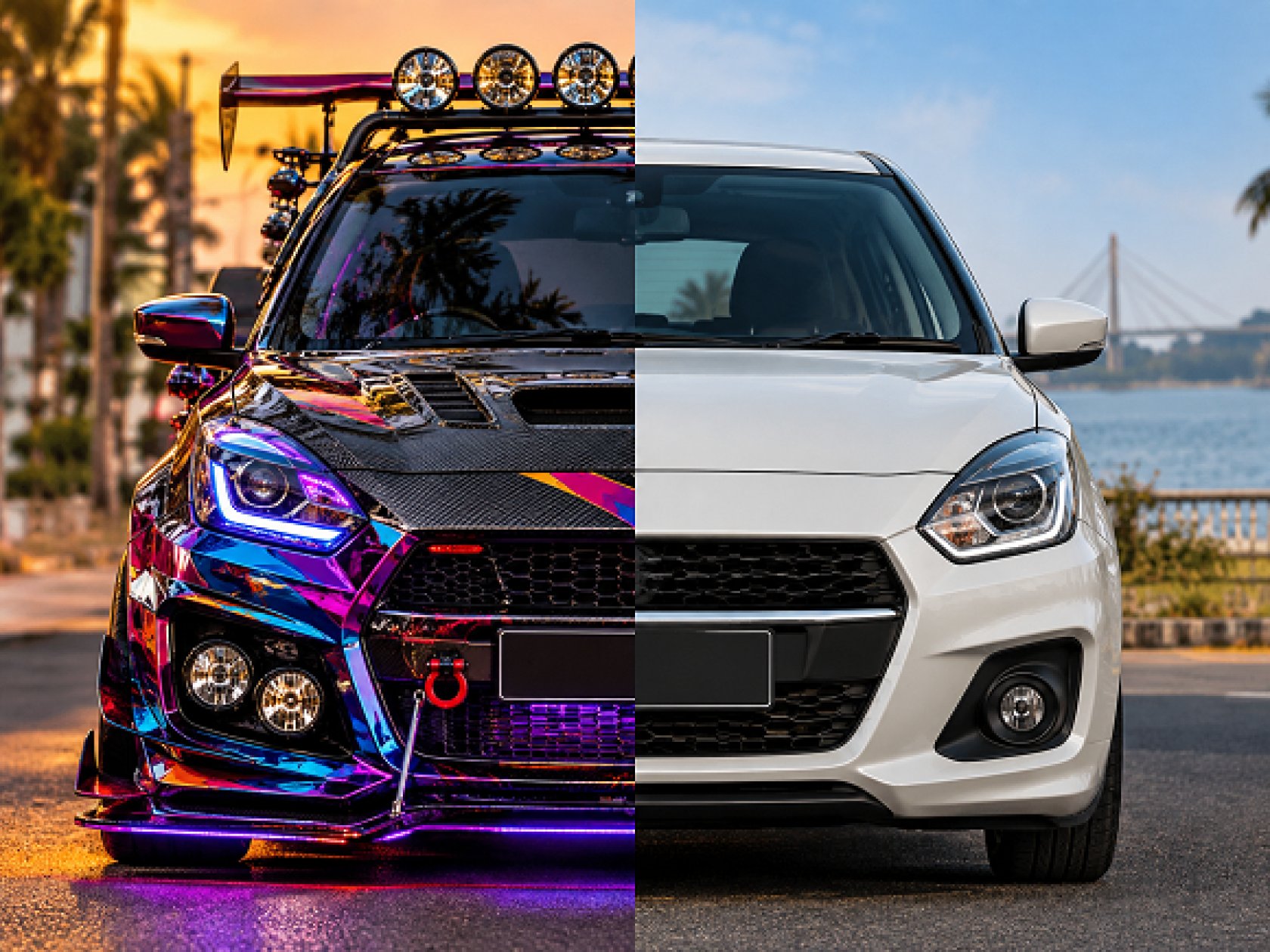
We have all seen cars that seem to demand attention from every passer-by. Oversized spoilers, blinding auxiliary lights, impossibly loud exhausts, garish stickers and enough aftermarket accessories to fill a shop window can transform an otherwise attractive vehicle into something that looks as though it has been assembled without a second thought. The question is not whether cars should be customised, but whether every modification actually makes them better.
The problem begins when the modification becomes more important than the car itself.
Too Much
Car customisation has a long history. Enthusiasts modify vehicles to improve performance, enhance handling, personalise their appearance or recreate a particular style. There is skill and creativity involved in doing it well. A carefully restored classic car or a thoughtfully modified performance vehicle can be a genuine work of art.
However, not every modification is an improvement. An oversized spoiler fitted to a modest hatchback may add little practical value. Loud exhausts can turn an otherwise ordinary drive into an unwelcome public announcement. Excessive exterior lighting may make a vehicle look dramatic in photographs but can become a hazard if it dazzles other road users. Stickers, chrome accessories and contrasting colours can also overwhelm the original design when used without restraint.
It is tempting to assume that a more heavily modified car must be more impressive. In reality, good design often depends on knowing when to stop. The best modifications complement the vehicle's proportions and character instead of competing with them. After all, a car that looks good in a photograph does not necessarily look good on the road.
Social Media
Social media has changed how people display their cars. Custom builds, dramatic wraps, elaborate lighting and unusual modifications can attract views, comments and followers. For some owners, the vehicle becomes a mobile content-creation project, designed as much for the camera as for the driver.
There is nothing inherently wrong with this. Automotive creativity deserves an audience, and online communities have helped enthusiasts exchange ideas, learn new skills and discover specialist workshops. The difficulty arises when the desire to stand out becomes an endless competition.
One modification leads to another. A new set of wheels calls for lowered suspension. That is followed by a body kit, a louder exhaust and a more conspicuous paint scheme. Before long, the original objective of improving the car is lost in the pursuit of making it more noticeable than the next one.
The result can be a vehicle that attracts attention without necessarily earning admiration. Of course, taste is subjective. What one person considers stylish, another may find excessive. The argument should not be about enforcing one universal standard of automotive beauty, but about asking whether a modification serves a purpose, suits the vehicle and respects everyone else who uses the road.
Public Roads
There is a more serious side to excessive customisation. A car is not merely a personal possession once it enters public roads. Its owner shares space with pedestrians, cyclists, motorcyclists and other motorists, all of whom have a legitimate expectation of safety and consideration.
A noisy exhaust may thrill its owner, but it can disturb an entire neighbourhood. Improperly installed lights can distract or dazzle oncoming drivers. Extreme changes to suspension, tyres or bodywork may affect a vehicle's handling, depending on how the work is carried out. Modifications that compromise safety are not simply matters of taste.
India's Motor Vehicles Act, 1988, places restrictions on alterations to vehicles, particularly changes that make their specifications differ from those originally prescribed by the manufacturer. Certain modifications may therefore attract legal consequences, while others must comply with applicable standards and requirements. Owners should check the rules before spending money on substantial alterations.
In August 2026, a car owner in Gwalior reportedly received a ₹5,500 fine after his Maruti Suzuki Swift was covered in more than 3,400 lipstick marks. The unusual incident illustrated how an attempt to make a car stand out can attract unwanted attention from the authorities. The circumstances were extraordinary, but the broader lesson is relevant to anyone considering an unconventional modification: personal expression does not place a vehicle beyond the rules.
Style Matters
None of this means that every car should look exactly as it left the factory. That would take much of the fun out of car culture. Customisation allows owners to give older vehicles a new lease of life, improve comfort, upgrade technology and create something that reflects their personality.
A subtle colour change, well-chosen wheels, quality upholstery or a properly executed restoration can make a considerable difference. Performance modifications, too, have their place when they are professionally installed, appropriate for the vehicle and compliant with the law.
The secret is to distinguish between improving a car and merely adding things to it. Before installing an accessory, owners could ask themselves three simple questions: Does it serve a purpose? Does it improve the vehicle's appearance or function? And does it remain safe and legal for road use?
If the answer to all three is yes, the modification probably deserves consideration. If the only justification is that it will make people stare, perhaps it is worth thinking again.
Know Limits
The automobile industry itself spends considerable time and money developing the proportions, aerodynamics, lighting and overall appearance of a vehicle. Designers work to ensure that the different elements complement one another. While factory designs are not beyond criticism, modifications made without considering the vehicle as a whole can upset that balance.
This does not mean owners must follow manufacturers' choices unquestioningly. Rather, it highlights the value of understanding what is being changed and why. A modification should ideally enhance the original design, not simply cover it up.
There is also the question of cost. Money spent on unnecessary accessories could instead go towards quality tyres, regular servicing, safety equipment or other improvements that offer tangible benefits. A vehicle that looks spectacular but is poorly maintained has its priorities backwards.
Final Word
Ultimately, a well-customised car should reflect its owner's taste without becoming an inconvenience to everyone else. It should look considered rather than cluttered, sound purposeful rather than obnoxious, and offer genuine improvements rather than empty spectacle.
There will always be differences in opinion about what makes a car beautiful. Some people prefer a factory-fresh finish, others love modified hatchbacks, and some will happily spend months creating a one-of-a-kind machine. All have a place in a healthy enthusiast culture.
But there is a difference between turning heads and turning stomachs, between making a statement and making a nuisance of oneself.
The best modification is not necessarily the most expensive, the loudest or the most outrageous. Sometimes, it is the one that makes people look at a car and think, “That looks fantastic,” without needing to ask what on earth the owner was thinking.
Because when it comes to car customisation, as with most things in life, a little restraint can go a very long way.