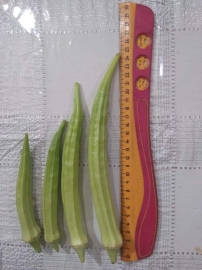
The choice ladyfingers for the Goans are the local “ ‘Saat Shirancho Bhendo’. The Geographical Indications Cell of the Goa State Department of Science, Technology & Environment has researched, processed, applied and obtained from the central registry, Chennai, a GI registration in favour of Goa for this variety of ladyfingers. It can officially be called SXB only if it is cultivated in Goa. Otherwise, it is just any other ladyfinger (Bhendi).
Brinjals are traditionally grown organically in Goa. The farmers are increasingly aware that one spray to wet the plant with Beauvaria bassiana suspension is sufficient to control the insect pests. To control soil-borne fungi that cause these plants to suddenly die at flowering time, Trichoderma viride, that is available in Goa in both liquid and powder forms, can be applied with the compost at transplanting.
Geographical Indication (GI) is to identify products that come from a region or a locality and, consequently, have distinctive characteristics. The quality, reputation or other characteristics of a commodity or product is attributed to its place of origin. GI registration is granted to a product if the product has a ‘link’ with the region or locality, which provides the uniqueness to the product as recognised by the World Trade Organisation (WTO). It is a community right and all the producers within the specified region can obtain benefits of the GI rights.
Unfortunately, SXB is very susceptible to the Bhendi Yellow Vein Mosaic Disease or BYVMD. The work that Sheila Kumar (later Tiwari) had begun at Ela Farm in the 1990s to do selection of seed from plants that did not show the BYVMD needs to be revived by the Goa College of Agriculture, which is now established on that same land. An inter-disciplinary approach is possible as there is a virologist as principal and there is faculty in plant genetics and breeding, entomology, pathology and soil science available in-house. The Directorate of Agriculture also has in its ranks a former assistant professor with post-graduate degree in seed technology as also a NET-passed post graduate in plant pathology. The ICAR-CCARI, also located nearby in Ela, can also help in resistance breeding.
Conventional breeding techniques of selection and hybridisation were found inadequate to meet the requirement for pest and disease tolerance as well as a long shelf life for vegetables and genetic engineering was attempted in the 1980s. A company named Calgene based in California-USA developed the first genetically modified or GM food in the world. This GM tomato was named as ‘Flavr Savr’. Calgene was able to slow down the post-harvest ripening and thus prevent it from softening during transport, while still allowing the tomato to retain its natural colour and flavour.
As in the case of Covid vaccine for emergency use, the US-FDA declared in 1994 that the tomato ‘is as safe as tomatoes bred by conventional means’ even though it contained two proprietary genes, one of which inhibited rotting. The other gene created resistance to commonly used antibiotics like neomycin. The so-called Covid ‘vaccine’ is now being reported to cause some unfortunate deaths. These deaths are statistically insignificant as data but disastrous to the families that lose a loved one in the prime of her or his life.
Unfortunately for us, Monsanto bought its technology for transfer of genes of animals, insects and microorganisms to plant materials and developed it further to produce Bt cotton, brinjal and other crops. Except for Bt cotton, it is illegal to grow any other GMO crop commercially in India. However, India is not famous for enforcement of laws. Use of a plant hormone Paclobutrazol (with brand names like Cultar, Hoard, etc), developed for chemical pruning of roadside ornamental trees, is prohibited for use in fruit crops. Yet, it is routinely used by mango growers in coastal Maharashtra and even the coastal agriculture university still has it in the course curriculum and teaches it to the undergraduate students, even now.
There are other ramifications of the GM technology, too. The Covid ‘vaccine’ was one of them. Genetically modified variant of Agacaim brinjal known as ‘event’ GO-112 of Bt Brinjal was tested by the University of Agricultural Sciences, Dharwar, at the KVK-South Goa of the Directorate of Agriculture in 2008-10. Brinjal is a cross-pollinated crop and the pollen may have spread the proprietary Bt gene to other brinjal plants in Goa. No one even knows if some of the staff members had taken a few plants for their kitchen garden or given to friends. We may be eating GM vegetables even without knowing it. Incidentally, Agacaim brinjal has a GI tag for Goa since July, 2023. We have to be careful to breed resistance in SXB ladyfingers by conventional methods as done for other varieties. This will help us to keep our traditional food free of GM as has been successfully done by Dr KK Manohara for Korgut rice.
(The writer, former Agricultural Officer and a mentor to the GenNext organic farmers, is committed to nurturing young talent for a food-secure future)