


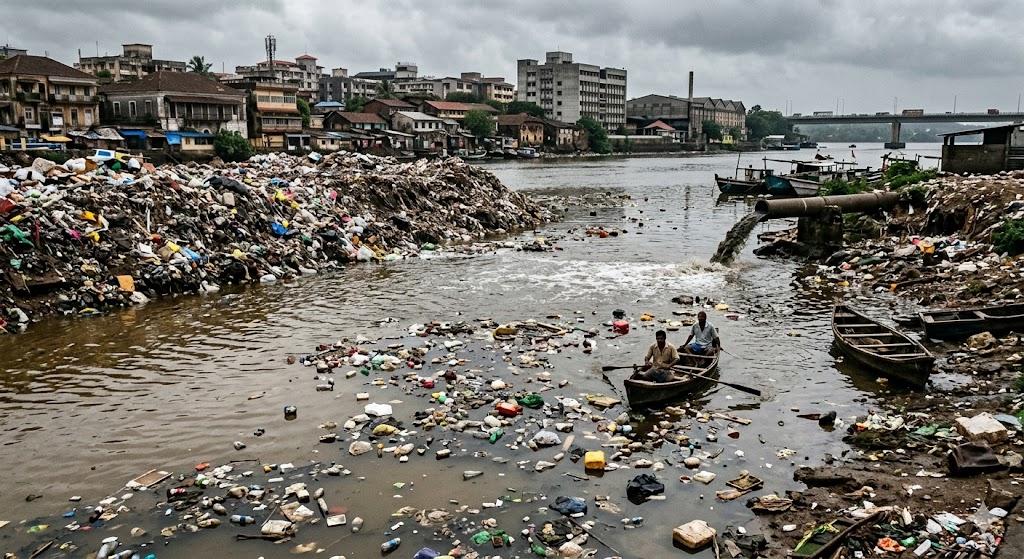
Every year, as summer tightens its grip and our rivers and water bodies shrink under the heat, the system goes into hurried inspections and bureaucratic blame games. The failure of civic infrastructure lies exposed time and again. Then, when the monsoon finally arrives, the administration seems content to let nature do the work it has neglected all year. That truth was recently laid bare by Water Resources Department Minister Subhash Shirodkar, who remarked that the four monsoon months naturally “flush out accumulated dirt and pollutants” from our rivers. Relying on seasonal rainfall as a waste-management strategy is more than an example of poor governance; it is an admission of systemic failure.
The crises unfolding in South Goa’s River Sal and North Goa’s Mandovi River reveal just how deep that failure runs. In Margao, the government has announced plans to install four Sewage Treatment Plants along the banks of the Sal. On paper, the project shared between the WRD and the Public Works Department is projected to be a major intervention to intercept untreated wastewater before it enters the river. In reality, it risks becoming little more than an expensive bandage on a wound the system itself has created.
More than half a dozen stormwater nullahs run continuously through Margao, carrying dark, foul-smelling wastewater instead of rainwater. What were designed as natural drainage channels have effectively become open sewers. Their heavy flow during the peak summer months exposes the grim reality of Margao’s underground sewerage network. Built over decades at a cost of crores of rupees, it has failed to achieve its most basic objective to this day.
By placing STPs at the points where these nullahs meet the river, authorities are treating the symptom rather than addressing the disease. Such measures may reduce pollution at the final discharge point, but they leave the underlying problem untouched. Worse still, they do nothing to prevent the ongoing contamination of groundwater resources upstream, where untreated sewage continues to seep into the environment long before it reaches the river.
If Margao illustrates a failure of planning, Panaji exposes a failure of enforcement. The High Court of Bombay at Goa recently expanded a suo motu public interest litigation that began with the mass death of fish in Mala Lake to encompass the wider Mandovi river system. The Goa State Pollution Control Board detected high levels of faecal coliform bacteria in parts of the river, particularly around areas where offshore casinos operate.
The River Mandovi forms the centrepiece of the capital city, yet it is being treated like a septic tank. While the Corporation of the City of Panaji, under judicial scrutiny, rushes to connect a handful of homes to the sewer network, larger questions remain unanswered. The substantial volumes of waste generated by casino vessels and commercial tourism boats require rigorous, transparent, and continuous monitoring. Instead, it has taken a court order for the GSPCB to produce even an interim assessment of water quality within a prescribed deadline.
When courts are forced to oversee sewage connections for individual households and dictate schedules for water testing, it is a clear sign that environmental governance has broken down. Regulatory agencies such as the GSPCB, the PWD, and local bodies have become reactive, acting only after judicial interventions while ignoring their bounden duties otherwise.
Goa’s rivers and water bodies cannot survive on temporary fixes. The state does not need more downstream treatment plants to conceal the shortcomings of urban planning, nor should it depend on the monsoon to cleanse pollution that should never have entered its waterways in the first place. What Goa needs is a determined, time-bound programme to connect every urban property to a functional sewerage network, backed by strict enforcement and realistic penalties for commercial polluters.




