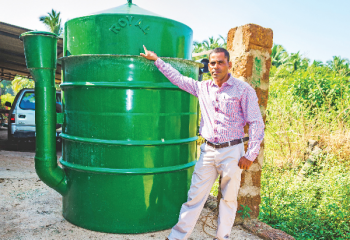
A few kilometres from Panzorconi in Cuncoliem, the road diverges - one leading towards nature and the other towards the industrial estate. As one takes the narrow road to the unmanned area at the foothills of the mountains in serene Veroda, here under the sky stands his open-air unit ‘Royal Ecolyf', sharing a part of a shed belonging to a kind friend.
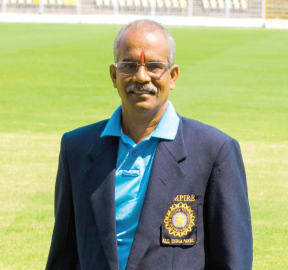
"I want to avoid industrial pollution and hence this is the perfect location to run my manufacturing unit as the source of the feed, dung, is ample here," reasons Subodh Kumar D'Souza, the first person in Goa to have initiated the manufacturing of fibre portable biogas plants that can be installed on the rooftops, backyards at ground level or underground, as one may place them, depending upon the suitability and usage. The biogas plants can be used in households for domestic purpose as well as commercial purpose. Adopting an organic way of life, the farmers, dairy farmers, hotels, canteens, schools, churches, hospitals, NGOs and government bodies can also use biogas plants to save fuel, energy, electricity and LPG.
A hard core social worker who has combed the remote agricultural villages in South Goa, working closely with the locals and aiding them to avail various central government and state government projects, Subodh is a known name in Netravali, Kajor, Sulcorna, Nune, Padi, Gokulde, Quepem, Quisconde - all in South Goa. "Working with Don Bosco Society and Fr George Quadros for a decade has taught me so much. I want to dedicate my life to uplift the rural community," says Subodh, pointing out that despite much hue and cry about the non-availability and the rising prices of LPG cylinders, very little is done on individual level to replace their requirement.
"Usage of freely available solar energy, smokeless Sarai cookers and installation of biogas plants producing cooking gas can be some of the substantial, eco-friendly and organic replacements for LPG and wood fuel in the rural areas," feels Subodh who, after supplying readymade biogas units to the locals in these villages for the past five-six years, now has started manufacturing of biogas plant.
To kick start the plan, cattle dung is required, states Subodh. "Initially cattle dung is fed into these biogas plants as it is rich in a type of bacteria which helps in producing methane from cellulosic material. Later on the biogas plant can be fed with kitchen wet waste, leaves, fish bones and rotten food. While installing the unit, we supply cow dung to those who don't have access to it," explains Subodh, adding, "Later on kitchen waste, starch rich biomass and non-edible oil seeds can also be added to produce organic biogas."
What else can be used in a biogas plant? "Leftover food, kitchen waste, flour, curd, milk, vegetable peels, rotten vegetables, waste leaves, spinach, waste coconut, all type of fruit waste, fish, meat, prawn waste, fish bones, flowers, cut pieces of water hyacinth, rice cleaned water," shares Subodh. He is prompt to add that one must know what should be avoided too. "Lemon, lemon parts, upper peel of onion and garlic, all types of shells (groundnut, coconut, egg, crab), fresh tamarind, bones, acids, chemicals and soap water, plastic, paper, glass, rubber, drumstick, cloth, flower garlands etc are strictly not to be put in the biogas plant," he adds.
The portable biogas plants that Subodh makes are available in various sizes from 1 cubic metre to 10 cubic metres and can be easily installed anywhere. "Our maintenance free products, when installed in the sunlight, yield more gas," he says. Made of fibre reinforced plastic, this pollution-free, environment friendly unit reduces carbon emission and has life span of minimum 10 years. They help in converting wet kitchen waste into cooking gas, and thus keep the surroundings clean. The bio-slurry generated in this plant is utilised as liquid fertiliser. The cooking gas produced saves up to 10 LPG cylinders per annum. There is no danger of fire or explosion as in LPG.
Explaining the process Subodh says, "A minimum one kilo and maximum five kilos of waste is required per day while the water required is minimum two litres and maximum 10 litres per day. The plant that has four ft height and four ft diameter offers 2.5 to 4 cooking hours per day which is equal to 0.5 kg gas per day equal to LPG. We also supply a single burner stove that is specially designed."
All the waste is then converted into gaseous fuel called biogas which is produced by the biological breakdown of organic matter in the absence of oxygen.
"Biogas is produced by the anaerobic fermentation of biodegradable materials such as cow dung, kitchen waste, biomass materials and human waste. It comprises of primarily methane and carbon dioxide and may have small amounts of nitrogen, hydrogen, hydrogen sulphide, moisture and siloxanes," elaborates Subodh who has been living in Goa since 1998 and having fallen in love with its nature and people, has now made it his second home. "I wish to study the working model of dry waste too and in future venture into making it," reveals Subodh who is thankful for having worked in close co-ordination with his mentor Fr George who has remained a source of inspiration for him for life.