


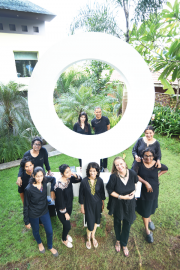
She' is an expression. It's the narration of unspoken stories in diverse mediums of art that easily engages the viewers. And it was a compulsive urge to express themselves through ink and paper, paint and ceramics, sounds and visuals that led eight Goa based artists- ceramicist and sculptor Verodina De Souza, textile painter Liesl Cotta de Souza, installation and video artist Katharina Kakar, acrylic painter Shilpa Nasnolkar, charcoal and graphite artist Fernanda de Melo, water-colourists and mixed-media-artists Chaitali Morajkar, Kausalya Gadekar and Soumitrimayee Paital to conceptualise the evergreen concept of ‘She'.
For Shipa Nasnolkar, ‘She' is a celebration. "She in my painting is a carefree soul, independent and happy in her own skin. Agitated, strong and unassuming, she depicts the carefree moment she lives in. She is the creator, the bound power unleashed," she says.
Katharina Kakar on the other hand takes ‘She' as an opportunity to engage with other Goan artists and bring together works from different perceptions. She asserts, "The role of the female and her place in society is often central to my work. I work in a variety of media: drawings, installations, text and videos, which you can also see in this exhibition. There is a video depicting the idea of feminine energy in words, there are two installations that tackle the idea in an abstract manner, but you can also see a few ink drawings."
"My artworks are the outcome of my quest to unfold the myths and taboos associated with menstruation prevalent in Indian society, which affects the life a woman," admits Kausalya Gadekar whose favourite painting of the series is the ‘Impure Couch' done in water colour and pencil on paper. Pointing out that in our country, a menstruating woman is still considered to be impure and she is subject to many restrictions in her daily life, Kausalya cites examples - ‘She' is not allowed to enter into the pooja room to offer prayers and made to stay in isolation and is prohibited from touching other members and things in the house. So much so that she is even prohibited from sitting on a couch, for the fear of turning everything impure.
With charcoal and graphite on paper Fernanda de Melo pays tribute to the force of maternal energy. Her painting ‘Mother' depicts a mother carrying in her arms her child with special needs. Fernanda's ‘She' is all in admiration for her child in spite of the condition. It expresses her love for her child - the unconditional love that transcends and persists regardless of circumstances. "In today's world where we abandon anything that is not of use to us, not suitable to us... each day, each moment ‘She' is fighting for the wellbeing and for the future of her child, against all odds, working overtime to care and see that her child is cared for. ‘She' is not prepared to give up, no matter what. This painting brings out the character of woman," elaborates Fernanda.
As an artist and a painter, the process of painting has helped Chaitali Morajkar to look within and know her own self better. Chaitali's ‘She' has a quality of being special in a mysterious but attractive way. The protagonists in her works have always been women, or subjects or issues pertaining to a woman. "While my subject and style has changed over the years, compared to the past, I now approach the work with more conceived idea. Subjects like gender or identity issues or relationships are addressed naturally," says Chaitali whose paintings are peppered with motifs of fish, steps, rooster, architectural structures, wings, patterns or designs. Sometimes they are symbolised as per the painting or the subject demanded. The stylised surrealistic style of layering and forming the image helps to convey the mysterious power of the subject ‘She', says Chaitali whose works talk about celebrating the female power - power to rise above the regular jobs and reach infinity, power to balance, absorb the negative and create positive.
Textile painter Liesl Cotta De Souza however, employs the traditional female occupation of embroidery to painstakingly create female characters, relaxed in their latent sensuality. Liesl stitches as if she is drawing creating the pictorial surface by stitching with thread on fabric. Building up vast areas of the work with laborious stitches, the repetitive act reinforces the strength of these cherished feminine beings indulging in their enjoyment. Nature becomes an organic force replete with sexual, spiritual and feminine symbolism.
Soumitrimayee Paital had an entire series of names she was called as a child. The series of self-portraits internalise feelings of pain from external forces. Using thorns, sharp weapons, insects and ‘touch-me-not's, the artist embarks on a sensitive journey of self-discovery. As for Verodina De Souza , the ceramic artist explores universal truths - of resilience and malleability - both of her material as well as her subject.
"Women are often represented in art as objects of male desire, as saleable commodities or as merely decorative," says the curator, Samira Sheth. "These eight artists reclaim power in ‘She' as they both create and control the way their female figures are represented, free of the male gaze. They speak with intention and agency in authentic voices."
As Samira puts it, ‘She' has multiple identities. "We are as others see us. But it is necessary, even vital to show others


