Covid-19 raises crucial questions about how best to move forward from the pandemic and its many effects. We are reassessing key political and economic assumptions and perceptions of what is possible and desirable.
Basic income guarantees, public child care, loan forgiveness and other programs are laudably being considered as we recognize the fragility and interconnectedness of our socioeconomic web, and grapple with how to prevent future harm.
We also need to take animals seriously. Our families, communities and society include animals. There are inspiring, mutually beneficial and even life-saving ways we engage with other animals. But animal suffering not only harms other species, it endangers our own. This is a significant ethical and moral matter. It is also fundamental to the future of our economic, environmental and physical health.
This is not about vegans versus omnivores, or pitting cities against rural cultures. This is about humans and the future of life on Earth.
Consumption of animals
Science tells us that whether the next lethal pathogens are viral or bacterial, people will likely get them from consuming animals. And the scary truth is that we are exacerbating both threats.
There are millions of viruses inside animals that humans never encounter ” until people touch and consume those animals. We do not have vaccines for virtually any of these viruses.
Antibiotic resistance and strengthened bacterial infections are also significant challenges. A major reason is that overcrowded factory-farmed animals are given antibiotics when they’re not sick. Industrial animal agriculture in our own backyard could very well be the cause of the next pandemic.
What do we do about these chilling realities? We have to start taking animals’ presence and well-being seriously. There are many important policies and paths worth considering; three are particularly salient.
Stop exotic animal trade
First, we need to curb the trade in exotic animals.
Millions of animals, from snakes to turtles and monkeys, are taken from the wild and shipped across borders for pet ownership, entertainment, consumption and research.
Much of this is currently legal, despite the risks of zoonotic (animal to human) virus transmission. The stakes are too high and the health landscape too fraught for this to continue.
It’s never been good for the animals, and it’s not safe for us. More robust national restrictions are needed, along with enforcement.
Industrial agriculture
Similarly, we must confront the dangers of industrial animal agriculture head on.
The industrialization and corporatization of animal agriculture hasn’t helped our health or our rural communities. The number of farms continues to plummet as family farms are replaced by large, highly automated corporate facilities that often trap and overcrowd animals in cauldrons of disease.
Statistics Canada reports that there are now only 193,492 farms in this country. In 1996, there were close to 300,000.
As author Jonathan Safran Foer and food academic Aaron S. Gross put it, the intensive confinement of chickens in particular is the Silicon Valley of dangerous viral development and mutation. Nearly 800 million chickens were killed in Canada last year.
And it has become unequivocally clear in recent weeks that contemporary slaughterhouses are dangerous for workers, in addition to being fatal horror shows for animals.
It’s time for bolder public policy that cultivates more sustainable agriculture, plant-based foods and drinks, and lab-grown meat and milk. Canada has already proven to be fertile ground for innovative product development and plant-based proteins. In fact, producers of pulse crops (lentils, chick peas) are thriving, not seeking public handouts.
We need a thoughtful transition to more sustainable and safer forms of food production that create good, humane and sustainable jobs. This will involve the private sector, but public and labour leadership and investment are also urgently needed.
Although its infection-transmission risks are significantly lower, plant-based agriculture still needs to be approached sensibly. And migrant workers, who make so much fruit and vegetable cultivation possible, deserve basic labour rights, safety, proper housing and personal protective equipment at the absolute minimum.
One Health
Third, we should embrace the concept of One Health ” the recognition that human, animal and environmental health are inextricably connected. The idea of One Health should figure in our personal consumption choices as well as our political decisions.
In education, health, law enforcement, food, care and every other sector, One Health should be at the heart of thoughtful, responsive and pro-active policy-making and practice.
Similarly, there are clear opportunities to learn from Indigenous perspectives on integrated well-being.
The animals deserve better, and so does our species. A simple return to the status quo is not only unjust, it is dangerous.
Other animal welfare issues
Cruelty to animals: Intentionally causing unnecessary harm to animals is considered animal cruelty. Whether killing for entertainment (blood sport) or hitting or kicking animals on farms, these acts of violence are deemed to cause unnecessary or unjustifiable suffering. Since these types of violence clearly violate welfare standards, they are considered cruelty.
Poaching: Poaching is a form of hunting where an animal is taken illegally from the wild. The animal themselves may belong to a protected, or endangered, species, or the habitat the animal resides in can be protected. Either way, poaching greatly impacts the welfare of targeted animals since it removes them from their natural habitat, or outright takes their lives. Pangolins are among the most-trafficked animals in the world. Elephants and rhinoceros are frequently poached for their ivory.
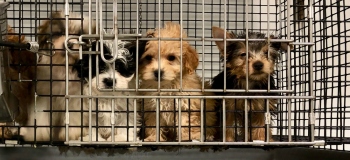
Puppy mills: What many people don’t realize about those adorable pet-store puppies is that they often begin their lives in heartbreaking conditions. In puppy mills, breeder dogs are kept in small cages for the duration of their lives, forced to produce generation after generation of puppies who are taken from them abruptly. Dogs in these cages do not get to run outside, enjoy the companionship of other dogs or humans, and sometimes live on wire-bottom cages for much of their lives.
Whaling: Whaling is a highly contentious issue for several reasons, among these being the long periods of time it takes for a whale to die. Modern-day whaling technology can include a harpoon tipped with what is essentially a grenade filled with shrapnel that is shot through a whales’ body upon impact. Still, at times it can take many minutes, and even many hours, for a whale to die. Humane slaughter methods are endorsed in many countries around the world, yet because of the logistical challenges of working at sea, coupled with the vast size of these animals, humane slaughters cannot always be guaranteed.