


The experience of eating out with friends looks very different these days, if it happens at all, due to social distancing measures.
Designer Marek GÅ‚ogowski, a recent graduate of Design Academy Eindhoven, wants to change the actual food you eat too.
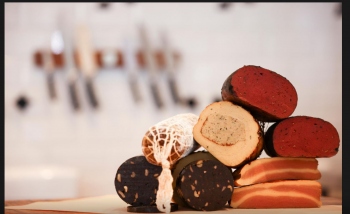
GÅ‚ogowski’s thesis project, Plurality Now, is a conceptual “metabolized restaurant” that challenges consumers to reconsider where the food they eat every day comes from. He does this by offering up new menu items: food derived from bacterial cultures and made solely through fermentation and molding techniques.
He also researched two other techniques that produced a kind of yellow flour, but he ended up nixing them for his dinner”they required lab equipment with a $1 million price tag.
It makes for an adventurous meal, even if it sounds a bit spartan: crunchy fermented crust, metabolized umami stew, cellular dumplings, and a sweet culture for dessert. But made with some less familiar ingredients, of course: T. pallidum, A. orzae, B. subtilis, and L. acidophilus, to name a few.
The big-picture goal: GÅ‚ogowski hopes the consumption of food derived from bacteria can introduce new food chains and shift people away from a reliance on industrial agriculture, a driving force behind climate change.
GÅ‚ogowski also wants people to think about how they can be “human bioreactors,” that is, environments for bacterial growth themselves, through their gut, and how the bacteria in their microbiome can affect the nutrients and calories they absorb from food.
GÅ‚ogowski’s vision is already underway, albeit with a narrower scope. There are probiotics such as yogurt; Activia has been around since 1987.
And more recently kombucha, a fermented tea, has become so popular it’s a cliché. The popularity of probiotics shows in the numbers, too:
The global probiotics market is expected to grow to $78.3 billion in 2026. (The market had a value of $47.1 billion in 2018.) Fermentation isn’t just a fad.
GÅ‚ogowski says the recipes he used for his dinner are pretty easy to replicate should you want to try some bio-based meals of your own.
He recommends the “Noma Guide to Fermentation,” by Danish chef Rene Redzepi, as a source for at-home recipes for miso, kombucha, vinegar, and more.
Plurality Now: The big-picture
GÅ‚ogowski hopes the consumption of food derived from bacteria can introduce new food chains and shift people away from a reliance on industrial agriculture, a driving force behind climate change


