the goan I network
PANAJI
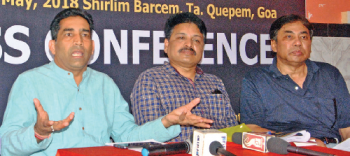
The Goencho Avaz and Goenkars Against PDA have rejected the announcement of the Town and Country Planning Minister Vijai Sardesai who announced that his decision to remove ten villages from the Greater Panaji PDA areas pointing to the fact that they had demanded that all PDAs be scrapped.
“We require a Gazetted notification. A gazetted notification that the PDAs are being removed together with the survey numbers,” leader of the movement Arturo D’Souza told reporters.
Rodolfo Fernandes, also a leader of the movement said that Vijai was trying to divide the people even as he accused Sardesai not really removing the Kadamba and Bambolim plateau from the PDAs.
“We read in the papers that he has removed the Kadamba plateau and all villages from the Greater Panaji PDA but he has retained two strips. These two strips are the Bambolim and Kadamba plateaus,” Fernandes said.
“We have demanded that all villages be removed from the PDAs. But here Calangute and Candolim have not been removed. He wants to try and see if some of us stop protesting once this is done,” Fernandes said.
On the issue of Regional Plan, Goencho Avaz said that they provided all evidence to the government at the meeting and the government can go ahead and act against these conversions.
“We showed the exact change of land use from agriculture to ‘settlement’ from orchard to ‘settlement,’ we showed survey numbers that is the proof. We showed form I & XIV that is the proof. And from where did we get it? We got it from the TCP Department. And he’s saying we want proof,” convener of Goencho Avaz Capt Viriato Fernandes said.
“When we met the Chief Town Planner we told him that you give access to our team of Goencho Avaz and few other NGOs we show you how to access the data and all the illegalities will be shown,” he said.
“This is nothing but an attempt but to shift the burden. We have been continuously saying that it is not only Vijai Sardesai which is involved in this whole process. But also the BJP and that is the reason why he has shifted the burden to the assembly,” Arturo D’Souza added.