MARGAO
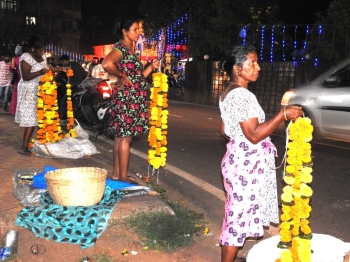
A bumper harvest and a readymade local market. Goan farmers must have hoped to encash on the huge demand for marigold flowers during the Dussehra festivities.
The presence of hordes of Karnataka-based traders, who came in droves with fleet of vehicles from across the border, however, came as a dampener as traders literally dumped tonnes of marigold flowers from the neighbouring state in the local market, adversely affecting the business of local farmers.
Taking cognizance of the ground reality, a sympathetic Agriculture Director Neville Alphonso remarked that dumping of flowers from the neighbouring State may cost the local farmers dearly in terms of business and revenue even as he mulled steps by the government to protect the local farmers from dumping.
The mathematics as well as the market forces of demand and supply seemed to have not worked in favour of the local farmers. For, a kilogram of marigold was offered for sale by the outside traders at a rate of Rs 70 by the outside traders, while a metre-long garland was available for Rs 40 three days ago. On the eve of Dussehra, these traders sold a metre-long marigold garland for a price as low as Rs 10 at some place in the commercial capital, leaving local farmers high and dry.
In fact, while the outside traders returned back to their home state on Tuesday, after making a fast buck, with many of them leaving behind the unsold stock on the road sides, the episode has thrown up a question for debate on how to protect the interests of local marigold farmers.
Consider this. As per the statistics dished out by Agriculture Director, Neville Alphonso, farmers posted a bumper harvest of flowers this season, as he pegged the local marigold production to around 125 tonnes this season. He, however, hastened to add that the total requirement of marigold flowers in Goa is around whopping 500 tonnes, indicating that the local supply cannot meet the huge demand for flowers.
“When there is shortage of supply in the local market, the demand is met by the produce coming from other areas. But, at the same time, there’s need to protect the interests of the local farmers, who have ventured into the marigold cultivation, who may stop the activity if it is not remunerative”, sources said.
Alphonso said marigold cultivation is being carried out by around 285 registered farmers, primarily in the talukas of Canacona, Quepem, Dharbandora, Valpoi and parts of Bicholim.
“Some of these farmers had pre-booking orders from local customers for the marigold flowers who insisted on quality. We are assessing the situation. Inputs received from the farmers on the sale of marigold during Dussehra will help the department and government in coming out with incentives”, he said.
He added: “The agriculture department provides a subsidy amounting to Rs 75,000 per hectare of marigold cultivation. We have schemes for the farmers who are into marigold production. A kilogram of marigold fetches a rate of Rs 70 in the local market. The farmers go for value addition as a kilogram of marigold can prepare three garlands”.