


OLD GOA
If the Indian Council of Agricultural Research (ICAR) has its way, Goa could soon see the cultivation of many vegetables which are not grown locally, such as potatoes, musk melon, cauliflower, apples, etc.
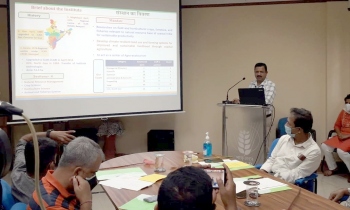
Interacting with media persons on Monday, ICAR Director Praveen Kumar said the institute has already identified two locations in Goa for growing potatoes, one being Dongurli-Sattari.
“We are going to cultivate 400 tubers of five varieties each which have capacity to tolerate heat. The same will be grown around November 15 when the temperature is a lot cooler,” Kumar said.
“Also, four varieties of hybrids of musk melon will be cultivated in different seasons so that we come to know which months and which variety of hybrid is suitable for cultivation in Goa,” he added
“Cauliflower will also be cultivated in different locations of Goa as well as avocado,” Kunar said.
Kumar further said that heat-tolerant varieties of apples will also be tried for cultivation in Goa.
“For the ear, it might sound crazy, but that was also the case with strawberry and we were successful though I cannot say whether we will be successful with apples or not. But we will give it a try,” he added.
“We are conducting experiments in Goa and if it is successful, we will try in other coastal states,” Kumar pointed out.
Khazan fields to be put to better use
OLD GOA:
Goa has a vast area of khazan fields which are lying fallow due to the entry of saline water and even though the Korgut variety of rice can be grown in such fields, the yield is less.
Now, the Indian Council of Agricultural Research (ICAR) has plans to increase the productivity of the khazan fields by introducing their variety of salt-resistant rice which has a high yield.
Speaking to reporters, ICAR Director Praveen Kumar said salinity is a problem in khazan fields.
“In such land where there is nothing cultivated, we will introduce salt-tolerant rice variety. Also where Korgut is grown, we will introduce our variety so that production and the income can be increased,” Kumar stated.
“We are evaluating many crops and vegetables for saline conditions and we have already started experimenting with the same so that they can be grown in Rabi season,” he added.


