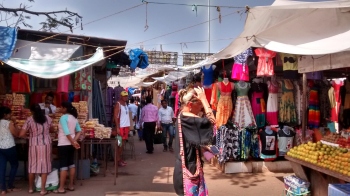
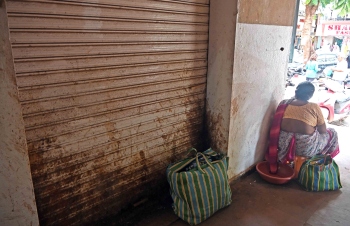
 Captured by : Narayan Pissurlenkar
PANAJI
A large mural of famed Goan artist-cartoonist, Mario Miranda, greets you as you walk in. It's arguably the only pleasant experience one has as you visit the new Corporation of the City of Panaji (CCP) market.
The rest is all chaos and confusion, much like what Mario indomitably depicts in the mural.
The first two phases of this new market, which houses the fruit and vegetable vendors on platforms besides general provision stores dealing with everyday use groceries, spices and masalas on the ground floor, is today a far cry from the expectations Panjimites had when the market was first commissioned back in 2004-05.
It's absolutely chaotic. The shop I used to always go to buy my 'masalas' is today a 'Jewellery Store'. No one knows where to get their specific requirements for daily use from anymore," said Panjim resident and former CCP councillor, Patricia Pinto.
Pinto said right from day one when the tenants and vendors were given possession of the shops, stalls and spaces to carry out their business back in 2004-05, proper planning was given a go-by.
"They should have demarcated locations for specific business such as masalas/spices in one area, groceries and provisions in another and so on," Pinto said, adding that failure to do so is the root cause of the chaos witnessed on a daily basis in the market.
At the top (first floor) level, the entire floor is swarmed with several dozen mobile and mobile repair stalls, electronic goods stores, electrical and electronic goods repair shops, readymade garment stores, a couple of chai and snack shops, while traditional tailors who many residents of Panaji engage for either stitching new clothes or alterations of old clothes are shunted in far-flung and obscure corners of the building.
Less spoken of the hygiene and upkeep of the place the better. The floors are never clean, walls are adorned with 'paan' and 'gutka' spit stains all over and the foul odor is all pervasive.
In all this gloom at the Panaji market, there is however a solitary silver lining: how tonnes and tonnes of waste, both wet and dry, generated there is managed on a daily basis.
Sources in the CCP's solid waste management cell say it is a daily miracle.
"It is perhaps one of the most efficient example of solid waste management in the entire city. The team engaged with the job is doing an excellent job. The composting unit is working very efficiently and no foul odor emanates from there. It takes care of a couple of tonnes of wet waste generated in the market every day," an official said.
The same is not true of toilet blocks located on the northern and eastern edge of the building's ground floor. Though functional, these two toilet blocks are badly maintained and many market goers are seen holding their noses when passing by these locations.
Roof sheets fly off,
temporary repairs done
In late July this year when Goa was hit by an overactive monsoon, a storm-like downpour hit the CCP market and several sheets of the roof were blown off on the western side of the edifice.
The CCP executed temporary repairs to the roof to prevent leakage and inconvenience to both vendors and visitors to the market but not before the senior officials of the CCP did a bit of coercing to leverage the situation and get the market occupants to sign lease deeds with the Corporation.
Already twenty years old, a senior official of the CCP's technical section said, the roof now needs a more solid refurbishment which they are working on.
"The roof work could be tendered within the current financial year and executed simultaneously when phase-III of the market is also tendered," the official said.
According to the official, CCP Mayor Rohit Monserrate has issued instructions to prepare a detailed tender for the overall repair and renovation of the entire market complex, including the toilet block in the northern side of the complex.
Old building demolition,
phase III of market
Currently in the news for all the wrong reasons is the evacuation of the meat stall operators and a few other occupants from the old 1980s-built market building which the CCP plans to demolish to pave the way for tendering and construction of phase III of the market.
The last deadline the CCP had set for itself to demolish the fish market sheds and the old building was January this year. But nine months past this date, it is likely to be delayed further with the matter of alternative location of the displaced meat vendors pending before the Bombay High Court.
Phase III which will house the fish and meat market was originally planned to take-off in 2012-13. The project was to be constructed by the GSIDC and after being put in cold storage for nearly a decade, it resurfaced on CCP's agenda only last year in April.
Plans have now been drawn to build this phase III once the old building, recently evacuated after being declared unsafe, is fully demolished.
The old building was built in the Francisco (Bashick) Branco dominated era of the CCP in its 'Panjim Municipal Council' avtaar of the 1980s -- infamous for the comical architectural blunder of a building sans a staircase.
How soon will phase III for the fish and meat vendors be taken up and completed is difficult to say. According to the senior official from the engineering/technical cell of the CCP, only when clear directions come from the ongoing High Court matter filed by the displaced tenants and meat stall operators, can work to demolish it begin and ground prepared for actual construction of the market's phase III.
Plastic ban, cloth
bags on hire
The 100 per cent ban on plastic in the market and the simultaneous initiative to make cloth bags available for hire launched by the CCP in early August, is yet to show tangible results.
CCP officials however continue to be optimistic about their 'cloth bags on hire' initiative with market inspectors and some other staff continuously going around the entire market trying to create awareness about the scheme.
The initiative is aimed at eventually eliminating the use of plastic bags and the CCP has for now, decided to focus on making sure that the ban on plastics is implemented by imposing fines. The officials hope that over time, the 'cloth bag on hire' as a replacement for easily available plastic bags and carry-bags will eventually get popular and succeed.
To enforce the plastic ban strictly, market inspectors are empowered to impose fines ranging from Rs 5,000 to Rs 10,000 on defaulters.
The "Amchi Poti" initiative is being implemented through dedicated stalls at the market where cloth bags can be rented for Rs 20. On returning these bags on their next market visit, customers will be returned their 20 rupees. Even if the bag is damaged or torn for some reason, the full amount is refunded. The bags are made from cloth donated to the RRR Center of the Municipal Corporation.
Market scam:
Epicentre of chaos
One of the main reasons for the chaos in the functionality of the first two phases is the long forgotten 'market scam'. The CCP has earned zero revenue in rents and other charges from the tenants right from 2004 due to the scam which erupted primarily because the tenant-merchants were relocated in the new premises by the GSIDC without executing fresh lease agreements or deeds.
Former mayor and currently the CCP's senior most councillor, Surendra Furtado has consistently been a vociferous crusader to get the culprits to book and resolve the issue so the capital's civic body can earn much needed revenue on a monthly or annual basis. Furtado's efforts, however, have failed to bear any tangible fruit.
Mayor Monserrate, who completed two one-year terms and began his third in March, however, claims that the issue is nearing resolution and most of the tenant-merchants have expressed willingness to sign fresh lease deals with the civic body. The mayor's claims, however will have to be believed only when the deals are actually inked.
More than a decade ago, the scam was probed and details unearthed, when former bureaucrat, N D Agrawal submitted his report. However, vested interests in the State government got it pushed to the back-burner and eventually into cold storage.
Since then, the only time that the 'market scam' got recalled into public memory was during the campaign for the CCP polls in 2016 and in 2021. But beyond the election campaign no one within the CCP seems keen to resolve this leakage of rental revenues estimated to be an astronomical Rs 12 crore annually.
Hundreds of merchants occupying shops and stalls allocated to them through dubious processes executed by multiple ex-mayors and commissioners and before them by officials of the GSIDC before the latter officially handed over to the CCP, continue doing brisk business but pay nothing to the civic body in rents.
Worse, many of these shops and stalls have been sub-let multiple times. Some occupants and vendors who did not want to be identified claimed that there are a few individuals who do collect money from them on a monthly basis as 'rent'.
If true, where this money goes and identifying who these individuals are could be a subject of yet another probe which could possibly open a can of worms from the shady dealings of some CCP officials and possibly some elected representatives.
Apart from mere words, there is little to show in terms of tangible outcomes, that Monserrate who is the current mayor with a brute majority, is pursuing a resolution to the 'market scam' with any earnestness. Since this new CCP market's inception in 2004 till date, a conservative estimate of revenue lost could be close to the Rs 100 crore mark -- money that could have made the capital's perennially cash-starved civic body a revenue surplus authority.
Worse, the CCP continues to bear the cost of power and water bills besides other maintenance costs of the market. In June this year, it cleared arrears to the PWD and the Electricity department to the extent of nearly Rs 6 crore.