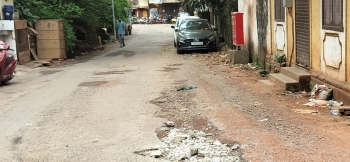
 BUMPS ON EVERY TURN: The main road near Alankar Theatre in Angod, Mapusa, is riddled with potholes and uneven surfaces, turning every commute into a bumpy ordeal for motorists and locals alike. Captured by : Agnelo Pereira
MAPUSA
In Mapusa, the broken roads and potholes don’t just swallow up tyres “ they’ve swallowed the town’s outrage. While the roads of Angod continue to crumble into a dusty and uneven mess, the silence of its people has become the bigger story. Once known for its bustling market and old Goan charm, Mapusa today seems to have traded its voice for convenience, even as residents bump, skid and stumble through roads that look more like war zones than thoroughfares.
The main road stretch from Hotel Vilenna to St Jerome’s Church, passing through Ward 10, is among the worst affected. The road was first dug up to lay underground power cabling “ a rare upgrade that placed both 33KV and 11KV lines beneath the surface. But the relief from power cuts came at the cost of a new problem above ground.
Months later, the same roads were dug up again, this time to replace old, corroded water pipelines. What followed was typical of Goa’s civic coordination “ both the Power Department and the PWD walked away after their work, leaving residents to navigate a patchwork of potholes, loose gravel and open trenches.
The result: a stretch that tests balance, patience and shock absorbers. Parents ferrying children to school have experienced minor falls. Pedestrians hop from one dry patch to another. Patients on their way to Kalangutkar Maternity Hospital and Remanso Hospital face the roughest of rides.
A priest’s lament
The issue burst into public debate on Sunday “ not at a protest, but from the pulpit. At the 7.45 am Mass at St Jerome’s Church, Fr Ramiro Luis voiced what many think but few say aloud: “It pains us to see the bad condition of roads in Mapusa. But it looks like the people of Mapusa are not concerned. Nobody is raising a voice.”
Fr Ramiro wasn’t just lamenting potholes. He was lamenting apathy. Using the moment to draw parallels with the ‘Goyant Kolso Naka’ movement in Margao organised by CSJSP, the church’s social wing, he urged Mapushekars to rediscover their civic spirit. “If people of the South can unite for Goa’s causes, why can’t Mapusa stand up even for its own roads?” he asked, and urged Mapushekars to join the protest against coal pollution in Margao on Nov 1 at 5 pm.
Susegad outrage
His words found an echo online, where residents vented on social media. “The whole of Mapusa roads are in a pathetic state. Authorities are sleeping. Goenche mhoje Mapushekars are susegad,” wrote Carmelina Da Cunha, a resident of Mapusa.
“Mapusa’s bhatkar is in sleeping mode,” replied Vivesh Goltekar, a pointed jibe at the local MLA. “Don’t worry, he’ll wake up in 2027,” quipped Wilbur Menezes, referring to the next Assembly elections. But Carmelina, originally from South Goa’s Seraulim, struck a deeper chord. “Down South, we unite and act. Here, it’s ‘apun apleak, Dev somesthank’ (each for himself, God for all),” she wrote. “There are amazing people here too, but we need to unite before someone else’s fall turns serious,” she added.
Patchwork governance
The PWD, meanwhile, has only just begun some patchwork “repairs” in Angod “ full grouting of potholes and broken stretches. But residents say the job is sloppy, uneven and more cosmetic than corrective. The situation has reached a point where even a modest rainfall could undo the work done. And yet, the people “ unlike in Margao or Curchorem or Cuncolim “ remain silent, resigned and almost numb to neglect.