PANAJI
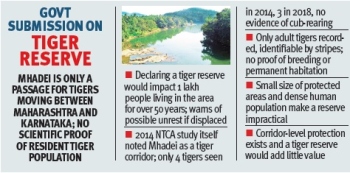
The Goa Government in its submission before the Central Empowered Committee (CEC) has said that the Mhadei protected area is only a corridor whereby the tigers transit from Maharashtra to Karnataka or vice versa and that there is no scientific evidence to prove they are residents of the State.
The State government also said that the National Tiger Conservation Authority (NTCA) recommendations are not binding on them and the final decision taken by the Petitioner would be subject to undertaking a review of the feasibility of the proposal to declare the protected area as a tiger reserve.
The CEC, as directed by the Supreme Court has commenced hearing on the Tiger reserve matter. It has to hear all the stakeholders including State, Petitioner Goa Foundation and various central agencies before submitting its report in two weeks.
In its submission, the State government also cautioned that displacement of one lakh population from the protected areas could lead to armed rebellion in opposition to the decision to displace and resettling the local inhabitants.
Quoting National Tiger Conservation Authority (NTCA), the State said that the area of Mhadei is only a route which is used by tigers to transit. "The protected area is only a corridor whereby the tigers transit from Maharashtra to Karnataka or vice versa and the area of Mhadei is only a route which is used by tigers to transit," the State government said.
In fact, it added that the 2014 report of the NTCA itself supports the contention of the State that the protected areas of Goa only acts as corridor for movement of tigers from the State of Karnataka to the State of Maharashtra and for which the protective measures have already been put in place.
The State government highlighted that a total of 4 tigers were found to be present in Mhadei in the year 2014, however, in the year 2018, the figure went down to 3.
"No evidence has been found through camera trapping on rearing of cubs. Only adult tigers have been found. Each tiger can be distinguished basis their stripes. There is no scientific evidence brought on record by the NTCA that the same tiger is noted to live in the area," it said.
The State government informed that during the SWLB meeting held in July 2023 post HC order, it was decided that declaring of already notified protected areas of Goa as tiger reserve “ in line with the NTCA guidelines on inviolate area “ would not serve any significant purpose and neither will it be feasible in view of availability of a relatively small, protected areas and a large population of people living in and around the protected area.
It said that the protected area proposed to be declared a tiger reserve has a population of approximately one lakh inhabitants, spread across several villages, who have been living there for more than 50 years. Since their lands are within the area, they would be most unwilling to be relocated elsewhere.
Further, there is no alternative to accommodate so many people elsewhere, the State government said.