PANAJI
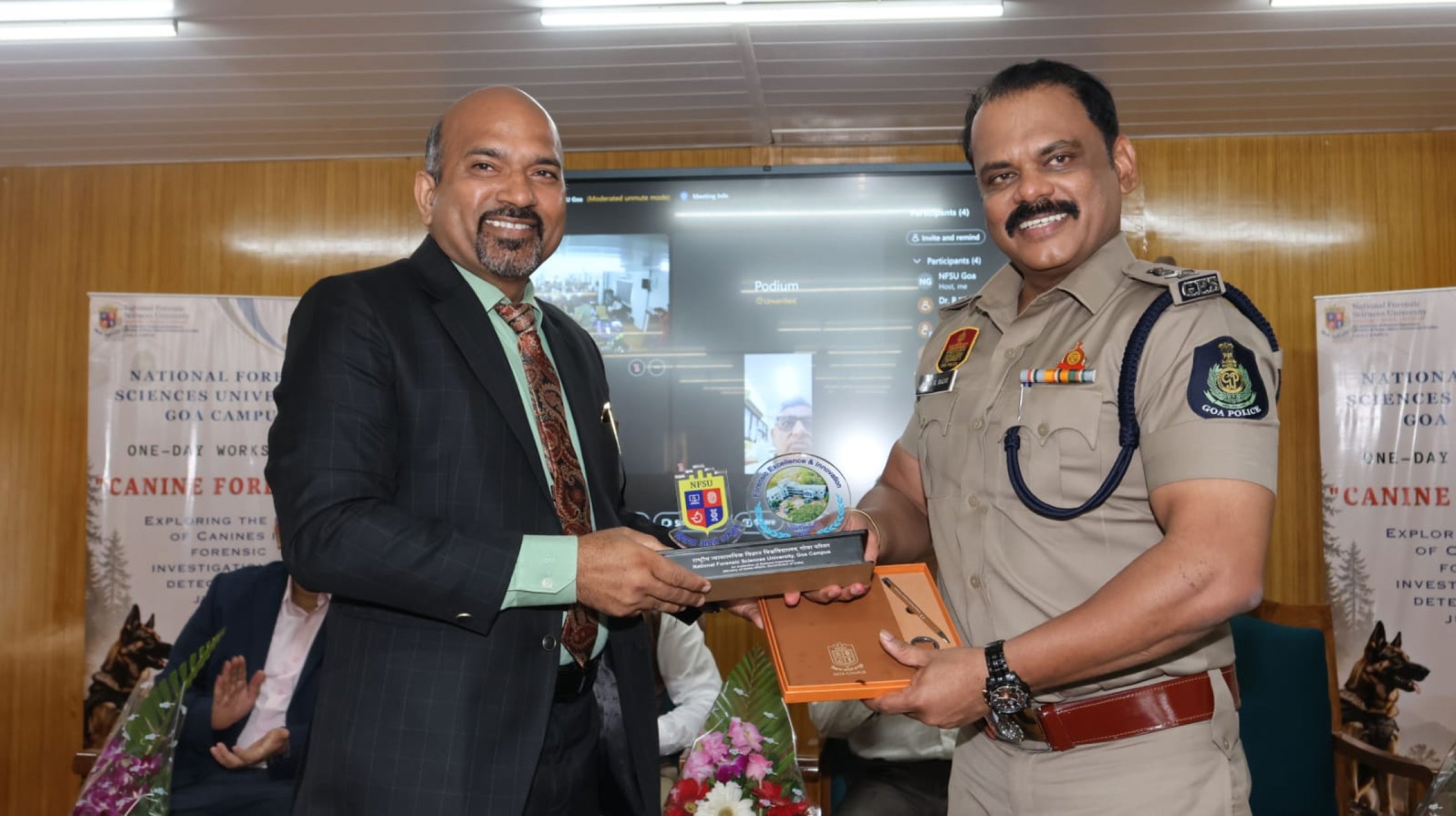
The role of trained sniffer dogs in tracking suspects, detecting narcotics and explosives and examining crime scenes came into focus at a one-day workshop on canine forensics organised by the National Forensic Sciences University (NFSU), Goa Campus.
The one-day workshop brought together forensic experts, police personnel and academics to examine how canine capabilities can be used in crime-scene operations and other investigative processes.
Campus Director Prof Naveen Choudhary said canines’ sensory and olfactory capabilities have significant applications in forensic and investigative work. He urged participants to use the workshop to learn from experts and strengthen professional networks.
The programme was organised jointly by NFSU Goa and Florida International University (FIU), USA.
Superintendent of Police Jivba Dalvi, who was the chief guest, addressed the gathering during the inaugural session.
The workshop further covered the use of canines in tracking suspects and missing persons, detecting narcotics and explosives, search operations and crime-scene investigation. Experts stressed that the success of such operations depends on the coordination between the dog and its handler.
Prof Kenneth Furton, University Professor of Chemistry and Biochemistry at FIU, delivered a session on canine olfaction and scent science. Col Pramod K Chug, Chief Trainer and Managing Director of Police Dog Centre India, spoke on training, handler-canine partnership, crime-scene and search operations.
Dr R K Sarin, Professor at NFSU’s Delhi Campus, addressed forensic investigation of explosion cases, while Goa Police Inspector Paresh Navelkar spoke on the role of canines in crime-scene investigation.
The technical sessions were followed by a hands-on crime-scene demonstration, giving participants practical exposure to the use of canines during investigations.
The workshop also sought to strengthen collaboration between NFSU Goa and Goa Police in applying forensic science and canine-based methods to criminal investigations.