


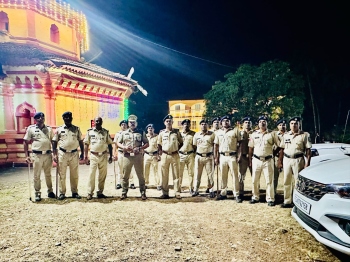
 A police team under the supervision of DySP Jivba Dalvi stationed outside the temple in Poriem-Sattari. Photo: Uday Sawant
THE GOAN NETWORK
VALPOI
Tension finally subsided between two groups over the conduct of rituals at a temple in Poriem-Sattari, when the Sattari deputy collector and sub-divisional magistrate on Saturday withdrew Section 144 imposed around the premises and re-opened the temple to enable devotees to conduct rituals.
Traditional religious ceremonies were later conducted by both groups in the presence of a strong police force stationed in the area.
Following tensions between two groups over rights to conduct rituals in the temple at Poriem, Sattari SDM Pallavi Mishra had imposed Section 144 and had ordered the closure of the temple till December 24.
The closure of the temple angered one group of devotees, who protested by blocking the Keri-Sankhali highway with stones and logs. Authorities then diverted traffic to Morlem and Keri via Honda.
On Saturday morning, North Goa Collector Sneha Gitte convened a joint meeting in the Sattari deputy collector’s office to resolve the tension. The issue of withdrawing Section 144 and re-opening the temple were discussed at the meeting.
The two groups agreed to all terms and conditions discussed at the meeting and it was resolved that all devotees would participate in the religious ceremonies.
The Sattari deputy collector later withdrew Section 144 and the temple was re-opened to the devotees.
As a result, the blockade on the highway was withdrawn and the devotees participated in the rituals on Saturday evening amid a strong police force.
DySP Jivaba Dalvi confirmed that traffic movement had been restored along the Keri-Belagavi highway.
He also informed that a large number of devotees participated in the rituals at the temple on Saturday and added that a police force would be deployed at the site throughout the night as a precautionary measure and to maintain law and order.
Meanwhile, supporters of one group tried to meet the deputy collector in the afternoon, but they were unable to do so.
Later speaking to reporters, representatives of one group accused the deputy collector of being responsible for the tension and confusion.
“The deputy collector had issued an order that everyone should be allowed to participate in the rituals but copies of the order were not made public in time. Had this been done, such a situation would not have arisen,” said one leader.


