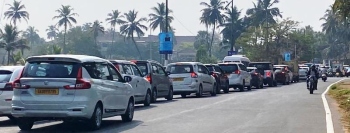
 Serpentine queue of vehicles were seen on the NH66 the last two days in view of the India Energy Week organised at ONGC, Betul.
MARGAO
The ongoing India Energy Week at ONGC, Betul, may give a further boost to Goa’s image as an ideal destination for international conferences, with delegates from over a dozen countries participating in the deliberations. However, for residents of Chinchinim, life has been far from normal since the event began on Tuesday.
With thousands of vehicles ferrying delegates from hotels and resorts across Salcete to the ONGC venue, vehicular traffic on the region’s narrow and congested roads has worsened significantly over the past two days. Serpentine queues were witnessed on National Highway 66, stretching from Sirlim to Chinchinim.
A similar situation prevailed on NH66 at the entrance to Cuncolim market, where traffic queues extended up to the defunct NUSI hospital. The heavy congestion has kept traffic police on their toes, as repeated attempts to streamline the flow proved largely ineffective.
Chinchinim resident and activist Savio Lopes slammed the traffic authorities for what he termed poor traffic management, particularly around the St Sebastian Chapel junction. “Residents of Chinchinim, including schoolchildren, have suffered over the last two days for no fault of theirs. We witnessed serpentine queues on NH66 from Sirlim to the St Sebastian Chapel junction, completely paralysing local traffic,” Lopes said.
He added that while residents were not opposed to hosting major events, adequate planning was essential. “Enough care should have been taken to regulate traffic and avoid inconvenience to the local populace. We actually felt pity for the traffic cops trying to manage the huge volume of vehicles heading towards ONGC, Betul,” he remarked.
Echoing similar concerns, Chinchinim Panchayat member Gerson Gomes said the authorities should have adopted a coordinated approach to traffic management to spare locals unnecessary hardship.
Meanwhile, traffic congestion continued on NH66 at Cuncolim, with long queues reported between the defunct NUSI hospital and Cuncolim market. Despite deployment of traffic police at key junctions, the sheer volume of vehicles made it difficult to prevent prolonged traffic snarls.