


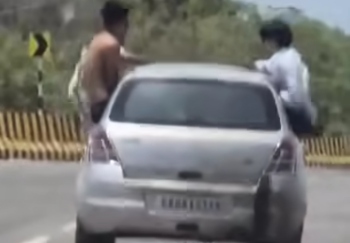
 RECKLESS THRILLS: Youths, believed to be tourists, were seen hanging out of the windows of a moving car along the Guirim–Mapusa stretch of NH-66, engaging in a dangerous stunt.
MAPUSA
Two separate videos that have gone viral on social media have once again put the spotlight on dangerous behaviour by tourists on Goa's roads, raising serious concerns over road safety, enforcement and the apparent lack of fear of law among a section of visitors.
In one incident, a group of youths, believed to be tourists, were seen hanging out of the windows of a moving car on the busy NH-66 stretch between Guirim and Mapusa.
The occupants were filmed leaning dangerously outside the vehicle, waving their hands in the air and engaging in reckless behaviour while the car was in motion amid regular traffic.
A video of the incident, widely circulated on social media, also shows one of the youths removing his T-shirt while protruding from the vehicle, seemingly oblivious to the risks involved.
In another incident reported from Baga, at least ten young men were seen crammed into a single car, with two of them travelling in the open dickey of the moving vehicle.
The video shows the rear door of the vehicle fully open while the occupants sat exposed to traffic behind them, turning a public road into what appeared to be a moving party.
Road safety experts and residents have termed both incidents as blatant violations of traffic regulations that endangered not only the lives of those involved but also other road users.
“These are not harmless acts of fun. One sudden brake, pothole, turn or collision can result in fatalities. Such behaviour puts innocent motorists, pedestrians and passengers at risk,” said Premanand Diukar, founder president of Calangute Constituency Forum.
“The image of anything chalta hai in Goa should change. Traffic vigilance should step up and punishment should be strict and quick,” he added.
Pattern of recklessness
The incidents come barely a day after a 32-year-old Siolim resident was killed and his minor nephew seriously injured in a collision involving a Thar vehicle allegedly being driven rashly in the Anjuna-Siolim belt.
Residents point out that reckless driving by tourists has increasingly become a recurring issue across Goa, with frequent reports of speeding, drunken driving, dangerous overtaking, overcrowding of vehicles, riding without helmets and even driving vehicles onto beaches and into seawater despite repeated warnings.
Several locals argue that while police often launch drives after major accidents or viral incidents, sustained enforcement on the ground remains inadequate.
“Every few weeks there is another viral video. We see tourists hanging out of cars, performing stunts on motorcycles or overcrowding vehicles. The real question is why they feel confident enough to do it in the first place," said Jawish Moniz, a resident of Anjuna.
Viral videos expose
enforcement gap
The latest incidents have once again exposed what many describe as a growing enforcement gap between traffic laws on paper and their implementation on the ground.
Traffic violations involving tourists frequently trigger public outrage, but critics argue that punitive action often comes only after videos surface online. They say Goa cannot afford a system where enforcement is dependent on social media posts rather than active policing and surveillance.
Former members of road safety bodies have repeatedly advocated stricter monitoring of rental vehicles, greater use of surveillance cameras, stronger accountability mechanisms for vehicle owners and operators, and swift prosecution of offenders.
"We need to install CCTV cameras at every road junction and crucial road stretches so that such mischiefs are immediately tracked and police take quick action. There has to be a clear message that Goa's roads are not playgrounds. Tourism cannot come at the cost of public safety," said, Roland Martins, Coordinator of GOACAN and a road safety campaigner.
Beyond tourism, a
governance challenge
While tourism remains Goa's largest economic driver, stakeholders warn that repeated incidents of unruly behaviour risk damaging the State's image as a safe and responsible destination.
Industry observers note that the issue is not tourism itself but the inability to effectively regulate a small but visible section of visitors who repeatedly flout laws.
The latest viral videos have once again reignited debate over whether authorities are doing enough to deter dangerous conduct before it leads to tragedy.
For many residents, the concern goes beyond two viral clips. They see them as symptoms of a larger problem “ a perception among some visitors that traffic rules can be ignored with little consequence.


