DR AMIT DIAS
For The Goan
The theme for World Alzheimer’s Day observed on September 21 this year is ‘The earlier we know, the more we can do: A dementia diagnosis matters.’
Dementia is no longer a distant problem. We all would know of a person within our homes, families or community who has cognitive impairment. Yet one of the biggest challenges is that many people living with dementia are often not diagnosed.
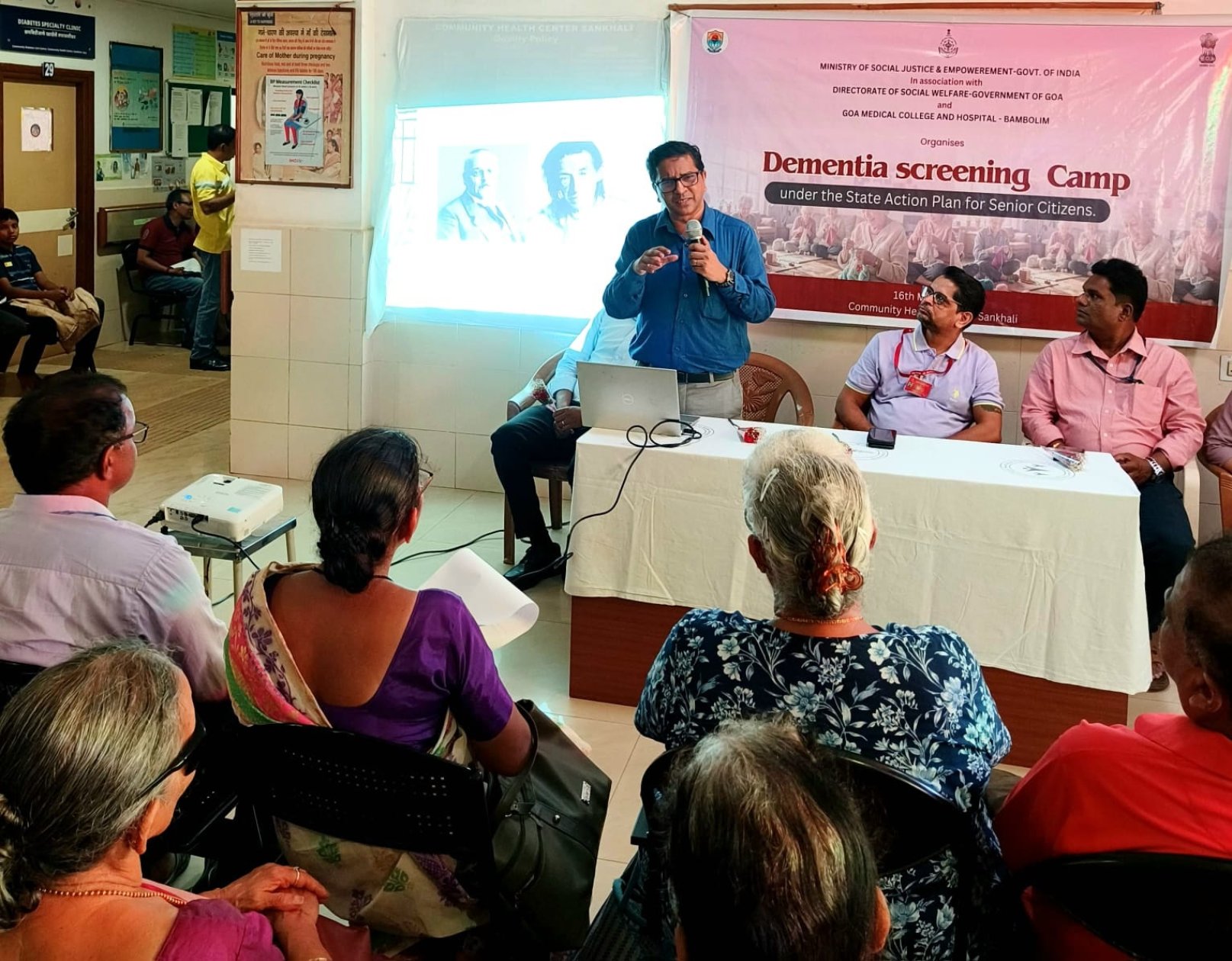
Dementia screening camps provide an opportunity to find people early, connect them to care and, importantly, help families understand what is happening and help them take the right path.
We need to promote person-centred care – where we do not look at the disease, but look at the person. It should start with our language. We no longer use the word ‘demented’, but we use ‘person with dementia’ instead. We need to realise that behind the diagnosis is a person who is struggling to make sense of his life.
Rising numbers: Ageing Population
The World Health Organization estimates that 57 million people were living with dementia worldwide in 2021, with nearly 10 million new cases every year. Alzheimer’s disease accounts for about 60–70% of cases. The number is projected to reach about 139 million by 2050, with much of the increase occurring in low- and middle-income countries.
Goa is estimated to have around 5,000 people with dementia. There will be many more with mild cognitive impairment. The diagnosis gap is enormous. Alzheimer’s Disease International (ADI) reports that up to three-quarters of people with dementia globally do not receive a formal diagnosis.
Our research revealed that around 90% of people with dementia remain undiagnosed. Our experience from our camps in Goa has also highlighted how frequently dementia remains unrecognised.
Why diagnosis matters
Without diagnosis, there is often no clear explanation for the changes in a person’s behaviour. A person may repeatedly ask the same questions, forget appointments, become suspicious, wander away from home or struggle with familiar tasks. Instead of being recognised as symptoms of a disease, these behaviours may be interpreted as stubbornness, laziness or deliberate misbehaviour.
In the resulting confusion, people with dementia can be neglected, restrained, shouted at or even exploited. Families too may suffer because they do not know how to respond.
A diagnosis does not solve every problem, but it provides a starting point. It allows treatable causes and medical conditions to be assessed, medications to be reviewed, safety issues to be addressed and appropriate treatment and support to be planned. It also allows families to plan for the future while the person can still participate in important decisions.
Who should seek assessment
Anyone who notices persistent or progressive changes in cognition that interfere with everyday life should consider an assessment.
Warning signs include:
- Repeatedly asking the same questions
- Forgetting recent conversations or events
- Getting lost in familiar surroundings
- Difficulty managing money, medicines or household tasks
- Struggling with familiar activities
- Increasing difficulty finding words or following conversations
- Changes in judgment, personality or behaviour
- Withdrawal from activities previously enjoyed
Increasing dependence on others
But not every memory lapse is dementia. Occasionally forgetting a name, misplacing keys and remembering later, or needing more time to learn something new can occur with normal ageing. Dementia is more likely when changes are persistent, progressive and begin to affect independence and everyday functioning.
Dementia screening into community
This is where the Dementia CARES screening camps in Goa become important. Initiated under the Ministry of Social Justice and Empowerment, in collaboration with the Department of Social Welfare, Goa Medical College and IPHB, CARES stands for Cognitive Assessment, Risk Evaluation and Specialist Referral.
Those who test positive would be looked after by the Neurology department at GMC. These camps are taking dementia awareness and screening closer to older people in their own communities.
The response has been extremely encouraging, with an excellent turnout. Importantly, many participants were found to have mild cognitive impairment, providing an opportunity for further assessment, monitoring, risk reduction and early support.
Screening, however, is not the same as diagnosis. A positive screening result needs appropriate clinical evaluation. The value of the camps lies not merely in identifying possible cognitive impairment but also in linking people to post-diagnostic care and support.
Care does not end with diagnosis
Counselling and an individualised dementia care plan can make a remarkable difference. Families need practical guidance: How should they communicate? How can the home be made safer? What should they do when the person becomes agitated or confused? How can wandering, medication errors and financial exploitation be prevented? Who will provide care when family members are working or living elsewhere?
This approach has been tested in Goa. The psychosocial intervention developed by the Dementia Society of Goa demonstrated that home-based support using trained non-specialist community workers could improve carer mental health and reduce carer burden and behavioural problems in people with dementia.
The work received the prestigious Fondation Médéric Alzheimer–Alzheimer’s Disease International (FMA-ADI) Prize in 2010 for the best evidence-based psychosocial research/intervention for people with dementia. The experience taught us an important lesson: supporting the carer is an essential part of treating dementia.
[The writer is an assistant professor in the Department of Preventive and Social Medicine at Goa Medical College. He has contributed to international and national work on dementia prevention and care. He was the nodal officer for the dementia screening initiative]