


MARGAO
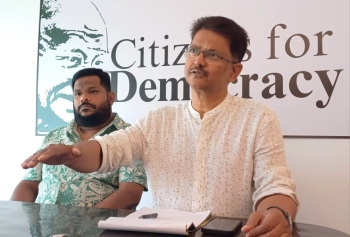
Terming the delay in municipal elections and the appointment of administrators as unconstitutional, Citizens for Democracy (CFD) Convenor Elvis Gomes on Wednesday accused the State Government and the State Election Commission (SEC) of deliberately causing a delay in conducting municipal elections across the State for political convenience, ignoring the constitutional mandate with impunity.
Addressing the media, Gomes said that the dual standards of governance by these constitutional bodies were exposed after they had shown a suspicious “overzeal” to conduct the Corporation of the City of Panaji (CCP) elections using a defunct electoral roll even after the SIR Final Roll was published and much before the term had expired. He said that they were acting in direct violation of the Constitution of India and established judicial precedents.
Gomes said that Article 243U of the Constitution, which mandates that elections to constitute a municipality must be completed before the expiry of its five-year term, and the landmark judgment in Sandeep Vazarkar v. State of Goa (2022) had settled the issue. “Appointment of administrators is a subversion of local self-government. Democracy cannot be kept on ‘standby’ at the whims of the SEC, which perhaps was following the ECI in behaving as an extended arm of the Government,” he said.
Pointing to the Sandeep Vazarkar case, Gomes said that the Court had categorically ruled that the constitutional mandate to hold elections is “inviolable”.
He said the Goa Bench of the Bombay High Court had, in four different cases, viz: Naresh Gaunekar, Joseph Sequeira, Rohan Shirodkar and Sandeep Vazarkar, laid down that the State Election Commission must act independently and cannot wait indefinitely for government notifications; administrative excuses or political convenience cannot override the mandatory requirement to have an elected body in place; and that the appointment of administrators is meant for brief transitions, not as a long-term substitute for elected representatives.
Stating that the decision was based on the law laid down by the Supreme Court in the case of Kishansing Tomar v. Municipal Corporation of the City of Ahmedabad & Ors, Gomes said that the apex court had explained that the object of inserting Part IX-A in the Constitution was to ensure that elections to local bodies were held regularly and on time.
“The Court had held that there is a constitutional mandate to complete the elections before the stipulated five years expire,” said Gomes, adding that these kinds of delays may be used as precedents in the future.
Gomes expressed alarm at the lack of public resistance to this erosion of governance, noting that both the government and the SEC are acting as if the Constitution simply does not exist. “People must know what is happening. This same government previously sought to deprive women of their mandatory quota, a matter they pursued even up to the Supreme Court, where they were defeated. More recently, it had shown a suspicious ‘overzeal’ to conduct the Corporation of the City of Panaji (CCP) elections using a defunct electoral roll well before the natural expiration of the then corporation’s tenure,” he added.


