


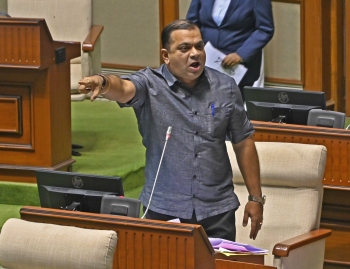
 COMBATIVE: Tourism Minister Rohan Khaunte replies to opposition queries over the proposed Tourism Bill, in the Assembly. Captured by : Narayan Pissurlenkar
MAPUSA
A major confrontation erupted between Leader of Opposition Yuri Alemao and Tourism Minister Rohan Khaunte regarding the appointment of a Hyderabad-based agency to draft the proposed new Tourism Act.
The controversy centres on the decision to outsource the drafting work to NALSAR (National Academy of Legal Studies and Research Institute), which Alemao criticised for its high fees.
Alemao questioned the tourism minister on why the drafting of the law was outsourced to NALSAR despite objections from the Goa Tourism Board. He revealed that NALSAR was paid a substantial sum of Rs 1.32 crore for its services.
“The Goa Tourism Board in its 2022 meeting had stated that drafting acts or laws should not be outsourced to external private legal agencies. Why then was this law outsourced despite the board’s direction?” Alemao asked.
He also inquired about the criteria used to select NALSAR for drafting the tourism promotion and management bill, questioning whether their experience in tourism-related legislation was verified. Alemao alleged that the selection of NALSAR was made based on nominations, implying possible favouritism by the tourism minister.
In response, Khaunte clarified that NALSAR’s role was limited to preparing a report, which would then be submitted to the law department for the actual drafting of the law. He justified the need for new laws by pointing out that previous ones had failed to adequately modify tourism activities in Goa.
Khaunte explained that the groundwork for the new law began in 2021 with a centralised law study, involving three expert agencies to draft the foundational aspects. While these agencies did not draft the law themselves, their expert insights significantly contributed to the bill’s development.
Khaunte countered Alemao’s allegations by detailing the project's costs. He stated that Phase 1 incurred an expenditure of Rs 35 lakh, plus taxes, amounting to Rs 41 lakh, with an additional Rs 8 lakh allocated to bring the bill to the legislative house. He further clarified that the bill for the second phase is still in draft form and that financial allocations for it have not yet been made.


