MAPUSA
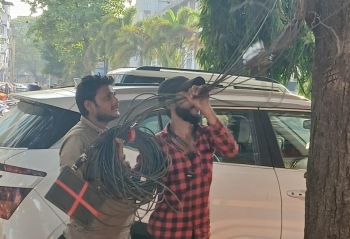
The abrupt decision by the State government to cut overhead internet and cable TV wires has triggered widespread disruption and drawn severe criticism from service providers.
The move, executed without prior intimation, has impacted businesses, educational institutions and even government departments, raising concerns over the administration's handling of the Right of Way (RoW) policy and infrastructure planning.
Lack of due process, transparency
Service providers have decried the government’s failure to communicate before implementing such a drastic measure.
Sagar Govekar, head of Ethernet Xpress, a broadband and internet service provider, criticised the lack of due process, highlighting that his company had applied for RoW permissions as far back as November 2023.
“Despite our application being pending for 15 months, the Department of Information Technology, which is responsible for RoW matters, has not acted on it. Similarly, our underground cable permission request has been ignored for two years,” Govekar stated.
He further expressed frustration over the sudden execution of the cable-cutting operation just a day after the State adopted the Central government’s revised RoW policy on January 11. “How is it fair to enforce a new policy overnight without informing stakeholders?” he questioned.
Confusion over fee collection
Adding to the grievances, Govekar pointed out inconsistencies in fee collection. Initially, service providers paid dues to the electricity department. However, in 2021, the government outsourced the task to Vasco-based agency, Vinson Graphics. The contract with Vinson Graphics was terminated in December 2024, but no official communication was made to service providers.
“The government suddenly started billing us directly without any prior notice, leaving us scrambling to adjust to the change,” he added.
Chaotic overhead cabling, regulatory gaps
Acknowledging the issue of haphazardly strung cables on electricity poles, service providers placed the blame on regulatory gaps.
“The IT department has failed to establish clear guidelines. If the government is generating revenue from this, they should introduce proper regulations, such as mandating clamps on poles for organised cable management,” Govekar suggested.
Ragu Shetty, a partner at DNA Goa broadband, also highlighted the chaotic state of overhead cabling.
“There are 20 to 25 cables tangled on poles, but there is no clear distinction between legal and illegal service providers. In reality, only 10 to 12 ISPs in Goa are properly registered,” he claimed.
Shetty supported the enforcement action led by Executive Engineer Kashinath Shetye but argued that the government should first ensure clarity by differentiating between authorised and unauthorised operators.
He also pointed out the impracticality of shifting to underground cabling without adequate infrastructure.
“Currently, only Panaji has proper ducts for underground cabling. If the government wants us to transition, they must first create similar provisions across the State,” Shetty emphasised.
Cable TV operators also affected
The crackdown has also impacted cable TV operators, who argue that they too were left in the dark about the government’s decision.
President of The Goa Cable TV Networking and Service Providers Association, Molly Fernandes condemned the abrupt action.
“Authorities should have provided prior notice. Thousands of people have been left without cable TV and internet services due to this sudden move,” she said.
She further revealed that cable TV operators had initially paid fees to the electricity department and later to Vinson Graphics, but disputes over inconsistent rates led them to file a writ petition demanding a uniform fee structure.
“We are willing to clear 20% of arrears as directed by the High Court. However, we need clear policies and fairness in how these regulations are enforced,” Fernandes stated.
Call for a structured policy
The government’s aggressive action against unauthorised overhead cabling has left service providers grappling with operational challenges, exacerbated by the absence of clear regulatory guidelines and inadequate infrastructure for underground cabling.
While stakeholders acknowledge the need for organised cabling, they emphasise that the transition must be planned and structured rather than executed abruptly. With disruptions affecting critical services, there is now a growing demand for a balanced approach that ensures both regulation and industry viability.
The government must engage in dialogue with service providers to establish a framework that supports infrastructure development while maintaining uninterrupted connectivity for the public.