


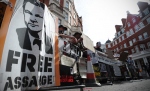
Julian Assange’s supporters have upped the ante againstGreat Britain in their battle to prevent his arrest and extradition to Swedenfor questioning over alleged sex crimes. In particular, the suggestion thatBritish police might not even wait for the 41-year-old Australian to leave theEcuadorean embassy in London to arrest him drew the ire of Vladimir Putin’sgovernment in Moscow, opposition newspapers in Ecuador and the country'sleftist South American allies. That British warning, based on the UK’s 1987Diplomatic and Consular Premises Act, has been characterised by Ecuador as athreat to “storm” the embassy.
Assange’s supporters claim that the Swedish allegations area smokescreen. They insist he faces extradition to the US for trial overWikiLeaks publishing of classified secrets, including regarding the wars inIraq and Afghanistan. According to former human rights prosecutor BaltasarGarzon, who now represents Assange, he is entitled to safe passage under theUN’s 1951 Refugee Convention. That flies in the face of statements by BritishForeign Secretary William Hague that “diplomatic asylum,” which requires safepassage from any consular premises ” as opposed to “political asylum” ” is aconcept unrecognised by the UK.
According to legal experts, diplomatic asylum only exists inLatin America. On Saturday August 18, Hague received backing from an unexpectedquarter on that point ” the man who had granted asylum to Assange, Ecuador'sPresident Rafael Correa. In a radio interview, the populist left-wingeracknowledged that he had known that the concept of diplomatic asylum is notrecognized in the UK, effectively leaving Assange still holed up indefinitelyin a tiny room in the embassy. That raised the prospect that Correa haddeliberately thrown down the gauntlet to Washington and London over what heunderstood was likely a symbolic gesture.
But in a typically defiant response, Correa claimed that theUK’s 1987 Diplomatic and Consular Premises Act was intended to deal withterrorists and using it against Assange would be an abuse.He went on to warnthat Ecuador would respond forcefully, adding: “They [the British government]don’t know who they are dealing with.”
And in two further signs that Assange’s fate was spinninginto a major international crisis, Russia criticised the British government’shandling of the affair and the Organization of American States also agreed tomeet to discuss the issue. Moscow appeared not to see the irony in adoptingthat position less than 24 hours after a Russian court had sentenced thefeminist punk group Pussy Riot to two years in a penal colony for a “punkprotest” against President Vladimir Putin that barely lasted 60 seconds.
But in Ecuador, the protesters outside the British embassyhad vanished, and most locals appeared uninterested in the global furor nowfocusing on the South American country. Yet even some fans of the president,who is due to face re-election in February, were concerned by Correa'santagonizing of the UK and US. Taxi-driver Xavier Olmos, 45, praised thepresident's overhauling of the decrepit state education system and police,widely viewed as corrupt and inept. But he added: “It’s populism by Ecuador. Wehave made a big mistake and it will be Ecuador that suffers, if there areeconomic sanctions."


