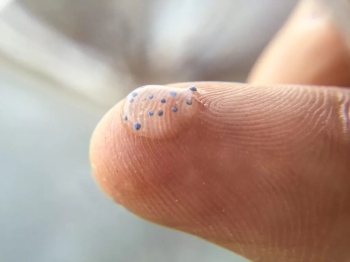
Diplomats from 175 countries gathering in Paris for plastics treaty talks on Monday may want to pack an umbrella, but not just because there’s a chance of rain. France’s capital will also be showered during the five-day talks by billions of microplastic particles falling from the sky, according to the first-ever plastics pollution weather forecast.
The predicted downpour will range between 40 and 48 kilogrammes of free-floating plastic bits blanketing greater Paris every 24 hours, the scientists said.
If the weather delivers heavy rain, the “plastic fall" is likely to increase up to tenfold.
“This should sharpen the focus of negotiators," said Marcus Glover, head of plastics research at the Minderoo Foundation based in Perth, Australia.
“Plastic particles break down into the environment and this toxic cocktail ends up in our bodies, where it does unimaginable damage to our health."
Concern over the impact of plastics on the environment and human wellbeing has surged in recent years along with a crescendo of research documenting its omnipresence and persistence.
In nature, multi-coloured microplastics ” by definition less than five millimetres in diameter ” have been found in ice near the North Pole and inside fish navigating the oceans’ deepest, darkest recesses.
Plastic debris is estimated to kill more than a million seabirds and 100,000 marine mammals each year, according to the United Nations Environment Programme, and filter-feeding blue whales consume up to 10 million pieces of microplastic every day.
Heads in the sand
The equivalent of a garbage truck’s worth of plastic refuse is dumped into the ocean every minute.
In humans, microscopic bits of plastic have been detected in blood, breast milk and placentas.
Animal tests have linked chemicals in microplastics to increased risks of cancer, reproductive problems and DNA mutations but data on human impact is still lacking.
“In our bodies, the plastics we need to be most worried about are probably those between 10 nanometres and one micrometre," said paediatrician Christos Symeonides, a researcher at Murdoch Children’s Research Hospital and the Minderoo Foundation.
“They’re the ones most likely to get through our biological membranes into tissues, including the blood-brain barrier," he said.
“We’re just now pulling our heads out of the sand when it comes to the health hazards of microplastics."
The forecast for Paris next week only covers significantly larger particles, mostly synthetic fibres at least 50 microns in length.
For reference, a human hair is about 80 microns across.
The method developed by Minderoo Foundation researchers does not measure plastic falling through the atmosphere in real time.
Rather, it is based on research done in Paris starting in 2015 that collected samples from multiple locations year round and sifted through them in the laboratory.
Virgin plastic
This pioneering work by French scientists found that most plastic particles falling across Paris’ 2,500-square-kilometre catchment area were nylon and polyester, probably from clothing.
Other bits were cast off by tyres, which shed them especially when vehicles brake.
Over an entire year up to 10 tonnes of microplastic fibres settle over the Paris area, they estimated.
The density of “plastic fall" can increase by an order of magnitude during heavy rain.
Measurements taken by other teams have replicated these findings in half a dozen cities around the world.
Microplastics that hit the ground can still be ingested or inhaled when stirred up, for example, on a windy day.