While much of the country is busy preparing for Lord Rama’s return to Ayodhya, the atmosphere in Goa is entirely different. Here, the festival of lights is deeply rooted in local Gomantak history and Lord Krishna’s epic victory over the demon king Narakasura. Growing up in the state means knowing that Diwali is less about exchanging opulent boxes of sweets and more about neighbourhood Narakasur rivalries, the scent of sandalwood paste, and a breakfast spread that honours the local rice harvest. To truly understand a Goan Diwali, it must be experienced step by step.
The Narakasur: Building and burning the demon
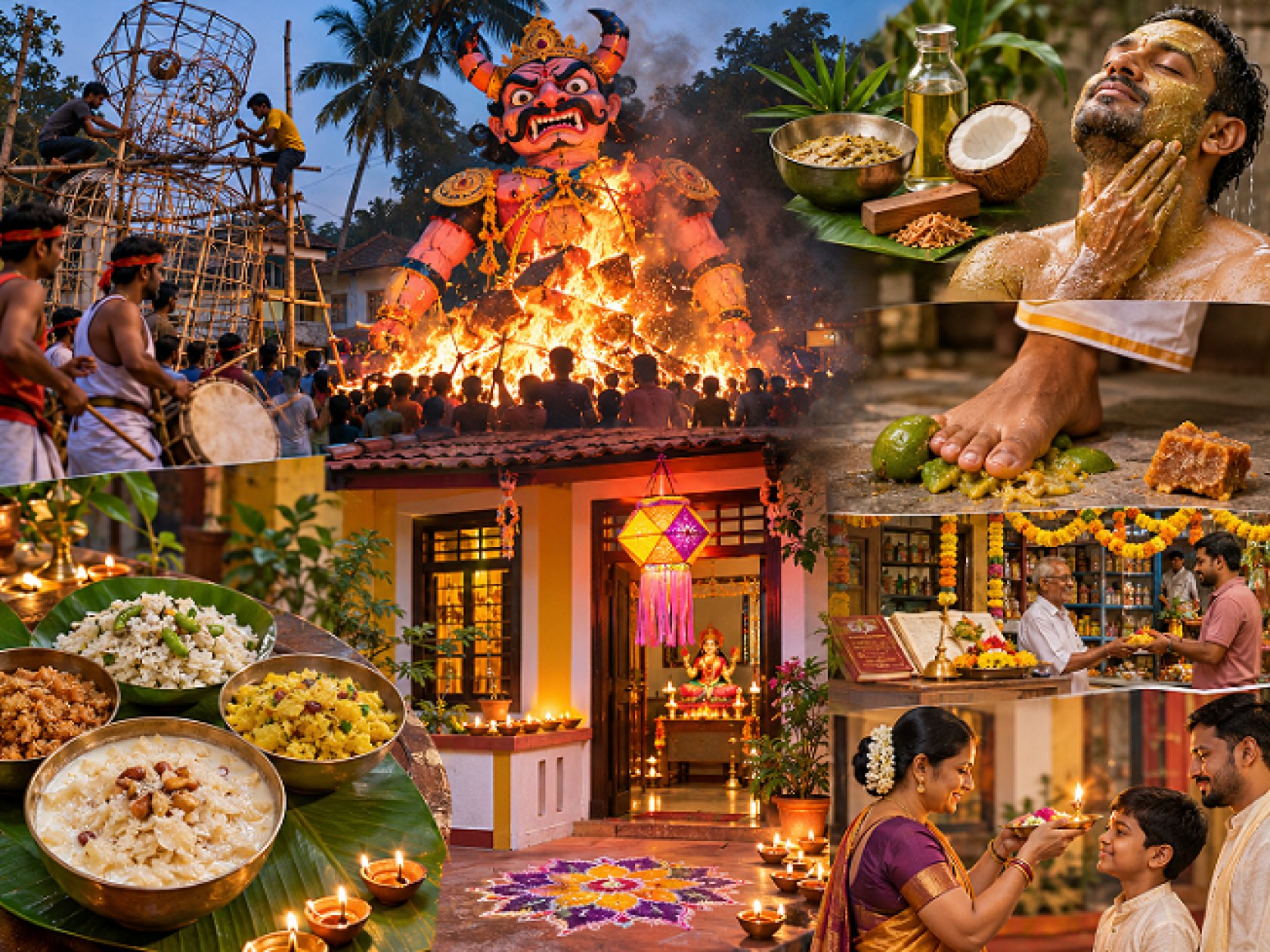
Long before the first clay lamp is lit, every vaddo (village ward) transforms into a massive, open-air workshop. Local youth spend weeks pooling their pocket money and staying up all night to build the famous Narakasur effigies. Using bamboo frameworks and chicken wire, they construct towering, grotesque monsters. Historically, these were stuffed with the dry hay left over from the October paddy harvest.
On the eve of Diwali, known as Narak Chaturdashi, the effigies are exhibited on the streets to the deafening, chest-thumping beats of the tashe. Then comes the fiery climax. In the early, misty hours of Diwali morning, before the sun even thinks about rising, these demons are symbolically beheaded and burned to ashes in the village squares. It is a loud and triumphant way to burn away the negativity of the past year.
Abhyangsnan: The scent of purification
Before the smoke from the Narakasur even clears from the streets, the household awakens for the abhyangsnan. Legend says that after Krishna defeated the demon, he smeared Narakasura’s blood on his forehead and took a purifying oil bath. This is honoured with a ritual bath before sunrise. But first, the skin is scrubbed with utnem, a traditional, rough paste made from ground sandalwood and fragrant herbs. It is usually mixed with coconut oil. The soothing, earthy smell of the coconut oil and utnem instantly replaces the smell of fireworks from the night, acting as an Ayurvedic cleanser that prepares the mind and body for the holy day.
Crushing the karit: Tasting the bitter
Right after the bath, the family gathers around a small, intensely bitter wild fruit called the karit. Representing the head of Narakasura, the karit is placed on the floor, and a member of the household must crush it under their left foot. But the ritual does not stop there. Everyone must dip a finger into the crushed fruit and taste a drop of the intensely bitter juice, usually followed instantly by a piece of sweet palm jaggery. Elders pass down the wisdom that this act is a reminder to accept the bitter moments in life to truly appreciate the sweet ones.
The feast of fov: A harvest on a plate
Forget the heavy, ghee-soaked sweets for a minute. For Goans, a Diwali morning feast is all about fov (flattened rice). It aligns perfectly with the state’s first rice harvest of the season, and it is said to be Lord Krishna’s favourite snack.
A traditional Goan household will prepare at least five distinct types of fov for breakfast. Families sit together to eat doodhantle fov cooked in warm, sweetened milk; rosatle fov dripping with freshly squeezed coconut milk and jaggery; kalayle fov tossed raw with grated coconut, green chillies, and tamarind; and a savoury batata fov spiced with turmeric and potatoes. It is simple, deeply comforting, and tastes like home.
Laxmi puja, local markets, and the akash kandil
As the morning turns to evening, the loud excitement settles into a warm, domestic glow. Families dress in new clothes for Laxmi Puja, drawing intricate rangolis at their doorsteps to invite the goddess of wealth inside. This deep reverence extends strongly into the local markets and commercial hubs. For shop owners and businessmen, Diwali marks an auspicious time to attract prosperity. Markets are adorned with strings of bright marigolds and mango leaves. Inside the stores, merchants perform a special puja for their ledgers and account books, seeking blessings for a profitable year ahead.
There is also a strong local belief that the first customer of the day is a direct manifestation of Goddess Laxmi herself. Because of this, shopkeepers will rarely turn away or barter aggressively with their first buyer, hoping that a smooth, happy sale will guarantee the goddess’s favour and keep the cash registers ringing.
Meanwhile, out on the balcão and along the window sills of homes, small clay diyas filled with coconut oil are lit. Overhead, handcrafted paper lanterns known as akash kandils sway in the November breeze.
Dive dhakavap and beyond
To round off the rituals, the married women of the house perform dive dhakavap, a beautiful custom that literally translates to “showing the light”. Mothers and wives prepare a special aarti thali, holding a lit brass or clay diya, fresh flowers, kumkum, and sometimes a few grains of rice. They carefully wave this thali in front of the men and children of the household, applying a small tilak to their foreheads. This delicate act is a silent, powerful prayer meant to ward off evil eyes, welcome prosperity, and guide the family out of any lingering darkness.
The festive feeling then lingers in the Goan air for weeks, officially wrapping up when Tulsi vivah, the ceremonial marriage of the sacred basil plant, takes place on November 21. From the roaring neighbourhood bonfires to the quiet taste of the bitter karit, a Goan Diwali is an event that is actively felt, tasted, and lived year after year.