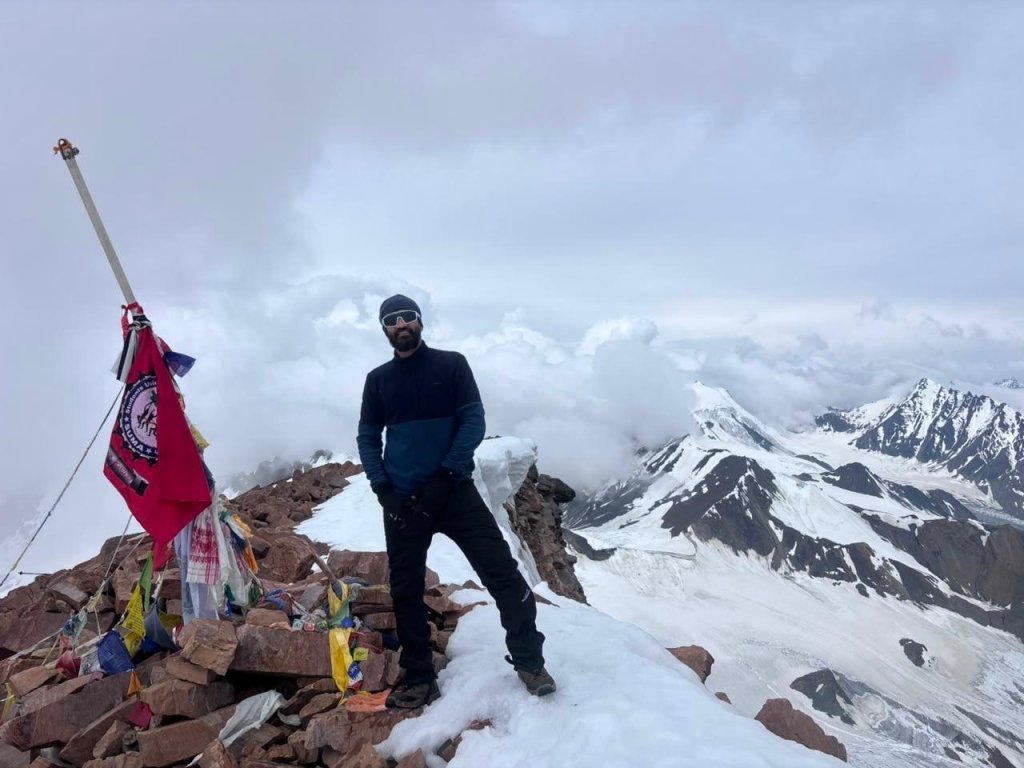
Independent Goan mountaineer Tarun Kerpal successfully summited Mt Yunam (6,111 metres / 20,049 feet) in Himachal Pradesh, marking a significant milestone in his mountaineering journey and adding another proud achievement to Goa’s growing adventure sports community.
Tarun reached the summit at 9.15 am on July 19, 2026, just a day before celebrating his 35th birthday, after a demanding high-altitude expedition that tested the team’s endurance, technical skills and resilience in the thin air of the trans-Himalayan region. The five-member expedition comprised experienced Himalayan climbers, with four members successfully reaching the summit.
The expedition began on July 17, with the team travelling to Bharatpur (4,600 metres) before trekking to an advanced camp established at approximately 5,500 metres. Following a day dedicated to acclimatisation, during which two members experienced symptoms of Acute Mountain Sickness (AMS), the summit push commenced at 4.00 am on July 19. They reached the summit between 8.25 am and 10.00 am before safely descending back to Bharatpur the same afternoon.
“Standing atop Mt. Yunam wasn’t just about reaching 6,111 metres. Every mountain reminds you how small you are and how much there is to learn. This climb is another step in a much longer journey,” Tarun shared.
MOUNTAINEERING JOURNEY
While the summit itself is a significant achievement, Mt. Yunam represents Tarun’s first successful ascent of a 6,000-metre Himalayan peak, an important benchmark for mountaineers preparing for more technical expeditions. For Tarun, however, mountaineering is not simply about collecting summits, but about embracing the discipline, humility and lifelong learning that the mountains demand.
Over the years, he has steadily built his experience through some of India’s most iconic high-altitude expeditions, including the Rupin Pass Trek (2018), Hampta Pass Trek (2021), Kedarkantha Winter Trek (2022) and the legendary Chadar Trek across the frozen Zanskar River in Ladakh (2023). The Chadar Trek remains one of India’s most demanding winter expeditions, requiring trekkers to navigate a frozen river in sub-zero temperatures through the dramatic Zanskar Gorge. Tarun was one of only 1,325 successful trekkers in 2023, when the trek resumed after a two-year hiatus, making the experience particularly memorable as one of the season’s pioneering expeditions.
TRAINING AND FUTURE GOALS
Determined to transition from trekking to technical mountaineering, Tarun completed the prestigious Basic Mountaineering Course (BMC) at the National Institute of Mountaineering and Adventure Sports (NIMAS), Arunachal Pradesh, in 2025. As part of the course, he underwent glacier and snowcraft training on the Mt. Gorichen Glacier, gaining hands-on experience in rock craft, ice craft, glacier travel, rope techniques and rescue procedures.
His journey continues later this year as he prepares to undertake the Advanced Mountaineering Course (AMC) at the Himalayan Mountaineering Institute (HMI), Darjeeling, one of India’s premier mountaineering institutes. Looking ahead, he also aspires to complete specialised Search and Rescue training, equipping himself with advanced skills required for high-altitude rescue operations.
“My dream is to inspire more people from Goa to discover the mountains, build a community of like-minded adventurers and encourage structured mountaineering training. Goa has always been celebrated for its beaches, but I believe it can also become known for producing passionate mountaineers,” he stated.
INSPIRING GOANS
Although Goa is renowned worldwide for its coastline and water sports, a quiet but growing community of adventure enthusiasts is now venturing into the Himalayas. Through his journey, Tarun hopes to inspire more Goans to explore mountaineering as a sport that builds resilience, leadership, teamwork and respect for nature.
As he prepares for more technically demanding expeditions and advanced mountaineering qualifications, Tarun’s journey shows that, with discipline, preparation and passion, a mountaineer from India’s smallest coastal state can stand confidently on Himalayan summits more than 6,000 metres above sea level.