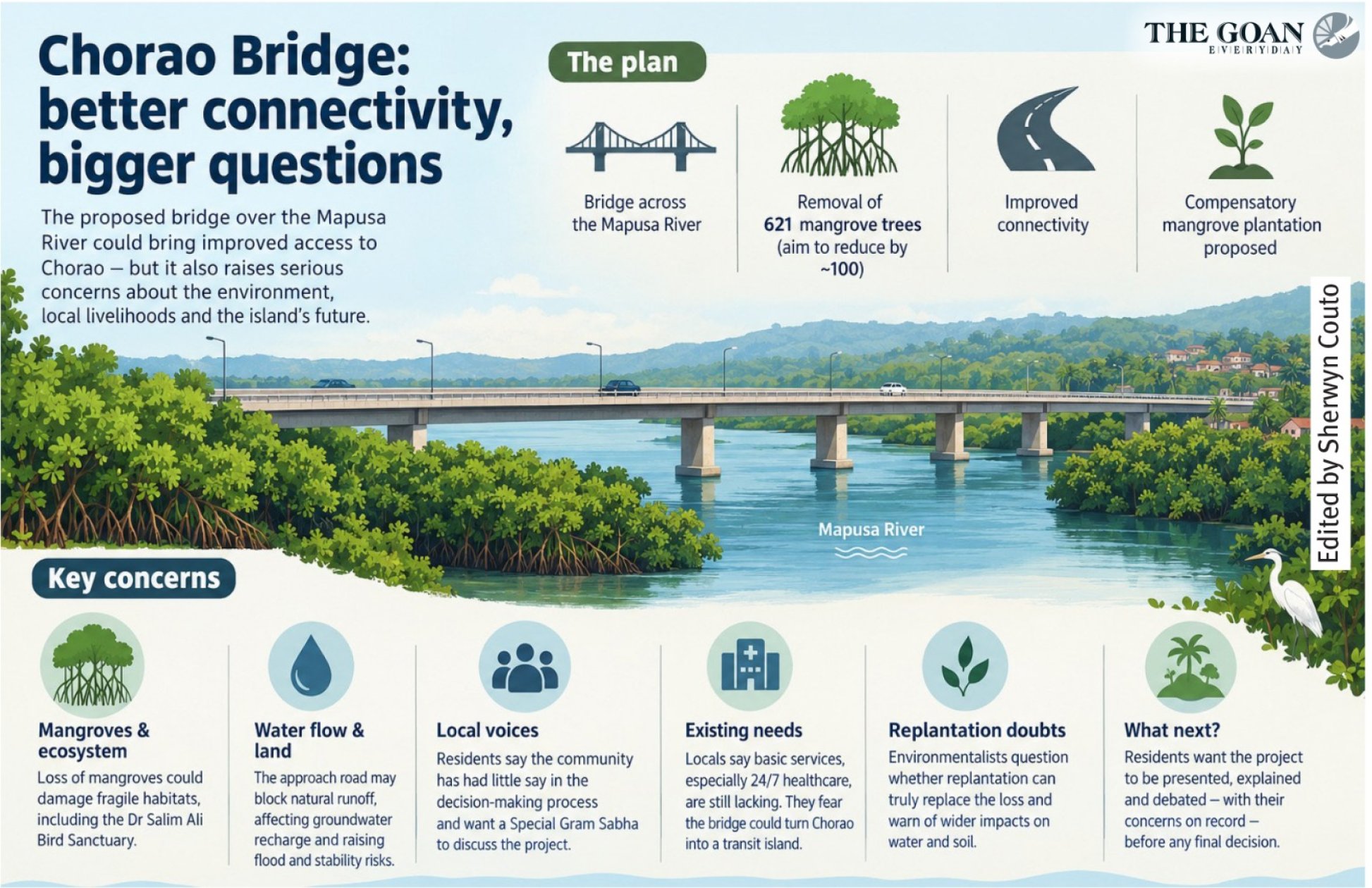
Hill cutting, deforestation, and wetland clearing have, unfortunately, been part of Goa’s development story for years. The proposed Chorao Bridge has brought another such project into focus, with the planned road link expected to improve connectivity while also requiring the removal of mangroves in an ecologically sensitive area. The project has consequently raised environmental and local concerns, even as better connectivity remains one of its key expected benefits.
Mangrove loss
The bridge will cross the Mapusa River and is expected to require the removal of 621 mangrove trees, although a revised plan is expected to reduce this by around 100. While measures have been proposed to minimise the ecological impact, including compensatory mangrove plantation, questions remain over the wider effects on the mangrove and khazan areas and the future development that improved connectivity could bring.
Local concerns
As voices for “Save Chorao” grow louder, concerns over the project are becoming clearer. “The manner in which this bridge has progressed has raised concerns as there has been very little involvement of the local community in the decision-making process,” says Eusebio D’Silva, a Chorao resident and an environmental and social activist associated with Save Chorao. He has also put forward a 10-point charter of demands before the authorities. “We do not want any changes to happen to our dear island. But we wish our needs and wants could be fulfilled rather,” says Rocky Vaz, another resident.
For many, the question is also whether the bridge addresses the needs of those already living on the island. Lisa Maria Dias Noronha points to the lack of basic services, particularly healthcare. “We have been asking for proper 24/7 medical services, but that has still not been provided. So when they speak of ‘better connectivity for medical services’, who exactly are we being connected to? The Porvorim side, which is already packed?” she asks. There is also concern that the bridge could eventually turn Chorao into a transit island, with residents fearing the impact of a project of this scale on their lives, property, environment and the island’s future. “The people deserve to be heard before, and not after, decisions affecting their island are implemented,” Eusebio says.
Ecological impact
The environmental impact remains another major concern. While the importance of mangroves is well known, environmentalists question whether cutting them for the bridge is justified. “The proposed Bridge will require clearing mangrove vegetation, causing an irreparable loss to the fragile ecology of the area,” says environmentalist Rajendra Kerkar, pointing out that the project will also affect the natural habitat around the Dr Salim Ali Bird Sanctuary, a notified and protected site. He adds that despite repeated assurances about protecting mangroves, similar projects have resulted in their destruction and degradation.
Mud architect and environmentalist Tallulah D’Silva shares similar concerns, questioning whether replantation can make up for the ecological damage. “When they say they will plant again, it is often just for namesake,” she says, pointing to the impact of previous projects and bridges. She also raises concerns about construction affecting the water. “The cement used may also change the pH of the water and cause further damage. Given all these concerns, I believe there are more sustainable ways to take development forward,” she says.
Water flow
Another concern is the proposed approach to the bridge, which involves a substantial earth-filled ramp that could block the natural runoff from the hill facing the Salim Ali Bird Sanctuary. During the monsoon, this water traditionally flows towards the agricultural fields, helping recharge Chorao’s groundwater. While the Government may provide a drainage system, questions remain over where the water will eventually go and whether diverting it into the river would mean losing an important natural resource. Disrupting the natural flow could also raise concerns over waterlogging, slope stability and risks to nearby homes and property.
Public hearing
Eusebio says the demand is not for the project to be stopped without hearing the Government’s side, but for the authorities to present it before a Special Gram Sabha, explain its rationale, benefits and safeguards, and allow people to put their concerns on record. “Many villagers feel the project is being imposed on the island, rather than being developed with the people through a participatory process,” he adds. “Simply giving a project a nod does not end the public discussion, nor does approval by an authority make a decision beyond scrutiny,” he says. “Chorao is our home. We will continue to speak for it, stand for it and protect its character for future generations,” he adds.
The bridge may bring better connectivity and new opportunities for Chorao, but residents want the island’s existing needs and natural environment to remain part of that conversation. As decision-makers look to build a new connection with the mainland, locals are also asking what will happen to the connection they already have with Chorao’s nature, mangroves, flora and fauna.