On the seventh day after Chaturthi, Cumbharjua comes alive with colour, music and scenes from epics, mythology and other stories. Goa’s Chavath is marked by traditions that vary from one region to another. Some remain small and are observed within homes, such as ‘Nave’, while others bring the community together on a larger scale, like Cumbharjua’s ‘Sangod utsav’.
A river procession
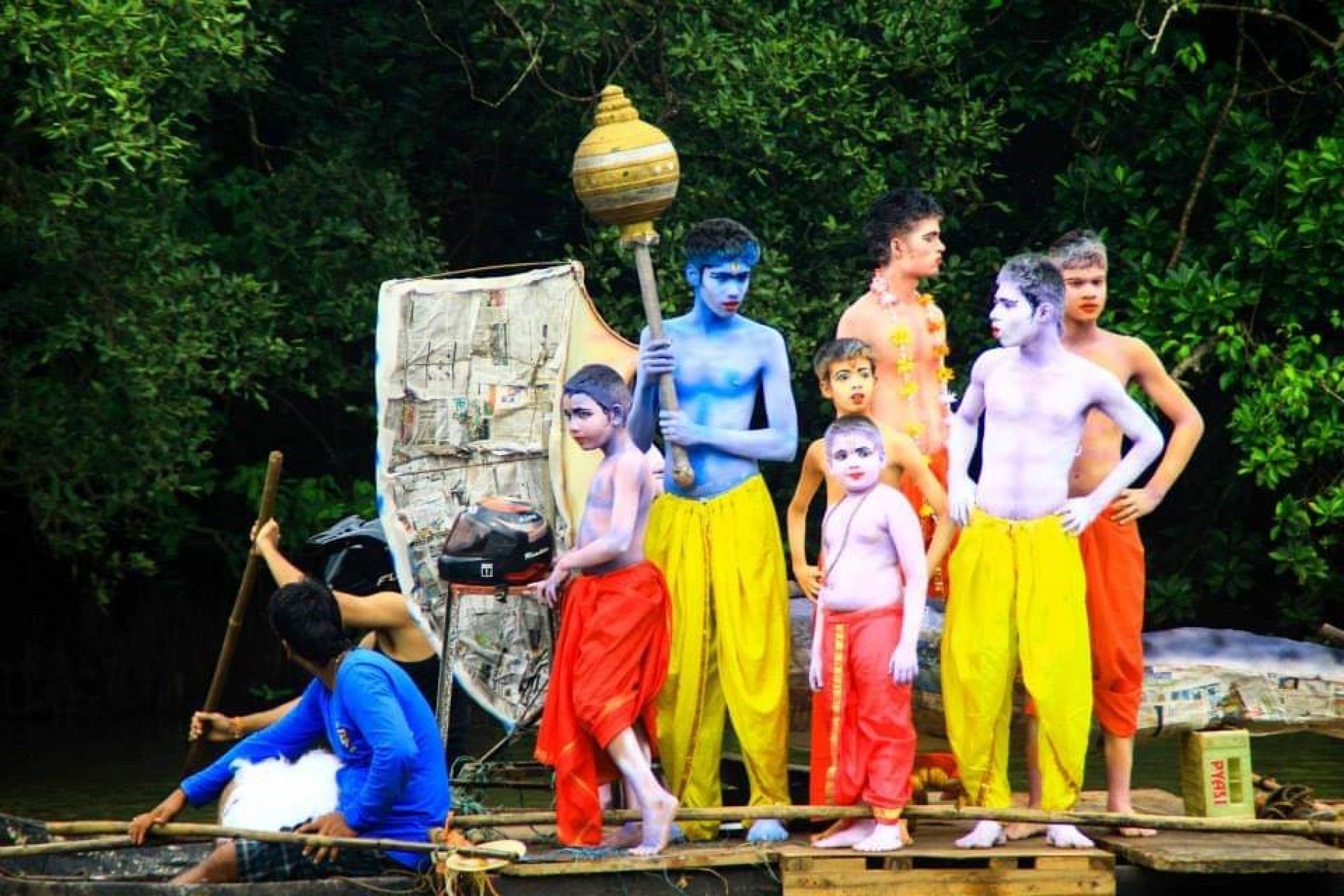
Colourful patakas, flowers, leaves and garlands adorn Sangods as an air of excitement builds along the river. As evening approaches, the decorated canoes begin to set out on the water, with the Sangod carrying the temple’s Ganesha idol. What began as a procession on the river has, over years, also become a way for villagers to present different stories, with the accompanying Sangods depicting scenes from the Ramayana, Mahabharata, Puranas, and other tales. As the Sangods make their way across the water, the river becomes the setting for these presentations, as the villagers watch from the banks. The procession makes five rounds along the river before Ganesha idol is immersed and prasada is distributed, bringing the seventh-day celebration to a close.
Meaning of Sangod
“What exactly is Sangod? It means the tying together of two canoes. That is called Sangod,” explains Dr Shivaji Mukund Shet, professional artist and research scholar and the President of Shree Shantadurga Kumbharjuvekarin Devasthan, Marcela. But Sangod is more than just a colourful procession. Its roots go back to the history of the village and a Ganesha’s visarjan tradition that has been followed for several years.
Temple’s history
According to Shet, the temple itself is nearly 500 years old. “During the Portuguese period, around 1550, the deity’s kalash was brought from Mangado in Korlim to Marcela. The temple was built in the almost 15th century, and the land for it was given by the comunidade of Vargaon,” he says, adding that the goddess is also known as the Bhatkann, that is, the landlord/landlady in Konkani, and some others also call her Devti.
According to Shet, the tradition of the Sangod is closely linked to the history of Cumbharjua, its people and Pandurang Wadiye’s family. He explains that Cumbharjua was originally associated with the potter community, with Kharvi, Brahmin, and other communities later settling in the village. “At that time, they worshipped Ganesha in their houses. There were one-foot to one-and-a-half-foot idols, usually orange or red in colour, placed inside a decorated wooden structure called a makar,” he remarks.
A family’s journey
During a difficult period when people in Cumbharjua faced problems accessing food grains and other essentials, with wooden boats being the only means of crossing the rivers, Shet says Pandurang Wadiye’s family, which lived in Cumbharjua, was among those affected and eventually sought the Devi’s prasada for guidance. “The Devi gave a call that they could keep the Ganesha idol in the temple and leave,” he says. The family then placed their Ganesha at the temple and left Cumbharjua. The idol, a small orange or sindoor-coloured Ganesha, has since been worshipped at the temple during Bhadrapada Shukla Paksha. Later, residents decided to take the temple Ganesha in a procession on the water. “They decided they would prepare a Sangod. The Ganesha of the temple would come onto the Mandovi River on the seventh day, and then the procession would start,” Shet says. The tradition continues to this day. The Sangod carrying Ganesha is followed by other decorated floats depicting mythological, historical and other stories, with the procession traditionally making five rounds along the river, between the Cumbharjua Bridge and the area near the old cashew factory.
Preparing the Sangod
“It is decorated with colour papers, patakas, flowers and various kinds of trees and bamboo,” says Viresh Naik, a resident of Cumbharjua, explaining the different elements that go into preparing a Sangod. He adds that the traditional entourage accompanying Devi’s Sangod includes the Bhat, or priest, Jalmi, Vajantri, temple committee members, and the Katkar, who carries the pole. Naik also mentions families that represent different traditional characters, including Betal, represented by the Sawant family, Shankasur, Amba-Ambika, and Riddhi-Siddhi. Around 15 Sangods, or canoes tied together, take part in the procession, making five rounds along the river before the idol is immersed and prasad is distributed.
Growing spectacle
Over the years, the Sangod has grown into a larger presentation, with floats depicting different mythological and historical scenes. “Now there is a big transformation of float presentations on water. It is similar to the floats of Shigmotsav. It has become big floats,” says Shet. While Ganesha is worshipped in Cumbharjua for different durations, preparations for the Sangod begin from Chaturthi and continue through the days leading up to the seventh-day procession. The larger dekhavas in the village begin their preparations much earlier, while the Sangod takes around 10 to 15 days to come together.
Yet, despite the additions and changes over the years, the essence of the tradition remains the same. On the seventh day, the Ganesha idol is taken from the temple to the river, followed by the decorated Sangods. For a few hours, the waters become a stage for stories, characters, and a tradition that the village has kept alive for centuries.