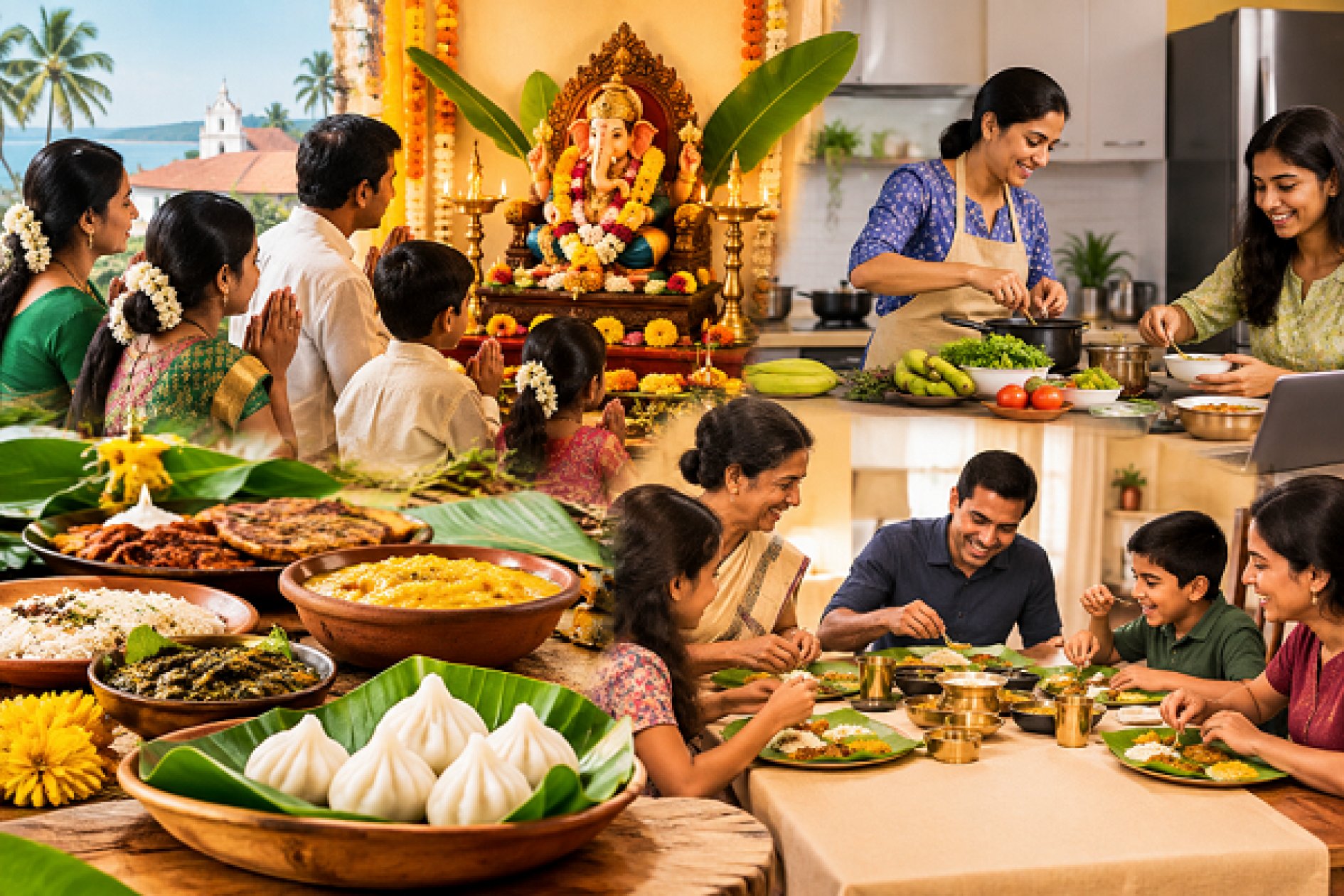
Goan houses will be filled with aromas over the next few days as Chaturthi approaches. Preparations begin days in advance. The menu is discussed; raw materials are brought and sometimes even prepared at home. Many Goan families return to their ancestral house where grandparents, uncles, aunts and cousins gather to celebrate Chavath! And while the house is filled with activity, it is often the kitchen that sees the most action.
HELPING HANDS
There are sweets to prepare, faral to be made, and naivedya to be arranged. It is a lot of work, particularly when the number of people at the dining table grows from the usual few to an entire extended family. Earlier, the work was often shared by almost everyone in the household. But as families have become smaller and working schedules busier, some households are now looking outside the family kitchen for help. Cooks, or ‘ranpis’, are increasingly being brought in to prepare the Chaturthi meals, sometimes working alone and sometimes with a team. For these ranpis or cooks, Chaturthi is hardly a last-minute affair. Some are booked weeks, months and sometimes even a year in advance.
TESTING TIME
A family priest from Mapusa, Acchal Hari Apte, who, along with his wife, Bhakti Acchal Apte, prepares Chaturthi food, says the planning starts well before the festival. “We usually have a set number of items like daal, rice, puri, kheer, bhaajis like mooga gaathi, ambada saansav, among others. We prepare these items and additional ones too, like ukdiche modaks, if anyone wants. They need to tell us months in advance,” he says. Bhakti Acchal Apte shares how it is a very hectic time for them as they have to make sure everything is just right. “We prepare the food at home and then give out orders. Usually it is the Hartalika day, Ganesh Chaturthi Day and the panchami day, but this year both Hartalika and Chaturthi are on the same day, so we have for just 2 days.” What started in COVID, they say, has gained tremendous response in the last five years.
ADVANCE BOOKING
The advance bookings are also a reflection of the demand for these cooks and how much food is prepared during the festival. What may be a manageable task for a family of four or five can become a much bigger job when several generations come together under one roof. For many of such cooks, Chaturthi is one of the hectic periods of the year. Vinod Desai, who has been doing this for the last 20+ years, says that this year too his schedule is packed. “I am completely busy till Anant Chaturdashi this year. One family, I have been going to their house for almost 20 years now,” he says. For Desai, the bookings come well in advance. “Often someone tells me that they want me to prepare their food for the next year’s Chaturthi as well,” he says, adding that his work doesn’t stop at cooking. “For Chaturthi, we have to cook while following the traditional ritual practices (sovlyaani), so I alone do that. Once the dishes are ready, I also offer the Naivedya to their Ganapati.”
For families, bringing in a ranpi can take some of the pressure off the kitchen while still allowing them to celebrate together. Veena Sawaikar is yet another person who has been cooking professionally for 28 years. “My preparations begin well in advance. As I also go to people’s houses and sometimes cook at home too, the ingredients have to be brought,” she says as she sits down to make Karanjyas. “It is not an easy task. Sometimes the family has no prior arrangements made. When that happens, it takes a lot of time, since it is a new place and I don’t know what is kept where,” she remarks, adding that her first step when she steps into another kitchen is to see that the cooking platform or the otto is clean. Her next line of action is to make sure the vegetables are cut, and the other ingredients are in place.
FAMILY TIME
The changing kitchen does not necessarily mean that the traditions around Chaturthi are disappearing. The food is still being prepared, the same familiar dishes still make their way to the table and families still gather around to eat together. What has changed, in some homes, is simply who is doing the work.
Yet, for many joint families, the fun is still in cooking together, with everyone pitching in, even the children, who may happily do their bit in exchange for the promise of another Ukdicha Modak. For younger families, however, juggling work and other responsibilities, bringing in a ranpi can take some of the pressure off the kitchen and leave them with more time to spend with their families, without giving up the traditional Chaturthi meal.
And perhaps that is another part of how festivals evolve. The recipes remain familiar, but the kitchens that produce them keep changing with the families that gather around the table. The food still retains the taste of a festive spirit; only, in some Goan homes, there may now be a different pair of hands doing it.