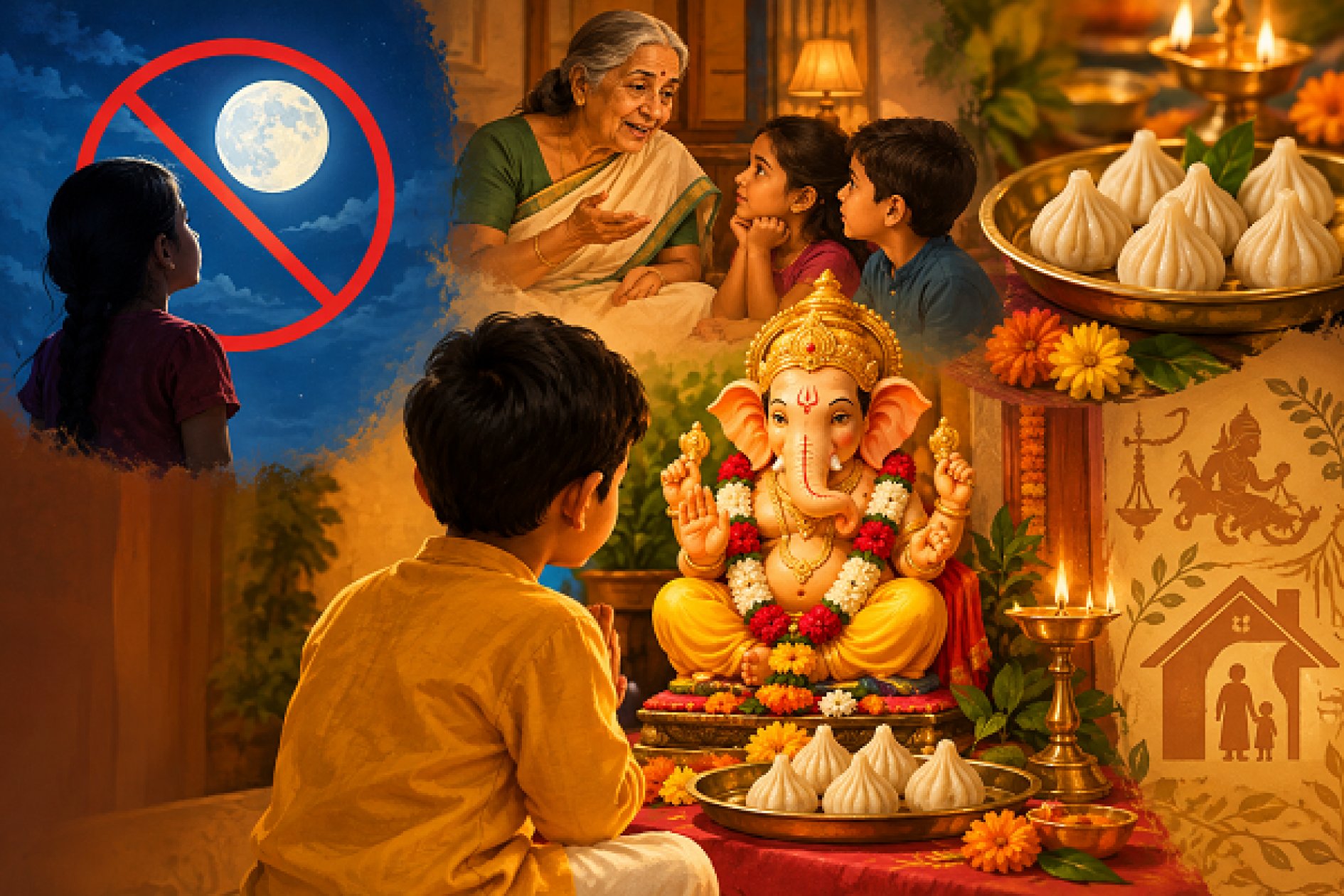
“Don’t look at the moon.” “Someone has to stay home with Bappa.” Chaturthi has always come with its own set of instructions, many of which were handed down to us long before we were old enough to understand why. As children, most of us followed these instructions. Ask why, however, and the answer was often a story told by a grandmother, a parent or an elder who had heard it from someone before them.
These little rules have become as much a part of Chaturthi as the modaks and aarti. Some are rooted in mythology, some in old customs, and others are traditions particular to a family. Yet, every year, they return with Bappa, reminding us of the stories we may have forgotten but the rituals we still remember to follow.
Don’t leave Bappa alone
The moment Bappa enters the house, the house somehow feels a little different. In many homes, leaving the Ganpati idol completely unattended is simply not done. The reason elders give is almost endearingly simple: Bappa has come home, so how can you leave him alone? The idol is treated not merely as something placed for worship but as a guest who has arrived for a few days. Just as you would not invite someone home and then disappear, the family is expected to remain around Bappa and look after his space.
Don’t offer Tulsi
There is something particularly curious about this rule. Tulsi is considered sacred in many Hindu homes and is carefully tended throughout the year. Yet, when the Ganpati puja begins, it is not among the leaves being offered to Bappa. The story behind it goes back to a legend involving Tulsi and Ganesha. According to the story, Tulsi came across Ganesha while he was immersed in meditation and expressed her desire to marry him. Ganesha refused, choosing the life of a celibate. The disagreement that followed resulted in curses being exchanged, and one version of the story says that Tulsi was then forbidden from being offered to Ganesha.
Don’t bring a standing Ganapati
For some families, choosing Bappa is not as simple as walking into a shop and picking the idol that looks the nicest. There are discussions about the size, the face, the trunk, the decorations and, sometimes, one detail that cannot be overlooked: Bappa must be seated. The belief is so because the first thing you offer any guest who comes home is a seat. However, it is not a universal rule, and plenty of families worship standing Ganpati idols. But for those who have grown up with this custom, a standing idol feels hurried, while a seated Bappa signifies a relaxed guest who is settling in to bless the household with peace and stability.
Don't tie the Matoli after Bappa arrives
In Goa, Chavath is inseparable from the Matoli, the elaborate wooden canopy suspended above the idol, heavily laden with seasonal fruits, vegetables, and wild forest produce. A strict rule in traditional Goan homes is that this canopy must be completely assembled before the Ganpati idol is officially seated on the altar. Elders insist that nature’s grand roof must be ready to welcome the Lord. Hanging the canopy or tying the bunches of betel nuts after He has taken His place is considered deeply disrespectful, akin to preparing a guest’s room only after they have walked through your front door. The vibrant Matoli is Bappa's royal pavilion, and it must always await its king.
Don’t look at the moon
Then there is the warning that has probably been repeated more times than any other on Chaturthi: don't look at the moon.
As children, this could make the moon feel almost like something forbidden. A quick glance at the sky and someone would immediately remind you to look away. But behind the warning is the story of how the Moon once laughed at Ganesha's appearance. Angered by the insult, Ganesha cursed the Moon and said that anyone who saw it on Chaturthi would face false accusations of robbery. And so, every Chaturthi, an old story finds its way into an otherwise ordinary evening.
While purohits explain that the moon is generally considered the god of the mind. Hence after creating the auspicious atmosphere of surrender to the supreme during the puja, looking at the moon again becomes a conflict of emotions.
The reasons may be forgotten over time, but the restrictions remain. And every Chaturthi, as the same rituals are avoided, the stories behind them get another chance to be told.