THE GOAN
PANAJI
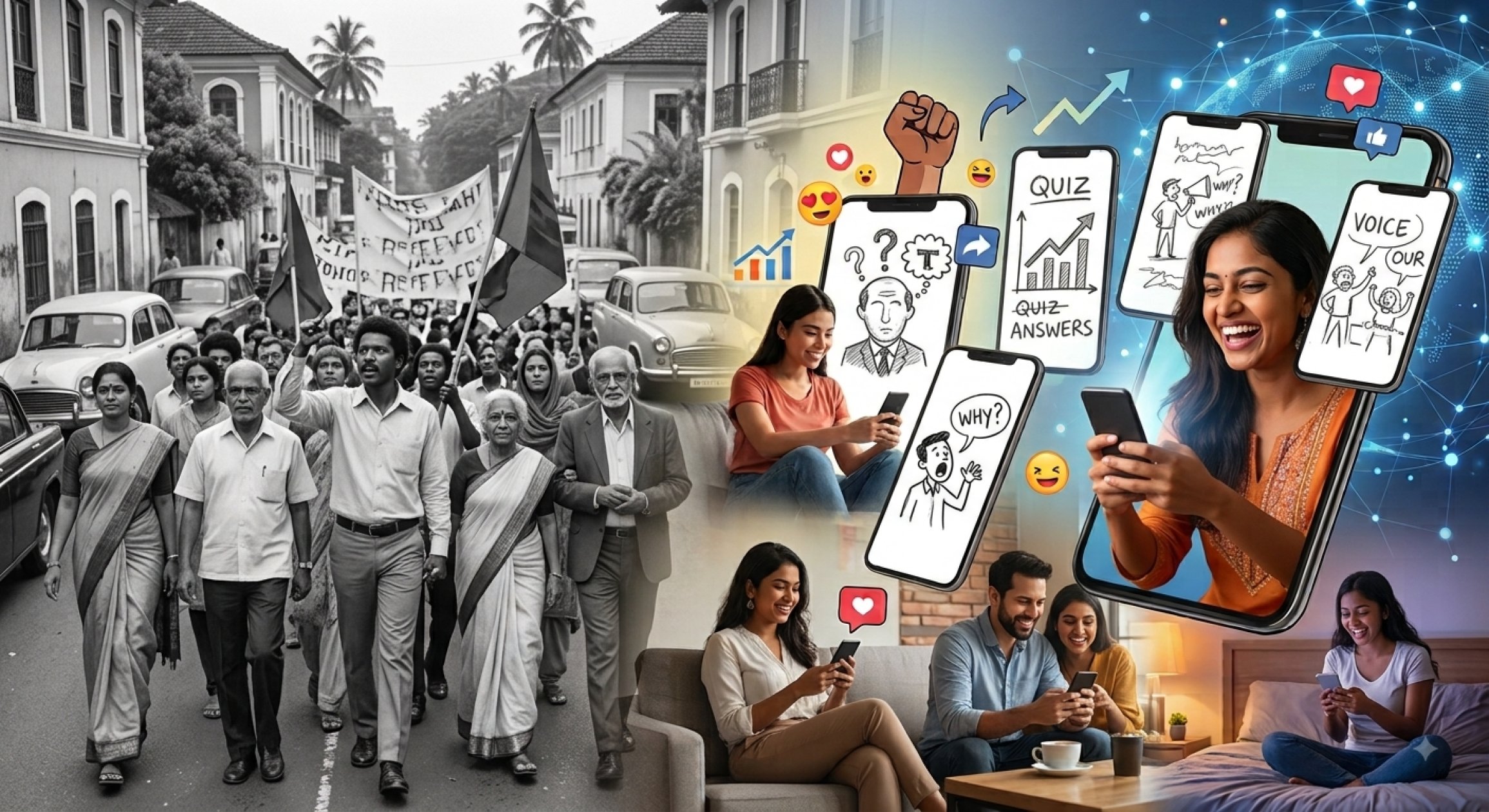
What if the next political movement does not begin with a rally, but with a reel? While it may sound unlikely, it is not entirely impossible, as the way in which young people are engaging with politics is changing. From satire and social media videos to street protests and community-led movements, the youth are finding ways to question those in power that go beyond traditional politics. For a generation that has often been accused of being politically indifferent, the picture looks quite different today.
Satire speaks
From satire and social media reels to an entire movement emerging from a website marked as satire, which ultimately led to the education minister stepping down, these developments show how actively the youth are participating in matters that are affecting them while simultaneously demanding answers from those in power. Satire, in particular, has helped break the larger-than-life image politicians often have around themselves. The idea that they are unaccountable or beyond criticism is being challenged as the youth ask them questions, call out decisions and, at times, simply make fun of the very people they once saw as too powerful to question.
Shravani Govind Gaude, a student, remarks that the distrust in some sections of the mainstream media has contributed to the growing use of social media as a tool for reporting the happenings on ground. “We’ve all seen how the mainstream has drastically failed to cover the major topics happening in the country, and it’s very disappointing. Because they fail to provide coverage of authentic news, the social media platforms have to intervene,” she remarks. Amreen Shaikh, a social activist, adds that social media makes complex events, news or any other issues easy to understand. “Satire, on the other hand, makes heavy topics seem approachable, which helps people drop their cynicism and actually start asking questions,” she adds.
Beyond online
But political participation is not limited to what happens online. For too long, politics has been treated as something that young people can participate in only after they have “grown up”. Shohail Francis Furtado, a youth leader, expresses his happiness at seeing the increasing participation of young people. “At the end of the day we are the ones who will inherit the future that today’s politicians are creating,” he remarks.
While Shohail sees a growing participation, Amreen believes that the youth were never really indifferent to politics. “We just didn't connect with old-school party politics. What’s changing now is that young people are stepping up because the issues have hit close to home,” she states. The youth are now realising that if they do not speak up, no one else will. “People are taking ownership of their local spaces through peaceful, community-led action rather than waiting on traditional political machinery,” she adds.
Starting local
With that being said, youth participation thus becomes crucial, and being politically involved does not necessarily mean being present at every protest. Dr Shoaib believes that taking an active part in political discourse can begin much closer to home. “Rather, it means having the relevant discussions among your friends circle, family dinner table, and most importantly asking your elected representatives the right questions,” he mentions. For Shohail, however, the next step is to see more young people actually enter politics because they have something to contribute, not simply because of their surname. “I believe Goa needs a Youth Sarkar, a government where the youth aren't merely spoken about, but are actually sitting at the decision-making table,” he remarks.
Changing discourse
Shravani too believes that the youth, including the upcoming generation, are the backbone of the country and the state. “Hence, for us to be taking part actively in political discourses is equally important as actively playing or watching football games, cricket games and concerts,” she shares. Dr Shoaib is confident that the youth have already started changing the political discourse. He recalls that previously many people, particularly young people, would hesitate to criticise the government publicly “Today, you see young people questioning government decisions much more openly and calling out policies they believe are anti-people,” he says, adding that it is a significant shift. For Amreen, this growing participation matters because the youth are ultimately the biggest stakeholders in the future being shaped today. “India being the nation with the highest young population, if we aren't part of the discussion, decisions get made without considering the representation of the youth,” she reckons.
Perhaps that is the biggest change taking place. The youth are not necessarily moving away from politics, but finding their own way into it. Whether it is through a reel, a protest, a conversation at the dinner table or eventually a seat at the decision-making table, young people are beginning to realise that politics is not something that happens around them. The decisions being made today will shape the Goa and the India they inherit tomorrow, and they increasingly want to have a say in what that future looks like.