THE GOAN
PANAJI
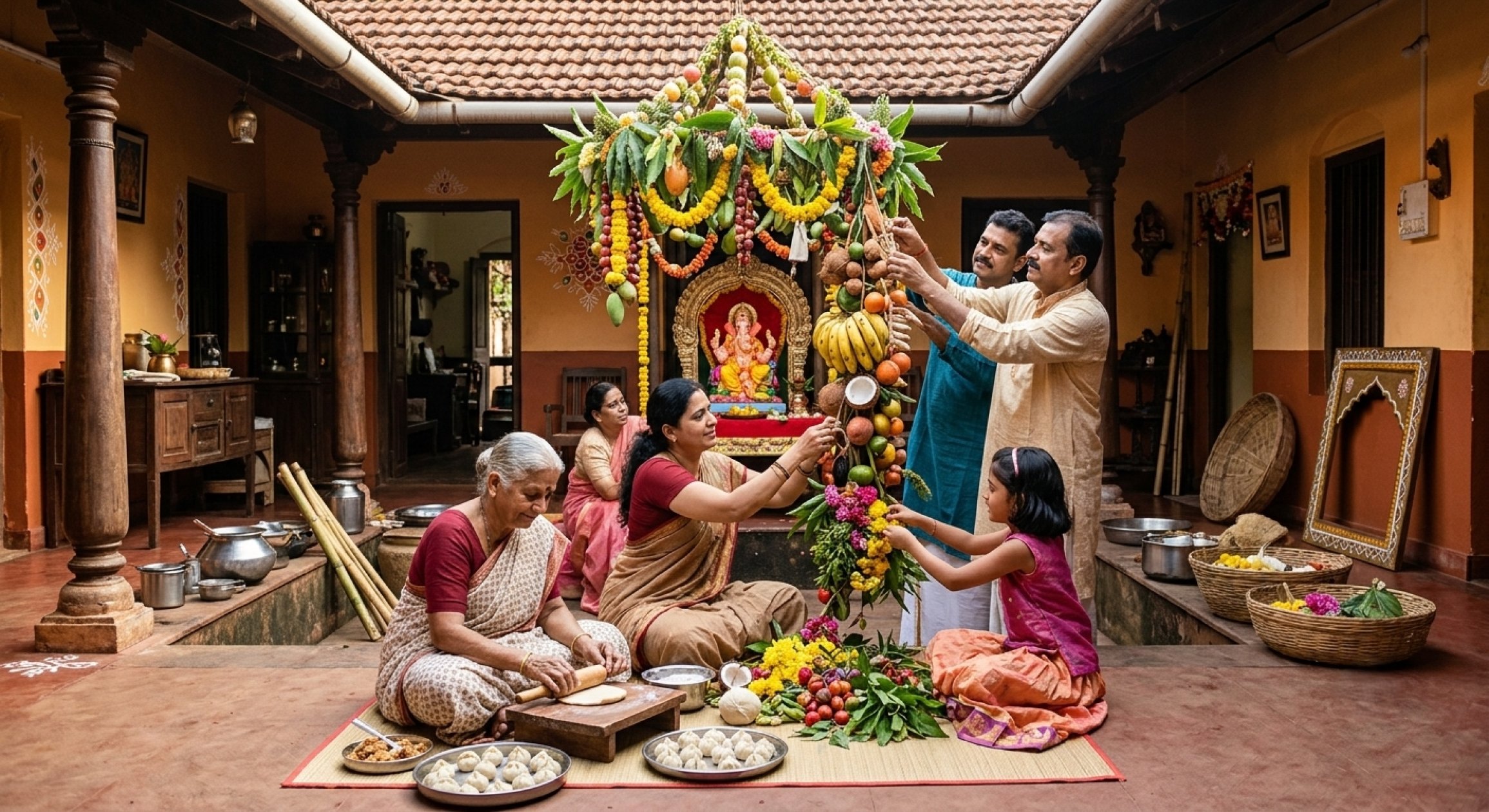
The countdown to Ganesh Chaturthi has begun, and Goa is already slipping into the festive frenzy. With less than a week to go, Nevryeos are being prepared, Vojem are being sent, decorations are taking shape, and matolis are being carefully arranged. Across homes and neighbourhoods, the familiar sights, sounds and smells of Chaturthi are slowly taking over, signalling the arrival of one of Goa’s most awaited festivals. More than just a celebration, Ganesh Chaturthi holds a special place in the hearts and homes of Goans, as families prepare to welcome their beloved Lord Ganapati home once again. For many, the preparations are also a time to return to customs followed in their homes for generations.
Tuesday Visarjan
For once, Monday is being much looked forward to, as Chaturthi, or Chavath as it is commonly called in Goa, falls on September 14, 2026. For many families who traditionally celebrate it for one-and-a-half days, or ‘dedh dis’, this has led to some hesitation as the Visarjan falls on Tuesday, which is commonly believed to be an auspicious day for Lord Ganesh. However, this is a widely held misconception, as the day of the week does not determine when the Visarjan should be done. The concern, therefore, appears to stem more from a commonly held belief than from any specific religious restriction surrounding the immersion.
But does the day on which Visarjan falls really matter? We spoke to a few Purohits to understand whether the fact that Visarjan falls on a Tuesday has any relevance or is simply a commonly held belief. “Ganapati Vrat is dedh disacho. Ganapati comes to our house on Chaturthi (the fourth day of the waxing moon phase in the Hindu month of Bhadrapada) and the Visarjan is on Panchami; hence the days of the week aren’t of much significance,” explains Purohit Sandeep Tengse. He further adds, “Here what matters more is the Muhurt of visarjan, which is the Panchami.” Bhatt Kunal echoes this view, saying that families who have traditionally followed the one-and-a-half-day celebration need not alter their practice based on the weekday. “If you have been keeping it annually for dedh dis, then you should go about your Puja without changing anything. The Visarjan should be done as follows on the day after Ganesh Chaturthi,” he says, reiterating that the traditional observance is guided by the tithi rather than the day of the week.
Vaddo traditions
While the one-and-a-half-day tradition is followed by many families, the duration of Ganapati celebrations can differ from one vaddo to another. Bhatt Raju from Shri Bal Ganesh Mandir, Campal, explains that there is also a tradition known as ‘Tisaal’ or ‘Tisrao’, where the duration of the Ganapati celebration follows a cycle decided collectively by the village or vaddo, based on a tradition passed down by their ancestors. Under this practice, Ganapati is kept for one-and-a-half days for two consecutive years, while in the third year, the celebration is extended to five or seven days, or for whatever duration has been traditionally decided. “We have ‘Tisaal’ on our vaddo, where for two years we keep Ganapati for dedh dis and in the third year for five days. So, for us, the fact that Visarjan falls on a Tuesday is not relevant,” says Sai, a resident of Santa Cruz. “It is similar to the annual tradition that people generally follow, so the day of the week still does not matter,” adds Bhatt Raju.
Personal vows
The same applies to families who keep Ganapati for a longer duration based on a personal vow. “Often when families pray, and their prayers are answered, they promise to have the Ganapati for five or seven days, without knowing which day Chaturthi falls or when the Visarjan will be,” says Purohit Tengse. He adds that such promises should be honoured, as “it would be best that they fulfil the promise which they have made in their mind.” He believes that once a person has made such a promise, it would not be right to go back on it simply because the Visarjan falls on a particular day.
So, while families following the one-and-a-half-day tradition can go ahead with the Visarjan on Tuesday without hesitation, there is no particular significance attached to the weekday. What remains fascinating, however, is how Chaturthi takes on different forms across Goa, with each family and vaddo having its own customs, whether it is the number of days Ganapati is kept, the matoli, the nevryeos, or traditions like Tisaal. These variations are what make the festival as much about keeping traditions alive as they are about welcoming Ganapati home.