


Dr Alvarinho J Luis
Ganesh Chaturthi commemorates the birth of Lord Ganesha, the beloved son of Lord Shiva and Goddess Parvati. Revered as the remover of obstacles and the first deity to be worshipped before beginning any new venture, Ganesha holds a special place in Hindu tradition.
The festival lasts from 1½ days to as many as 21 days, culminating in the immersion (visarjan) of the idol. In Goa, however, Ganesh Chaturthi, locally known as Chovath, has a distinctive character. Celebrations are held at ancestral homes, creating an atmosphere that is intimate, warm and deeply rooted in family traditions.
Most Goan families venerate the idol for 1½, 3, 5, 7, 9 or 11 days, while some community and regional traditions extend the celebrations to 21 days. Some families and villages also follow ancestral customs such as Tisaal, in which the celebration's duration may rotate or vary according to longstanding family vows and traditions.
According to Hindu mythology, Goddess Parvati created Ganesha from sandalwood paste and breathed life into him. She entrusted him with guarding the entrance while she bathed, instructing him not to allow anyone to enter.
When Lord Shiva arrived and was stopped by Ganesha, he became enraged and, in the ensuing confrontation, severed the young boy’s head. Heartbroken by the loss of her son, Parvati demanded that Ganesha be restored to life. Filled with remorse, Shiva promised to revive him. His Ganas, or attendants, brought the head of a young elephant, which Shiva placed on Ganesha’s body, restoring him to life.
Dance: The vibrant fugdi
During Ganesh Chaturthi, women in Goa traditionally perform Fugdi, a vibrant, energetic folk dance that combines devotion, celebration, and community spirit. Originating in the Konkan region of Goa and Maharashtra, Fugdi is performed primarily by women during religious festivals such as Ganesh Chaturthi, Vrata and Dhalo, as well as at weddings and other social occasions.
Passed down through generations, the dance serves not only as entertainment but also as a way to preserve Goa’s rich folk traditions, stories, and cultural identity. Traditionally, Fugdi is performed without musical instruments. The rhythm comes from hand-clapping, coordinated movements, and the distinctive foo or fu sound dancers produce through controlled breathing.
Dancers often move in circles or coordinated formations, creating a lively display of rhythm and togetherness. The simplicity of the dance, combined with its energy, fosters a strong sense of unity, devotion, and shared joy, making Fugdi an enduring and cherished part of Goa’s cultural heritage.
Traditional Bhog
Chaturthi celebrations in Goa are incomplete without preparing traditional bhog—devotional offerings made to Lord Ganesha. While modak is his favourite sweet, the festival table is traditionally filled with a variety of homemade delicacies, each prepared with devotion and holding a special place in the celebrations.
The most iconic offering is Ukadiche Modak, a steamed rice-flour dumpling filled with coconut, jaggery and dry fruits. Other popular sweets include Talniche Modak, Motichoor Laddoo, Coconut Laddoo, Besan Laddoo, Karanji, Shrikhand, Coconut Barfi and Puran Poli. Nevrio, filled with coconut, semolina, sugar and dry fruits, is a traditional delicacy.
Among the savoury and traditional preparations are Coconut Rice and Patholi. Patholi is particularly distinctive, consisting of rice-flour rolls filled with coconut and jaggery and steamed in fragrant turmeric leaves. Preparing these delicacies is more than culinary tradition—it is an expression of devotion, family bonding, and cultural heritage, with recipes passed down through generations.
During the festival, many families also follow dietary customs, abstaining from meat, fish, eggs, and alcohol, while avoiding onion, garlic, and ginger after Sthapana. Tulsi leaves are traditionally not offered to Ganesha. Food is first offered to the deity as naivedya before being shared among family and guests, reflecting the spirit of gratitude and devotion at the heart of Chaturthi.
Some unique Visarjan
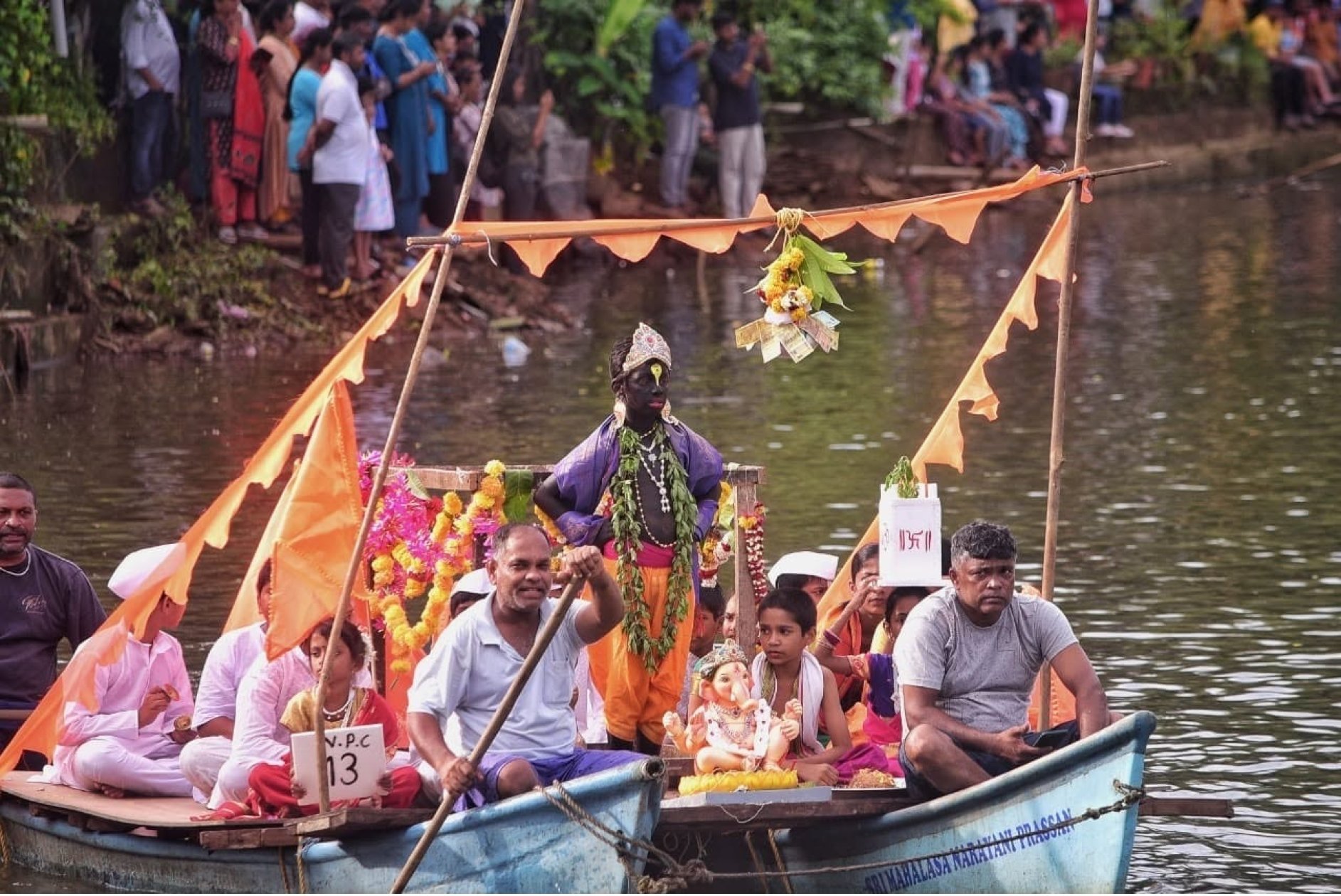
Goa’s traditional immersions are closely intertwined with local rituals, community participation, and cultural performances. Among the most spectacular is the Sangod Utsav, celebrated on the seventh day at the Cumbharjua Canal. Centered around the Shantadurga Kumbharjuvekarin Temple in Marcel, the festival brings together villagers, devotees and visitors in a vibrant celebration of faith and Goan culture.
Following prayers and rituals, the Ganesh idol is carried in procession and placed on a sangod, a decorated platform formed by joining two traditional canoes. The sangod makes five ceremonial rounds of the canal before the idol is immersed, amid chants of “Ganpati Bappa Morya, Pudhchya Varshi Lavkar Ya”
The decorated sangods often depict scenes from the Ramayana, Mahabharata, folk tales and contemporary social themes. Young villagers play a major role in designing the floats, preparing costumes, rehearsing performances and navigating the canoes, turning the canal into a vibrant open-air theatre. Families and entire wards from Golwada, Marcel, Rambhuvanwada and neighbouring areas participate collectively, transforming the festival into a celebration of creativity, cooperation and community pride.
Another distinctive tradition is the Kutumbaka Ganeshotsav at Adpai, Ponda, held on the fifth day of the festival. Seventeen families come together for a shared celebration, with each family bringing an idol presented in a unique tableau, complete with coordinated costumes and colour themes. The festivities culminate in immersing the idols in the Zuari River.
At Saleri in Agonda, Canacona, the Visarjan has its own intimate character. Families bring Ganesh idols from the ward and place them together in a line before immersion. Prayers, aarti, and traditional lamps add to the deeply devotional atmosphere.
Together, these diverse traditions demonstrate that Visarjan in Goa is far more than the conclusion of a festival—it is a celebration of faith, family, culture, creativity and the enduring community spirit of Goan society.


