THE GOAN NETWORK
From helping them plough and till the land to providing milk, the cattle played an important role in sustaining farming households. Much of the responsibility of running a farm rested on these humble creatures, quite literally on their shoulders! Thus, for cattle owners and herders across Goa, Gorvancho Padwo is a day to pay their respects and express gratitude to these animals for sustaining their livelihoods and supporting their fields. Also known as Gurancho Padwo, Gorvacho Padvo, or Gorvan Utsav, the festival is a day of rest for cattle and a day of celebration for their owners.
AGRICULTURAL SIGNIFICANCE
While a puja is performed in almost every household that owns cattle, the customs and rituals vary across Goa. The central idea, however, remains the worship of cattle and recognition of their contribution to farming. Some villages also follow distinctive traditions involving cow-dung models, special food preparations, village processions and community gatherings.
“This festival is celebrated as it is believed that Lord Krishna lifted the Govardhan Parvat on this day. Cattle are thus revered and worshipped today,” explains Siddhesh Acharya, a fourth-generation priest at the Devaki Krishna Temple in Marcel. For many families, the day also involves preparing special culinary offerings for their cattle.
TRADITIONAL OFFERINGS
One of the traditional preparations associated with the festival is poley or polem, savoury dosas usually made from parboiled rice (ukde tandul) and urad dal. “A unique ritual involves stringing these poley together and hanging them around the necks of cows and bulls before feeding them,” says Milan Naik from Sancoale, who looks after the Shankhavali Theerthkshetra Gaushala. The remaining poley are shared among family members and neighbours as prasad.
CATTLE WORSHIP
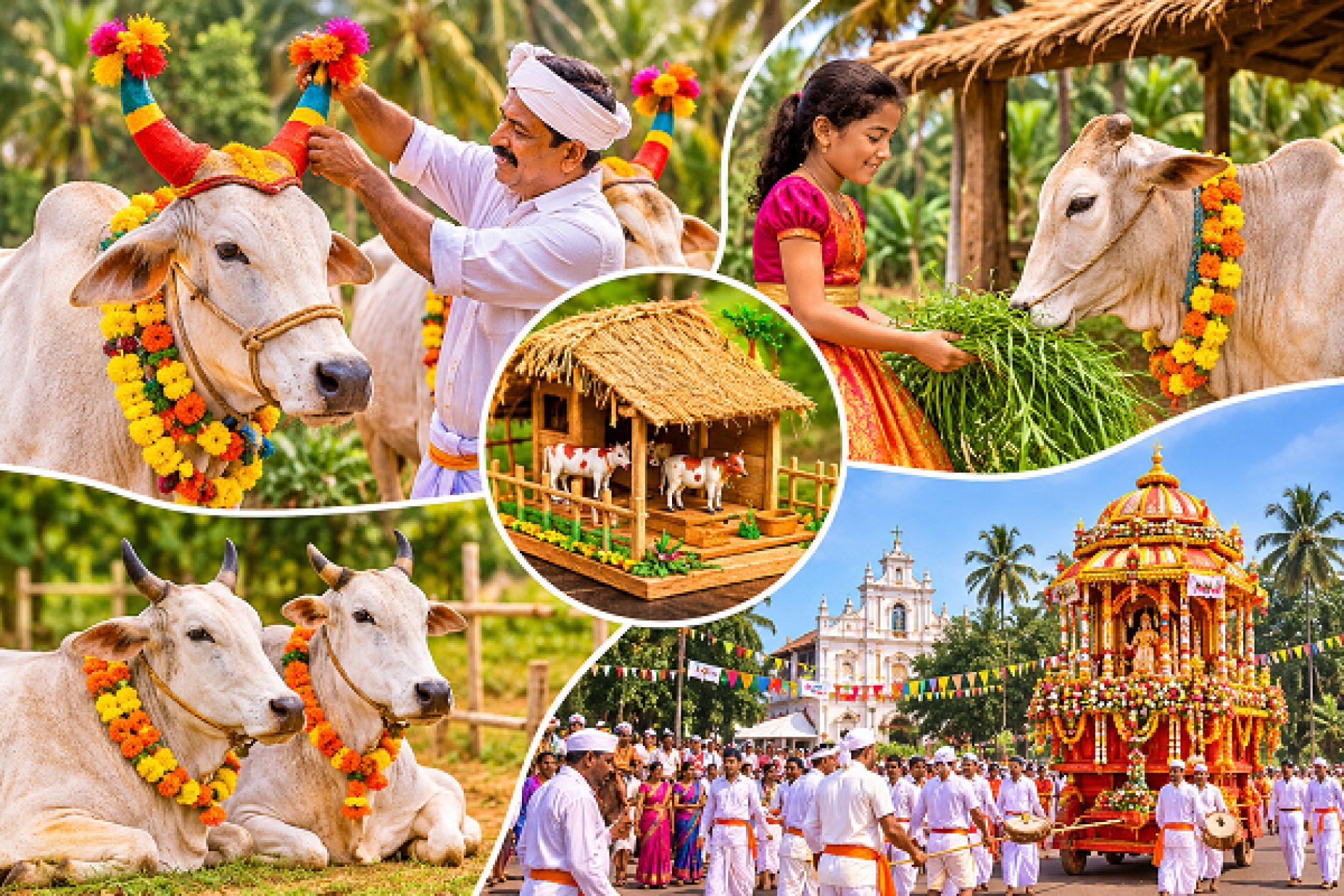
While the poley are being prepared at home, preparations in the cowshed begin early in the morning too. People wash and scrub the cattle, thoroughly clean the cowshed, apply kumkum to their foreheads, and perform a puja. “In some families, the horns are also painted with red vermillion and flower garlands are tied around their necks,” says Subhadra Satardekar from Maulanguinim, who has been looking after cattle for several years. “The cattle are massaged with oil, while their backs are often decorated with colourful powder designs. They are also draped in new stoles or cloth,” she adds. Another way of decorating the animals is by making designs across their bodies. “We take wooden rice bowls, traditionally used to measure rice, dip them in a paste of white clay and use them to create designs on the cows’ bodies,” says Avinash Naik from Mayem.
Once the puja is complete and the cattle are left to graze, the family prepares the ‘vaddo’, a miniature representation of the cowshed. “The vaddo is made using cow dung and mud. A bavali (doll) is also placed inside, along with a rakhno, and a puja is offered to the miniature cowshed along with naivedya,” Satardekar explains.
VILLAGE CELEBRATIONS
In Marcel, another distinctive ritual is observed, where the temple rath carrying the deity is offered a mala or garland of ‘doodhache pedhe’ (milk pedhas). “Since this temple is dedicated to Lord Krishna, this utsav becomes a Gavcho Utsav (village celebration),” says Acharya. He mentions that at around 8.30 in the morning, the rath carrying the Lord is taken on a procession around the temple premises. “The rath is adorned with the gude and makes a stop at every house, and every household then makes an offering of doodhache pedhe to the rath,” he mentions. Acharya adds that in earlier times, families prepared these pedhas at home.
Gorvancho Padwo is, therefore, more than a day of rituals and offerings. It is an occasion to acknowledge the important place cattle have held in Goa’s agricultural life and the care and respect they have traditionally received from farming households. “The festival commemorates the invaluable role of cows and cattle in traditional agricultural life. It reflects the Hindu belief that cows are sacred and deserve reverence, kindness and protection,” says Kamlakant Tari (Shikeri Gaushala) from Mayem.
While farming practices have changed over the years, the festival continues to preserve this connection between people and cattle. Through the different customs and celebrations observed across Goa, Gorvancho Padwo remains a day to recognise the animals that have been and continue to be an essential part of everyday life in farming households.