


#TGLIFE
Despite plenty of awareness campaigns and workshops conducted to educate people about the huge problem of waste management and segregation, there is still a tendency of some people to let others clean after their mess. David D'Souza of SID Allied Ventures wants to change this misconception. And he believes that the best way to do this is by educating the next generation.
"I have been working on garbage management for the last six to seven years. There have been a lot of challenges that I have come across, one of the biggest challenges I've faced is the concept that people have, ‘we litter and someone else will clean'. We mess up the place and complain about the government not clearing the garbage. And the same concept has been passed down to our children," says David. Another point that he wants to highlight is that since garbage is created everyday, the issue of taking care of and eradicating it becomes a daily issue. "There has to be some mechanism put in place, considering that Goa has a very large population of local residents and tourists who visit the state every day," he says, adding that cleanliness is not a drive. "It has to become a habit. We cannot clean one spot today and move on to the next spot tomorrow. Cleanliness in an ongoing process." There is also the question of the huge cost involved. "The entire exercise of maintaining and cleaning a place is very expensive. If we do not look into these matters seriously, then we can expect something more catastrophic in the days to come," he states. And thus the campaign ‘We Litter, We Clean' came about.
" ‘We Litter We Clean' means that we are taking the onus on ourselves ensuring that we do not make a mess and keep the place clean. We are doing our bit to educate our children in that manner. Hopefully two or three years down the line, we will see a lot less litter around us," says David.
But rather than just giving out this message in a monotonous manner, SID Allied Ventures has teamed up with musicians and artists for a more fun manner of educating youngsters. It aims to cover across 200 schools in Goa to educate children on waste management, garbage segregation and waste compost. "We have different activities lined up for students where we will communicate this message in a way which is attractive to the students - through song and dance and art. We pep the students up and give them a talk about garbage segregation," explains David.
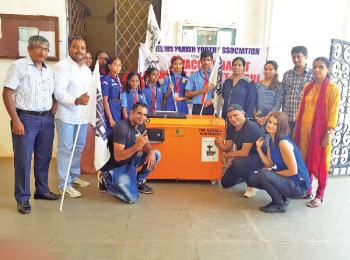
Varun Carvalho and his band Rise Nation Army for instance have created a special vehicle which drove to schools across the state to engage students via mini concerts, talks and demos on waste management. Varun has also composed a special song ‘Stand Up for What Is Right'.
The campaign kicked off at Our Lady of Remedies High School in Nerul and travelled to Little Flower of Jesus High School, Calangute, St. Micheal's Anjuna and Sharada Mandir High School, Miramar.
"This is a phase one process wherein we are trying to request schools to set up composting units. We will demonstrate the manner in which the composting units are set up and how they will be operated. I want the children to get involved in the entire exercise. The students should not only go back to their parents informing them about waste management; but also within the school vicinity and inform the teachers about installing the composting unit. The ideas is that when students go about spreading awareness, people will get educated and be more interested," says David. As part of this, they have begun a mentor/mentee program which will run across schools.
"The mentor/mentee program I would say, will show some sign of progress by the year 2020. The mentees are sixth and seventh standard students and mentors are eighth to ninth standard students. Students in year nine are already shifting to high schools. If there is a change in the mindset of those students its good," he explains, adding that he is targeting the sixth standard students. "Three years down the line the junior will become a mentor and will be in the ninth standard students in the year 2020. Hopefully in those three years, he will segregate waste at home and understands the importance of not littering. Not littering will become a habit and in three years' theses students will become responsible citizens," he says.


