


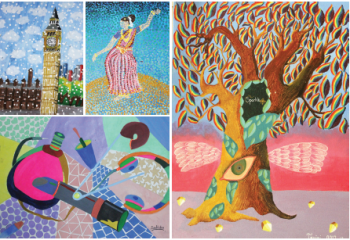
Allowing a little less than 100 kids to work freely with their imagination, Goan artist and art teacher Chaitali Morajkar has opened up a new window for them “ through a unique art show that exhibits 200 artworks each unique and totally different from the other. “It’s a feast for the eyes,” she exclaims.
Chaitali who feels that art is as natural as sunshine and as vital as nourishment believes that all children should be introduced to art and its immense possibilities. “I want them to know the elements and principles of art. I want to develop their inborn sense of design, imagination, visualisation and creativity “ which plays very crucial role in their formative years. It is very important at a young age as it helps their overall, holistic growth and also helps them to excel academically,” she says.
The exhibition which will be open from 11 am to 7 pm, includes children from seven different batches. “After working with them for some days, I now know their temperament, likes and dislikes as well as what they are good at. So it’s easier to work on them and develop their inborn talents. Children learn a lot through sharing and as each one is unique they all learned from each other,” says Chaitali.
Chaitali also observes that today’s parents encourage children to take up art, realising that art makes a person think, focus, and helps solve problems. “The parents were happy and proud to see their kids’ work being displayed and kids, all excited. Some are participating for first time, some have already participated. Those who have earlier experience of showcasing their work are able to express better. They can think visually. Their energy and enthusiasm helps me to work with them. It’s their energy that I feed upon myself. It recharges and rejuvenates me too,” she says.
The kids have chosen various subjects “ landscape, objects, conceptual ideas, optical illusion, creative and figurative, abstract, nature study etc. The mediums were different too “ acrylic on canvas, watercolours, oil pastels, graffiti, collages with paper and fabric, mix medium on different surfaces, wire, plastic assemblages etc.
Most of the child artists have chosen an element and worked on it. Some have played with lines or dots, while others have focused on shapes. Some chose colours and others opted for textures or space compositions.
Chaitali explains that putting different types of lines can also create an artwork and the kids learnt how just a line can be used to create patterns and textures.
Some have played up with shapes, giving more importance to the element of shape in their work. “They have experimented on how two shapes come together to form an image. Children have high imagination power. This is visible when I saw some of them working on metamorphic images “ wherein an image transforms into another image but keeps the same shape,” she observes.
Chaitali underlines that the element of colour plays a very important role in the expressions of a child. After learning colour theory, some of them have taken one image and then applied their own colour scheme by using lesser colours. As each person is different, there could be many different ways of expression.
“The colour schemes and choices of colours differed from person to person. Smaller children worked more in impressionistic style, where they chose and applied colours more freely,” she states.
Some of the child artists played with space and composition more consciously. Some created space as distance-perspective. Few of the kids worked with textures, creating compositions. “Children are brilliant. They even used textures in an abstract manner. Understanding tones and values of colours they used different techniques and mediums in a creative way,” appreciates Chaitali.
She hopes that this exhibition will encourage her students as well as other children to paint and visually express themselves which will boost to the art education at every level. “Sharing, appreciating, criticising will make the students learn and grow. Journey from idea to its visual form is experienced by students. Sharing is as important as creating and this is one of the reasons for this exhibition,” says Chaitali.


